Steffen Kristoffersen
The Hanging GirlSteffen Kristoffersen is an artist whose studio on Bornholm contains Fateopia, a life-size installation constructed around the damaged bicycle at the center of Alberte Goldschmid’s case. When Carl Mørck and Assad visit, Kristoffersen shows them a work assembled from images, objects, and materials associated with the collision and its aftermath. The installation does not offer a neat explanation of the crime; instead, it makes the case’s scattered evidence into a dense, unsettling visual environment.
Identity and Introduction
Kristoffersen first appears under the imposing studio name Stefan von Kristoff. A metal welcome sign gives that name alongside Universitopia, but he explains that his actual name is Steffen Kristoffersen and that the aristocratic-sounding “von” is only for show. The assumed grandeur is a deliberate piece of presentation rather than a biographical fact. His playful explanation establishes a distinction between the artist’s chosen public names and his ordinary identity, while his naming scheme makes the studio itself part of the performance.
He tells the investigators that everything in his world is given a name ending in “topia.” Fateopia, the installation they have come to see, belongs to this invented vocabulary. The names suggest a self-fashioned artistic world, but what that world contains is not an idealized refuge: Fateopia is built from the wreckage and remembered details of a fatal case. The contrast between the utopian-sounding titles and the work’s subject gives Kristoffersen’s presentation an uneasy edge.
The Studio and Its Presentation
Carl and Assad arrive at least an hour late, but Kristoffersen appears unconcerned with clocks and ordinary conventions. He welcomes them to the darkness and pulls a large lever, switching on the lights in a former machine room. Before the world changed, the room had held at least sixty men working metal; now the industrial space serves as an artist’s studio and exhibition room. Its scale is registered immediately by Carl, while Assad notices the metal sign above them. The change in use makes the setting itself a meeting point between labor and display: the old workshop’s machinery and size frame Kristoffersen’s artistic transformation of material.
At the far end of the room, a pair of projectors throws light across the back wall, almost as bright as daylight. Kristoffersen then removes a cover from a man-size installation and presents Fateopia as the focus of the visit. The sequence is carefully staged: first darkness, then the lever, then the bright projection and the unveiling. Kristoffersen controls how the investigators encounter the work, but the installation’s contents resist being reduced to a polished spectacle.
Fateopia and the Alberte Case
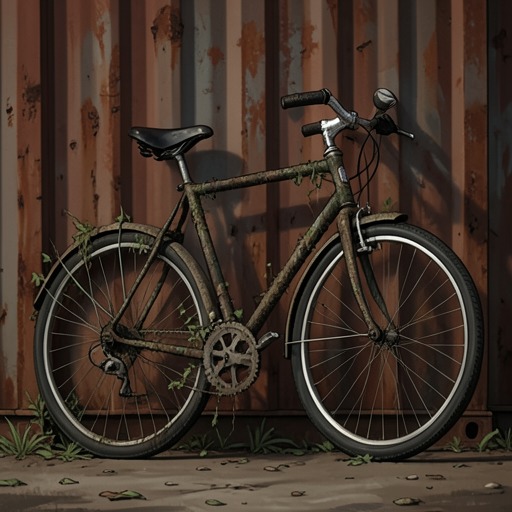
At the center of Fateopia is a woman’s bicycle with buckled wheels and twisted handlebars. Reinforced crossbars have been welded to its frame and point outward in all directions; evidence of details connected to the case hangs from their ends. Around the bicycle, Kristoffersen has placed metal and brass etchings depicting imagined car accidents, a colorful enamel rendering of the checks at the ferry, and copper etchings of a pixelated image of Alberte, apparently taken from a local newspaper. Casts of bone remains, branches, and leaves extend the work beyond the vehicle and the investigation’s documentary traces. Hands reaching out in protection add another bodily image to the installation.
The work’s arrangement brings different kinds of material together without making them equivalent. The bicycle is a physical object from the case; the ferry checks and Alberte’s newspaper image turn public and reported details into images; the casts and outstretched hands evoke remains, landscape, and attempted protection. Kristoffersen’s construction is described as not badly made, but as a tasteless jumble of techniques. That judgment distinguishes the installation’s technical competence from its aesthetic effect: its accumulation is not harmonious, and the discomfort of that excess is part of what confronts Carl as he surveys it.
The most disturbing element is a plastic vessel positioned beneath the etching of Alberte’s smiling face. It contains blood. Kristoffersen explains that it is treated pig’s blood, not human blood, and that he changes it from time to time; he notes that it may smell sweet. The material is therefore a constructed component of the artwork, not human evidence from the case. Its placement beneath Alberte’s image makes the installation’s movement from representation to bodily matter especially stark, while the explanation of its source does not dissolve the shock of seeing it there.
Art, Evidence, and the Investigators
Kristoffersen says he was on Bornholm when the case happened and had a summerhouse and studio in Gudhjem. He remembers how much was written and discussed about the case and describes the resulting search as impossible to ignore: every car was searched, including his, while National Guard men in Gudhjem ran about looking without knowing what they were looking for. He places his knowledge of the case within that atmosphere of public scrutiny and confusion, rather than presenting himself as an investigator or as someone with privileged access to a solution.
Fateopia makes that public history visible through an assemblage of the damaged bicycle, images, casts, and other case-related details. It converts the investigation’s dispersed traces into a single object that Carl and Assad must look at together. The artwork’s invented utopian naming sits in tension with the collision and death it gathers around itself: instead of resolving violence into an orderly account, it surrounds Alberte’s image with its physical and public afterimages. Kristoffersen’s role in this scene is to make the case newly visible as an artistic construction, while leaving the investigators to reckon with the difference between looking at its representation and explaining what happened.