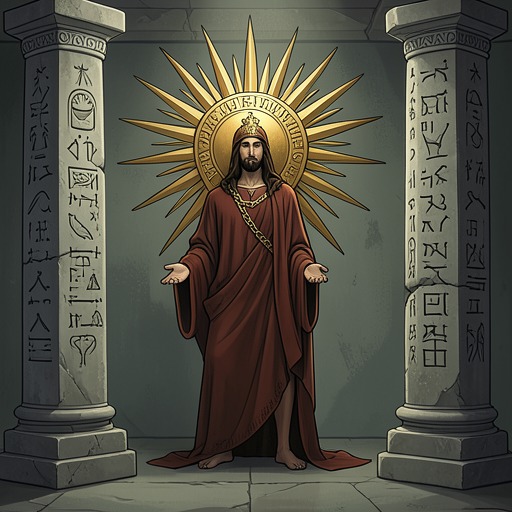
Sun and Nature Worship
The Hanging GirlSun and Nature Worship gives Atu Abanshamash Dumuzi’s teaching its central vocabulary and its public rituals. The sun represents life, nature provides the conditions of life, and Horus serves as a symbol through which followers can express gratitude without claiming to comprehend the universe. At the Nature Absorption Academy, these ideas promise renewal and peace of mind, but they also bind individual disciples into a reverent community organized around Atu’s words and presence.
Definition and Central Claims
The doctrine is presented as a way to attend to what can be known through immediate experience rather than to solve every spiritual mystery. Recalling Frank Brennan’s explanation of his beliefs, an older man tells Carl Mørck that Frank connected the divine with two concrete gifts: life in the form of the sun, and bread in the form of nature. In that account, Horus was the first sun god and also the name of a primal human instinct urging respect for both sun and nature. The formulation makes worship practical: it calls for care and attention to the conditions of life, not simply belief in a distant deity.
Atu’s own instruction places limits on what the symbolism can claim. Horus may represent the accumulated interpretations and wonder of people asking where life comes from and why, but the Academy’s rituals are not presented as a route to private self-absorption, a new creed, or indulgence in dogma. Atu describes their purpose as learning to be, using simple and durable means to reach peace of mind. The desired results are compassion, love for other people, and the ability to consider tomorrow’s path and yesterday’s actions without regret and despair. Nature and the sun are thus not merely objects of devotion; they frame an ethic of attention, humility, and conduct.
Ritual and the Natural World
The teaching is made tangible through repeated collective acts. At the Academy’s London Branch, in a simple apartment in Bayswater, Atu moves among people seated on the floor and leads them in rhythmic breathing and a chant of his name. The scene presents him as an approachable, physically present teacher rather than a remote guru enthroned in serenity. Followers are encouraged to imagine bodily renewal and a union between the self and the surrounding universe; the chant gives that promise a shared voice.
At a later assembly, the same pattern appears on a larger and more formal scale. Atu begins by addressing the crowd as a community that can feel together, then directs its attention to Malena and her pain. The group is invited to gather itself to draw that pain out, although Malena is not present. The moment shows how the doctrine’s language of connectedness can turn an individual’s suffering into a collective ritual concern, while Pirjo’s puzzlement marks the gap between the ceremony’s confident claim and the absent person at its center.
The Academy’s observances also anchor spiritual language in seasonal and material detail. In one address, Atu links the approaching full moon and the strengthening sun with the flowering of helianthemum, potentillas, and orchids, as well as greenhouse crops such as beans, onions, and cucumbers and the prospect of new potatoes and asparagus. The assembly answers with a shared invocation to Horus, asking to serve and follow its path and to remember the reason for its presence. Atu then cautions against assigning the gods a supposedly definite existence. His emphasis returns instead to ignorance before the universal, care for immediate surroundings, and the insignificance of any one person apart from humble participation with others.
Authority and Communal Practice
Sun and Nature Worship is not confined to abstract teaching; it is staged through the Academy’s order and the disciples’ dependence on its gatherings. Before Atu enters one hall, Pirjo, dressed in white, arranges the disciples according to rank and association. Skylights illuminate the room, while a glass-tiled section of the floor where Atu will stand appears golden. The prepared setting, silent expectant audience, and designated place for the leader make the doctrine visible as a social structure as well as a set of ideas.
The ceremonies are described as the high point of the disciples’ day, whether held in the hall or on a beach at dawn. Their trust is attached not only to the promise of nature absorption but to Atu’s personal presence: his words are treated as answers to the disciples’ quests. The contrast between instruction and arrangement is significant. Atu teaches humility and warns against demands, while the community is carefully ordered around his authority and the ritual places that give it form. The teaching’s appeal is therefore both ethical and relational: it asks followers to care for their surroundings, and gives them a collective practice through which to belong.
The name Atu Abanshamash Dumuzi reinforces this symbolic system. A woman at the Academy explains its elements as Sumerian: guardian, stone, sun or celestial body, son of, and spirit or life. She gives the full meaning as Guardian of the sunstone, lifespirit’s son. The explanation turns Atu’s name into a compressed statement of the institution’s solar and life-centered imagery, presented to visitors as an authoritative interpretation rather than as a casual label.
Frank Brennan and the Doctrine’s Ambivalence
The novel connects Atu’s teaching to Frank Brennan’s earlier interest in the same conjunction of sun, stars, nature, and religion. A woman recalling Frank’s time in a holistic commune says that he theorized about the common origin of religions and wanted a sun temple built in the back garden. She remembers him rising with the sun to chant outside, an activity that angered a housemate who had a job and was being woken early. When the man confronted Frank, Frank responded with severe violence. This recollection complicates any easy equation between solar devotion and peaceful conduct: an appeal to nature and the sacred could coexist with a frightening temper.
That earlier history also gives the doctrine significance in the investigation. Carl is advised to look for a man who lives by worship of the sun and nature, with Horus as symbol, as a way of recognizing Frank. The Academy’s chants and teachings consequently serve two functions in the story: they show how a spiritual vocabulary can shape a community’s daily life, and they provide a trail by which investigators can connect Frank’s beliefs to a later setting. The doctrine promises care for nature and fellow human beings, but the remembered violence prevents its ideals from being taken as proof of the believer’s character.