Terje Ploug
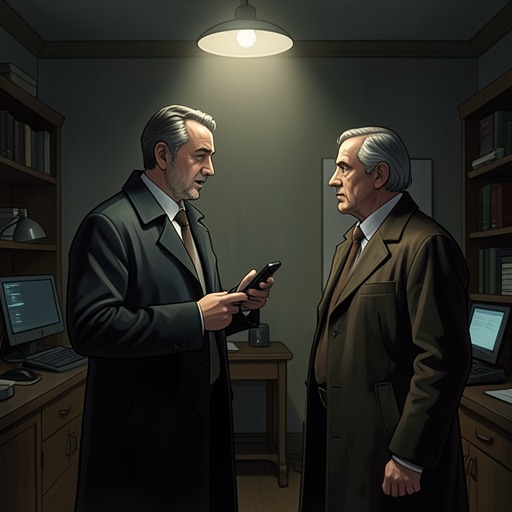
The Hanging GirlTerje Ploug is a deputy assistant commissioner whose role in the novel is defined by the gap between investigative command and public explanation. After Carl Mørck and his team are shot, Ploug is placed in charge of the investigation involving them. He later appears before reporters to set out the relationship between that case, other Danish crimes, and a murder investigated in the Netherlands. His appearances show him speaking for the institution, but also navigating the consequences of decisions made under his watch.
Position in the Investigation
At a formal briefing, Lars Bjørn introduces Ploug as his deputy assistant commissioner and says that Ploug has been in charge of the investigation since Carl and his team were shot down. The detail gives Ploug real authority over a case rooted in the attack on Carl’s group, not merely a ceremonial place at the conference table. His position is made visible in a room full of reporters, where the investigation must be presented as a coherent account even though its separate strands have not always been connected.
Ploug’s responsibility also reaches back to the handling of the Schiedam case. Carl explains that investigators had been unable to establish a link between the crimes in Denmark and the Dutch killings, so the Dutch case was handed to local colleagues. Ploug interjects that this was a mistake. The narration presents his remark as carrying an unmistakable implication that the decision was not his fault. That moment makes his position more complicated: he acknowledges the error, but the phrasing also distances him from responsibility for it.
The Briefing and Its Claims
The briefing gathers together crimes committed with the same weapon: the murder of Anker Høyer, the permanent physical damage to Hardy Henningsen, and the shooting of Carl, all on January 26, 2007. Ploug states that the crimes were committed with one weapon, now in police possession. The claim gives the assembled reporters a concrete connection among events that had previously been treated as separate, and the weapon itself is brought into the room and displayed. For Carl, its appearance is not neutral evidence; seeing it again causes pressure to rise in his head, while reporters immediately direct their attention to his reaction.
Ploug also presents the identification of Rasmus Bruhn, a Danish citizen living in the Netherlands, as a development in the inquiry. A photograph appears on the screen, and Ploug describes Bruhn as a forty-four-year-old man with prior convictions who had worked as a journalist under the pseudonym Pete Boswell. The public announcement supplies a name and a profile, but the briefing does not make every connection certain. Earlier, Carl had explained that investigators could not establish a link between the Dutch and Danish crimes; the later admission that separating the cases was a mistake describes a reassessment, not proof that every crime belonged to one continuous scheme.
Interpreting Evidence in Public
Ploug’s contribution is not limited to announcing findings. When the discussion turns to the man found in a drainpipe, he suggests that the perpetrators were probably trying to get something out of him. Bjørn gives him a penetrating look, then adopts the proposition in more qualified terms, saying that investigators can probably conclude that someone tried to extract information. The exchange shows how a possibility enters the public account: Ploug offers an interpretation, and Bjørn restates it as a cautious investigative conclusion. The distinction matters because the briefing is presenting evidence whose meaning is still being inferred.
The same tension shapes Ploug’s earlier acknowledgement about Schiedam. He recognizes that handing the case to the Dutch investigators was a mistake, while the circumstances of his remark leave responsibility contested. His presence therefore links two kinds of institutional speech: the retrospective explanation of a flawed decision and the forward-looking presentation of evidence. Neither is simply a final answer. Both reveal how investigators must communicate while the meaning and reach of their findings remain under examination.
Narrative Role and Limits
Ploug functions as an institutional counterpoint to Carl. Carl appears at the briefing as the observer who had visited the Netherlands and can recount the Dutch investigation; Ploug, by contrast, speaks from within the Danish command structure, framing the failures and new connections for the assembled press. The contrast is especially sharp when the weapon is shown: the conference treats it as an exhibit in a public explanation, while Carl experiences its sight as a personal reminder of the attack.
The novel gives Ploug no comparable private history or sustained account of his life beyond his rank, investigative responsibilities, and brief interventions. His characterization rests instead on these public acts: overseeing the investigation after the shooting, conceding that the Schiedam handoff was mistaken, proposing a possible motive for the drainpipe victim’s treatment, and announcing Bruhn’s identification. Read together, those acts present a senior officer whose work involves both assembling an account and managing uncertainty about how earlier decisions shaped the investigation.