The Initial Classification of Alberte's Death as an Accident
The Hanging GirlThe Initial Classification of Alberte's Death as an Accident shaped the investigation by turning a potentially deliberate killing into a hit-and-run case. The distinction mattered: the police never seriously considered premeditated murder, and investigators pursued clues that later proved misleading. The classification was not simply a conclusion about how Alberte Goldschmid died; it also governed which questions the investigation asked and which lines it left unexplored.
How the Case Was Framed
Kristoffer Dalby’s reaction captures how settled the accident explanation had become. When Carl Mørck called the case a murder, Kristoffer insisted that it was an accident, as it had been described everywhere. That certainty reflected the official account, not a demonstrated identification of the vehicle or its driver.
The files showed that the police in Rønne had converged on a hit-and-run theory but had never identified the vehicle involved, much less the driver. Their records had not been updated since 2002, and premeditated murder had never even been considered. Carl recognized that a murder classification would have meant the case could not be shelved in Denmark, making the original framing consequential not only for the investigation but also for its status within police work.
Habersaat's Theory and the Emerging Murder Hypothesis
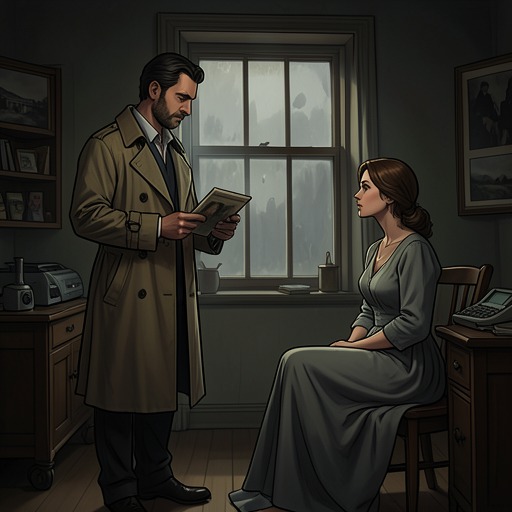
Christian Habersaat had pursued the case with unusual persistence, focusing it more specifically than the local investigation had. His hypothesis was that Alberte had been killed by a Volkswagen Kombi, probably one bearing a cross. A photograph contained a small pencilled arrow pointing to the man in the vehicle, with a note directing Carl toward him. The image gave Carl a striking lead, but it did not, by itself, establish that the man or the vehicle was responsible.
At the scene, Carl reconstructed a deliberate collision as a possibility. In his account, the driver and Alberte made eye contact at a bend; she put her bicycle on its prop stand and stepped forward, apparently smiling and expectant. Carl thought the vehicle accelerated only at the last moment, struck her, and hurled her into the branches. It then clipped the bicycle farther up the road. This reading transformed details of the collision into a possible sequence of intention and deception, but it remained an investigative theory rather than a confirmed account.
Why the Classification Persisted
The case files offered several possible explanations for the failure to consider murder, without settling on one. Perhaps investigators avoided that path because a murder could not be shelved; perhaps the impact scene had not been analyzed adequately. Carl also considered whether Habersaat’s forceful manner and insistence on his theories had pushed others away. He wondered whether the less experienced local investigators had lacked someone to prompt doubt about the cause of death, especially since no mobile task force had been assigned to the case.
These possibilities complicate the picture. Habersaat’s determination was the reason the inquiry had acquired a more specific direction, yet Carl could not assume that Habersaat was right. The files showed both the value and the limits of that persistence: one man’s conviction had kept the case alive, but it had not necessarily brought the police closer to the truth.
Reversal of the Leads
A later photograph overturned the apparent logic of the investigation. It showed Bjarke Habersaat in his Boy Scout uniform beside a four-wheel drive fitted with a plow. The plow bore a Christmas-tree-sale message, and Bjarke appeared proud of the vehicle and his improvised equipment. Carl immediately understood that the leads they had followed had been misleading: the supposed board had originated in a small splint found by Habersaat, while the search for a Volkswagen Kombi and the suspicions directed toward Frank, also known as Atu Abanshamash Dumuzi, had consumed days of investigative effort without solving the case.
Rose proposed a different explanation for Habersaat’s persistence: that he had suspected his own son for years and had directed suspicion toward the person he hated most, his wife’s lover. Carl resisted that interpretation, arguing that Habersaat had sacrificed seventeen years to the case and could not have known his son had the plow. The exchange leaves Rose’s theory distinct from an established fact, but the photograph forces the investigators to reconsider how Habersaat’s long pursuit may have interacted with the original accident classification.
The initial hit-and-run account had narrowed the inquiry to an unidentified vehicle and driver; Habersaat’s theory then supplied a specific vehicle and a suspecting gaze, but those leads also proved deceptive. The photograph did not, on its own, settle every question about Alberte’s death. It did expose how much of the investigation had been built on assumptions treated as answers, and how the original decision not to consider murder shaped the search that followed.