Unable to Escape the Past
The Hanging GirlUnable to Escape the Past is a theme that connects private regret to the repeated fantasy of beginning again somewhere else. For Christian Habersaat, the past inhabits a family home transformed by years of obsessive work; for Carl Mørck, it becomes an uncomfortable recognition that a change of place cannot change the self; and for Wanda Phinn, escape briefly appears as a future promised by devotion to Atu Abanshamash Dumuzi. These strands do not make the characters’ circumstances identical. Instead, they show how memory and responsibility persist even when a person tries to leave a room, a relationship, a job, or an old life behind.
Habersaat’s Home and the Weight of Memory
Almost twenty years after the family home had been warm and lively, Christian Habersaat prepares his parade uniform among heaps of rubbish and unwanted belongings. The contrast between the uniform, kept for an occasion after years of disuse, and the neglected room makes the passage of time visible in domestic details. Even ironing is unfamiliar enough to be clumsy. The house has not simply preserved the past: it has become crowded with the material traces of the life he let recede.
Habersaat sees that colored ring binders have taken the place of good books and that photocopies and clippings cover every available surface. The disorder registers the cost of having put his life into work instead of the people who once cared for him. Yet the narration also complicates regret: he shakes his head at his former choices, then recognizes that he understands why he made them. The case was trivial in the sense that it began as an ordinary matter, but it came to define his life. He could not let it go, and its persistence coincided with the collapse of his happiness at home.
The worn photograph gives this history a more intimate focus. Habersaat caresses it as he has done hundreds of times, wishing he could recover wasted days and feel once more the closeness of his wife and son. The living room holds several versions of the family past: intimacy on the sofa, play with his young son on the rug, the beginning of arguments, and the spread of his gloom. Eventually, his wife leaves him there after spitting in his face. The room therefore makes memory almost inescapable: affection and separation belong to the same domestic space, while his continuing attention to the case cannot restore what his devotion to work helped cost him.
Carl’s Recognition That Place Offers No Release
Carl Mørck’s reflection arrives far from home, on the edge of Denmark, after he has travelled to a place he had barely cared about before. A few days earlier, he knew nothing of Christian Habersaat or Alberte Goldschmid; now he feels alone and abandoned there. The distance has not delivered the clean break he might have imagined. Instead, the unfamiliar surroundings sharpen his recognition that people carry their past with them and remain responsible for who they have become.
The thought widens from Carl’s own unease into a criticism of escape as a habit of the present. People can leave opinions, marriages, countries, old values, or yesterday’s enthusiasms behind, but the newness they pursue does not provide what they are looking for deep down. What seems like movement becomes an endless search for one’s own shadow, and tomorrow may make the latest promised solution meaningless. This is not a claim that circumstances never change; it is a distinction between changing one’s surroundings and confronting the self that arrives there too.
That distinction becomes personal when Carl reviews his relationships. After his breakup with Mona, Lisbeth had been sweet and understanding, yet he turned his back on her as soon as he met someone else. He asks himself, in effect, who failed whom: Lisbeth could have reproached him but did not, while his own conduct remains part of the history he carries. His doubts extend beyond that relationship. He wonders whether his life has room for a lasting attachment and whether anyone could hold on to someone like him. The past, in this scene, is not only something suffered; it also includes actions for which he must answer.
Wanda’s Imagined Departure
Wanda Phinn’s story presents escape first as a release. In September 2013 she leaves her job without handing in notice, drops her cap, says goodbye to the woman at the control desk, and walks out. In her perception, the wall at Victoria Embankment Gardens slides away, along with the worries of wasted days. The whole of life seems to open before her, and she imagines herself among a chosen few. Her departure is concrete, but the hope attached to it rests on a larger promise of transformation.
That promise has gathered around Atu Abanshamash Dumuzi. Since he caressed her cheek, called her his flower, and later kissed the back of her hand, Wanda has understood him as the future she had dreamed of. She tells Shirley of this conviction and meets a sustained barrage of warnings. Wanda insists that she is still young, has had no children, and is ready for a family; she also feels certain that Atu does not sleep with the woman who helps him. Her confidence converts an emotionally charged encounter into a plan for a different life, though the passage presents that future as her belief rather than a guaranteed outcome.
The wall imagery makes the pressure behind this hope visible. Looking from her apartment, Wanda sees another wall blocking out light and dreams, with other people behind it nursing similar unfulfilled hopes. In the area around her, aspirations are shaped by narrow expectations and by a culture of television and junk food, while education and realistic ambitions are described as possible routes to opportunity. The statistics, as she understands them, suggest that very few reach the promised land of success, wealth, and happiness. Wanda has lived with that knowledge day after day; her departure and faith in Atu answer it with a personal dream of exception.
Shirley’s practical objections give that dream a material cost. Wanda may spend her savings on what Shirley considers a hopeless project, and if she returns she will have to ask where she can live; Shirley has no room for two people. The exchange does not establish what Wanda ultimately does, but it shows that leaving is not the same as escaping consequences. Her imagined future depends on money, housing, and a relationship that Shirley distrusts, just as the wall outside her window stands for hopes that do not automatically become attainable because they are intensely desired.
A Pattern of Departure and Return
The theme links these scenes without flattening their differences. Habersaat remains among the accumulated evidence of a life organized around a case; Carl discovers that a distant landscape cannot erase his own decisions; Wanda walks away from work believing that the world has opened, even as Shirley reminds her what she risks leaving behind. In each case, the past is not merely a memory that can be discarded. It persists as physical surroundings, unresolved responsibility, or the practical conditions that shape a hoped-for future.
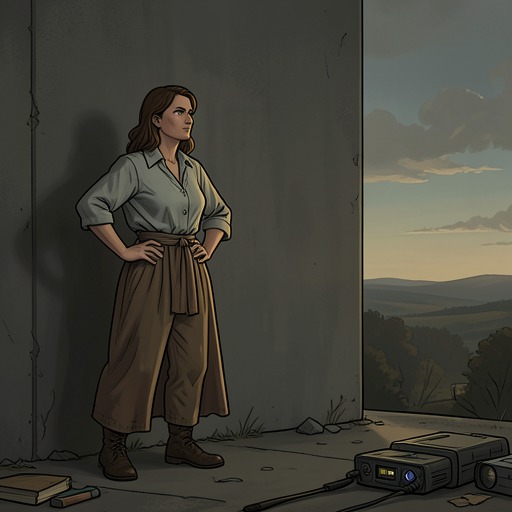
The contrast between walls and movement gives the idea its recurring form. Wanda sees a wall receding when she leaves, then sees another wall outside her window; Carl travels to the edge of the country and finds that he has brought himself with him. Habersaat’s family room is more intimate still: its objects and surfaces return him to the choices and losses that took place there. Across these different images, departure can alter a person’s immediate setting, but it cannot by itself settle what that person remembers, what they have done, or what they continue to seek.