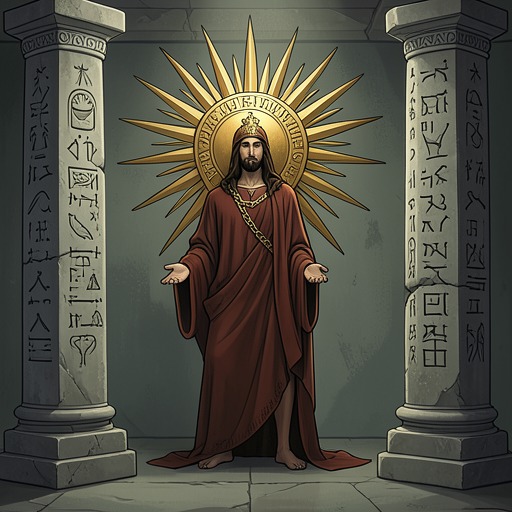
Winter solstice
The Hanging GirlThe Winter solstice is the midwinter point in the professor’s account of the sun’s annual movement: a period when the sun reaches its lowest position before beginning to move north again. His lecture makes that seasonal turning point the center of a broader argument connecting astronomical cycles, the sun cross, and religious stories of death and resurrection.
Place in the Astronomical Cycle
The professor explains that the solstices and equinoxes correspond to the turning points in the sun’s apparent yearly course, while sunrise, zenith, sunset, and nadir mark the daily cycle. Drawing axes between these points, he says, produces a cross across the circles traced by the sun. The Winter solstice is one of the two solstitial points in this scheme, paired with midsummer and set against the spring and fall equinoxes.
Midwinter and the Sun Cross
The lecture gives particular weight to December 22, 23, and 24, describing them as the days when the sun is at its lowest point of the year. The professor emphasizes the experience of the far north, where these are the darkest days, and says that people in earlier times could experience the darkness as death because they did not know whether the sun would rise again. In his account, the sun’s return northward after three days turns the seasonal pause into a pattern of apparent death followed by renewal.
He links that pattern to the constellation Crux, which, he says, would have been especially clear around December 22 roughly two thousand years earlier. The sun’s three-day position beneath the cross becomes the basis for his comparison between the sun’s return and resurrection. He presents Jesus Christ as sharing this fate with other sun gods, advancing a solar explanation of religious symbolism rather than merely describing the seasonal calendar.
Significance in the Lecture
The Winter solstice gives the professor a hinge between observable cycles and religious interpretation: the sun’s low point supplies the imagery of darkness and death, while its renewed northward movement supplies the promise of return. His account is delivered as part of a lecture to Carl Mørck and Assad, and Carl responds by asking whether such ideas are openly discussed in theology faculties. That question marks the distance between the professor’s confident synthesis of astronomy and religion and the institutional scrutiny it might face.