55 Lodovico Street
The Hellbound Heart55 Lodovico Street is both an inherited family property and the enclosed stage on which the novel’s domestic world is overturned. Its apparently ordinary rooms shelter Frank Cotton, concealed within the house after his disappearance, and the Damp room becomes the point where Julia discovers him and begins to understand what his return will demand. The house’s movement from neglected inheritance to occupied home, then to a site of concealment and confrontation, gives its familiar interiors an increasingly threatening significance.
Inheritance and Occupation
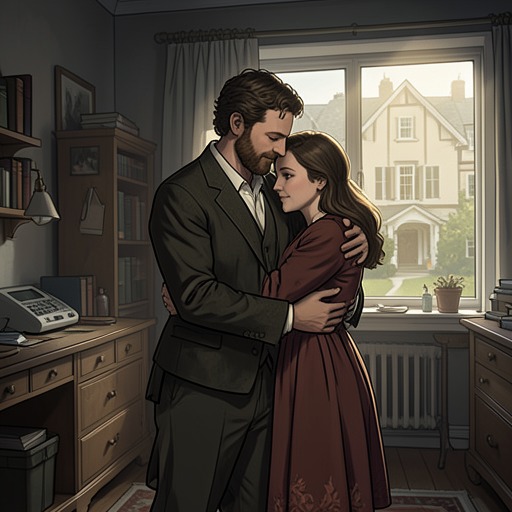
When Rory and Julia first view the house, it is twilight on a cold day in August, and Julia finds it less inviting than expected. Rory explains that it has been left untouched since his grandmother’s death, nearly three years earlier, and that it belongs to him and his brother, Frank. The property therefore arrives in the marriage with an unsettled family history: Frank shares ownership despite being absent, and Julia remembers that he was last seen shortly before her wedding.
The house’s neglected condition changes as Rory and Julia work on it. By September, it looks more hospitable, and neighbors visit to welcome its occupants back to number fifty-five. Their comments briefly bring Frank into the present: one neighbor remembers an odd man who stayed there the previous summer, and Rory identifies him as his brother. Julia smooths over the awkwardness. The social welcome makes the home appear restored to ordinary use, while the passing reference to Frank establishes that his connection to the property has not been erased.
Accounts of Frank’s earlier stay vary. Julia recalls hearing that he spent a few days at the house the previous summer; a neighbor refers to him as having lived there for a few weeks. The recollections agree on the essential point: Frank had been present at the property, then disappeared, leaving Rory and the neighborhood with only an incomplete account of his whereabouts. The inherited house thus carries a history its new household cannot fully explain.
The Damp Room and Frank’s Return
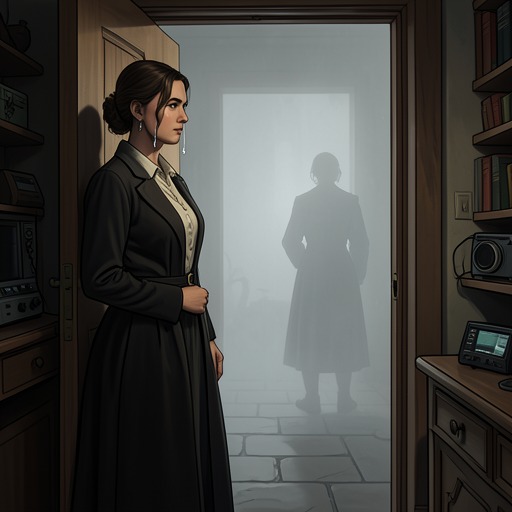
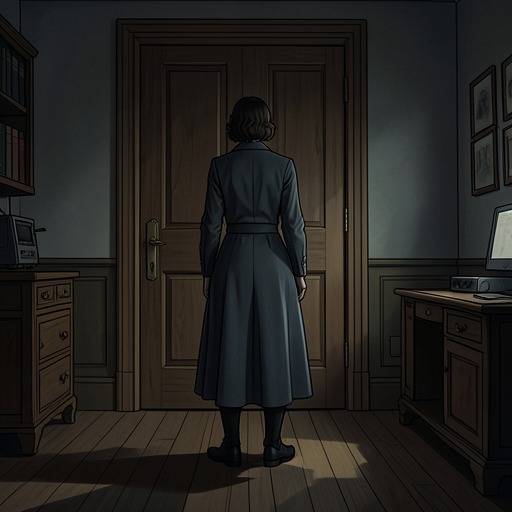
The Damp room is the house’s most consequential interior. During a gathering downstairs, Julia withdraws from the guests and enters it, where she notices that the boards bearing Rory’s blood have been cleaned. The threshold separates the sociable rooms from a darkness in which the wall begins to reveal a human figure. Julia sees a wrecked, barely recognizable body confined within the bricks; the scene changes the room from a place of retreat into evidence that something impossible is concealed inside the home.
The figure identifies itself as Frank and communicates the word blood before the wall closes over it again. Julia concludes that Frank is still in the house, trapped between her world and another place, though she cannot initially explain his condition. The wall’s concealment makes the home’s apparent solidity deceptive: the boundary between room and hidden space can open, disclose Frank, and close again, leaving him unseen but present.
Julia takes the demand for blood as a means of sustaining him. Later, after she brings a man to the house and kills him, the blood moves toward the wall and the body is drained of what Frank can use. The aftermath makes the connection between the hidden room and Julia’s actions concrete: the house is not merely sheltering Frank but receiving the material with which he can recover. Julia’s private care for him therefore transforms its domestic interior into the mechanism of his restoration.
The House as a Site of Recognition
The final return to 55 Lodovico Street brings Kirsty into the same enclosed world. She approaches without a settled plan, unsure whether Julia will be present or how deeply she is involved with Frank. Julia answers the door holding white lace, an ordinary domestic detail that gives the encounter an appearance of welcome even as Kirsty arrives seeking the truth. The house places the two women face to face at the point where concealment can no longer be treated as a private matter.
Inside, Kirsty recognizes that the man presenting himself as Rory is Frank. Rory’s corpse is elsewhere in the house, while Frank has taken on his brother’s appearance; the familiar family home has become the setting for a substitution that makes identity itself unreliable. Bells overwhelm Kirsty as she confronts the deception, and her recognition turns the house into the location of the final struggle over whether Frank can continue to pass as Rory.
The closing scenes retain the house’s mingling of domestic and horrific images. Kirsty encounters Julia’s head in the folds of a bridal dress, while a light begins to grow beneath the veil. The bridal clothing recalls the household’s ordinary social identity, but its ruined setting and Julia’s disembodied plea expose how far that order has collapsed. Across the novel, 55 Lodovico Street is therefore more than a shared inheritance: its walls preserve Frank’s hidden presence, its rooms enable Julia’s attempt to restore him, and its familiar thresholds draw Kirsty into the confrontation that exposes his assumed identity.