Cenobite realm
The Hellbound HeartThe Cenobite realm is the domain beyond the Schism that Lemarchand’s Configuration opens onto, a world whose inhabitants and rules challenge the assumptions of anyone who seeks it. It is glimpsed rather than surveyed: bells, brief openings in walls, and altered rooms make its presence felt across the boundary, while the account of Frank Cotton’s imprisonment reveals a realm where sensation, suffering, and access between worlds follow alien terms.
The Boundary and Its First Appearance
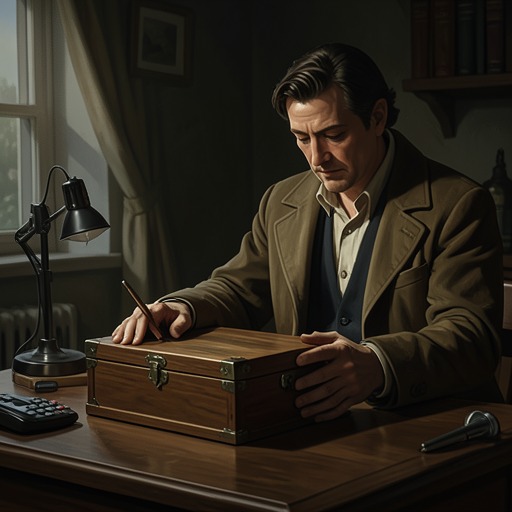
Frank encounters the realm while working on the box Kircher sold him. As the puzzle nears completion, a tolling bell reaches him through a door that is not yet visible. The sound does not come from the street; it comes from the far side of the threshold the box was made to open. The bell makes the distance between worlds seem at once immense and close, and confirms that the box has brought Frank to the threshold of the world Kircher promised.
The room changes with the tolling. Its light repeatedly dims and returns, and in the moments of illumination Frank sees the eastern wall give way to a view beyond it. That glimpse offers no stable map or familiar landscape. Instead, he perceives a confused province filled with brittle, broken things rising and falling in a dark, turbulent air, with vast birds as the uncertain image he can make of it. When the wall becomes solid and the bell stops, the opening closes; the realm has been revealed only in flashes.
The boundary appears again when Kirsty works on the Configuration in a hospital room. At night, the bell sounds although it is not coming from outside, and the walls seem subtly out of alignment. When the bedside light goes out, a Cenobite appears at the end of the bed. The scene makes the Schism felt inside an ordinary room without establishing that the hospital itself has become part of the realm. Instead, the bell, the altered surroundings, and the visitor show how the boundary can press into the human world.
A Different Meaning of Pleasure
The realm’s most consequential difference is not its visible landscape but its inhabitants’ understanding of sensation. Frank had assumed that his idea of pleasure substantially overlapped with that of the Cenobites. His experience there overturns that assumption: they subject him to sensations that overwhelm his capacity to endure them, and his appeals for relief bring no dependable reprieve. The division between pleasure and pain that structures ordinary human expectation offers no reliable guide to what happens on the far side.
The account of the realm allows no simple interpretation of its inhabitants as agents who reward or punish according to a comprehensible moral code. Frank finds no compassion to appeal to and no principle by which good behavior will secure mercy. Tears and laughter occur in response to experiences that do not fit ordinary emotional categories; even a brief respite can feel extraordinary against the expectation of renewed suffering. The Cenobites’ indifference to human measures of pleasure and justice makes the realm more than a place of physical danger: it is a place where human explanations fail.
The Engineer is associated with the design of grief within this order. The account describes the prisoners’ suffering as shaped by a mind that understands its operation, rather than as an accidental feature of an otherwise neutral environment. At the same time, the Cenobites’ actions remain difficult for Frank to interpret. He cannot tell whether their language of pleasure reflects their actual purpose or conceals a meaning unavailable to him. That uncertainty is part of the realm’s force: its rules are experienced as real, but not made reassuringly legible.
Captivity, Memory, and the Human World
The realm’s treatment of prisoners preserves a connection to the places they left. When they are not undergoing torment, prisoners can look out from their resting places onto the locations where they solved the Configuration that brought them there. For Frank, the view opens onto the upper room of 55 Lodovico Street. This arrangement makes captivity a continuing relation to the human world rather than a clean separation from it: the place of imprisonment keeps the prisoner’s former life within sight, without restoring access to it.
For almost a year, Frank’s view of the room brings no visitors. Then Rory and Julia arrive at the house, and hope returns. Their presence matters because Frank has not entirely lost the possibility of reaching back across the boundary. Before his imprisonment, he left behind a trace of himself; later, when Rory’s chisel slips, Frank finds an opening through which he can begin to escape. The realm’s capacity to retain a view of the originating location thus becomes part of the mechanism of his attempted return.
The opening is not a straightforward passage to freedom. Frank’s body has to be reconstructed through blood and flesh in the human world, and his return remains incomplete. The realm’s hold on him is therefore reflected in the damaged, partial condition in which he reappears. His presence in the house is evidence of a crossing, but not of an uncomplicated release from what lies beyond the Schism.
Crossing Rules and the Realm’s Narrative Role
The Schism separates the human world from the Cenobite realm, but the division does not work like an ordinary door that either side can open at will. Frank hears that a prisoner may be able to escape through a loophole and return to the room from which the Configuration was solved. The Cenobites, however, cannot simply follow an escapee across: they must be summoned. Without an invitation, they remain unable to enter the human world. Crossing is thus conditional and uneven, with the boundary limiting the pursuers as well as the prisoners.
Kirsty’s encounter with a Cenobite in the hospital makes the consequences of that rule immediate. The visitor tells her that the Schism cannot be sealed until the Cenobites take what they claim is theirs. Kirsty bargains for her own safety by agreeing to deliver Frank alive and make him confess himself. The demand links the realm’s rules to Frank’s identity: his return across the boundary has not ended the Cenobites’ claim, and bringing him back into their reach requires more than simply locating him.
Across these scenes, the Cenobite realm remains partly unseen but structurally central. Its brief landscape, its sensory order, its sightlines onto former homes, and its restrictions on crossing all shape events in the human world. The contrast between a door that seems to open onto an immeasurably distant province and the familiar rooms through which its consequences emerge gives the Schism its particular menace: the worlds are distinct, yet neither remains safely separate from the other.