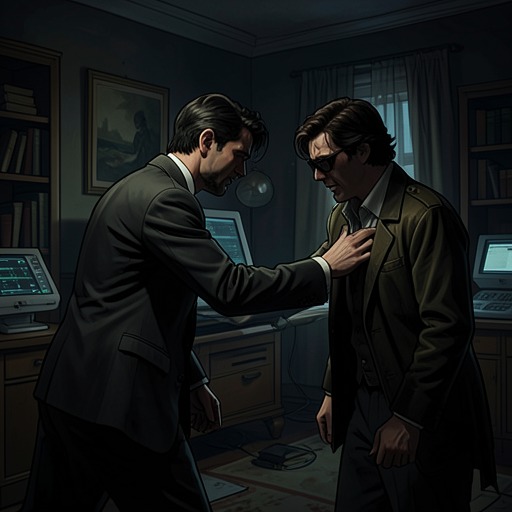
Frank Cotton and Julia’s relationship
The Hellbound HeartFrank Cotton and Julia’s relationship is shaped by desire, betrayal, and Julia’s later decision to sustain Frank’s return, making their premarital affair the beginning of a destructive bond.
Meeting and Premarital Affair
Barely a fortnight before Julia’s wedding to Rory, Frank returned after years away. His polished appearance differed sharply from the reckless, monstrous figure Rory had described, and Julia was quickly drawn to his charm. As the wedding approached, her attention shifted from her future husband to his brother. She recognized their family resemblance, but saw in Frank a desperation Rory did not possess.
Julia later remembered taking Frank upstairs under the pretext of showing him her wedding dress. Their encounter was not freely mutual, though she subsequently replayed it as a treasured memory, recasting its painful aftermath as evidence of passion. Frank disappeared the following day. Julia mourned him, and later wondered whether her continuing thoughts of him had helped begin the deterioration of her relationship with Rory.
From Memory to Obsession
The affair became a fixation after Julia encountered Frank again in the Damp room, where his barely living body appeared within the wall. He could make only a faltering contact before the wall closed over him, but he identified himself and named what he needed: blood. Julia understood that Rory’s blood, spilled in the room, had already given Frank enough strength to reach her. The revelation turned her memory of the affair into a possible plan for restoring him.
Julia’s desire was bound to the prospect of recovering Frank’s forceful presence. She imagined that if she supplied the sustenance he required, he might become grateful and answer to her wishes. She also recognized that she had remained in love with him and had mourned him throughout his absence. Rather than treat the consequences as a reason to stop, she resolved to provide blood so that he could return.
That resolve made Julia Frank’s accomplice and provider. She lured men to the house and killed them, while Frank drew nourishment from what she supplied. After one killing, Julia saw the blood move toward the wall and the victim’s body lose its useful substance; the process showed her that Frank could feed from the dead. Her response was not simply horror or reluctance: she watched, fascinated, as the remains were reduced to a useless husk. The intimacy she sought was thus sustained through an arrangement in which Julia committed the violence and Frank depended on its results.
The bargain also exposed the distance between Julia’s hoped-for reunion and the reality of their bond. Confronted with a dead man’s hand, she briefly recoiled from what she had done and from the seductions that had ended in death. She recognized that her ambition was no less corrupt than Frank’s. Yet when he pleaded with her to heal him and promised that they would be together, she agreed. Her promise renewed the relationship not as a return to the premarital affair, but as a shared expectation built on murder, dependence, and the prospect of Frank’s restoration.
The Unfulfilled Promise of Reunion
The intimacy Julia hoped to recover never becomes a secure life together. Frank’s request that she heal him and his promise that they would be together bind their future to his restoration, but their relationship remains dependent on violence and on Julia’s continued efforts to supply what he needs. Its promise of private reunion is therefore precarious from the moment she accepts it.
At the final confrontation, Frank recognizes Kirsty as the person who has brought the Cenobites back into his path. Julia’s own fate offers no image of the reunion she had imagined: in the ruined bridal setting, Kirsty hears Julia call her name and plead for help. The appearance places Julia’s appeal amid the collapse of the marriage imagery associated with her earlier desire, leaving her relationship with Frank not fulfilled but overtaken by death, exposure, and forces beyond her control.
The Failure of Reunion
At the final confrontation, Frank sees the Cenobites behind Kirsty and understands that she has brought them back into his path. His accusation marks a decisive break from the private future Julia had imagined: their bond is no longer governed by her promise to restore him, but by the return of the forces that claim him. The scene gives no sign that the two can resume their former intimacy or build the life together Frank had promised.
Julia’s last appearance makes that failure visible through the wedding imagery that had once surrounded her and Frank’s affair. In the ruined bridal setting, Kirsty hears Julia call her name and ask for help; Julia’s head is revealed in the bride’s lap, beneath the folds of the dress. Earlier, Julia had used her own wedding dress as the pretext for taking Frank upstairs. Now the bridal image accompanies a plea to someone else, not a reunion with him. Their relationship ends not in the restored intimacy Julia sought, but amid separation, exposure, and the collapse of the future she had hoped to purchase with blood.