Julia and Frank’s premarital affair
The Hellbound HeartJulia and Frank Cotton’s premarital affair takes place just before Julia’s wedding to Rory, Frank’s brother. Its significance lies not only in the betrayal but in the unsettled way Julia remembers it: an encounter marked by aggression that she later reshapes into a cherished memory, and a loss that helps govern her choices long afterward.
Background and Attraction
Julia’s curiosity about Frank began before she met him. Rory had spoken of his brother as a reckless man, and the mixture of revulsion and envy in Rory’s account intensified her interest. Frank appeared in person barely a fortnight before the wedding. His gold rings and tanned, taut appearance seemed at odds with the monster Rory had described; to Julia, he was polished and charming, and she yielded to that charm within hours.
As the wedding approached, Julia found herself thinking less about her intended husband and more about Frank. The brothers shared a lilt in their voices and an easy manner, but she perceived in Frank a desperate quality she felt Rory lacked. That contrast helps explain the force of her attraction, though it does not make the affair inevitable. Julia later presented it to herself as something her instincts would have brought about eventually, even if she had resisted longer. The account records that explanation as retrospective self-justification, not as proof that she had no choice.
The Encounter
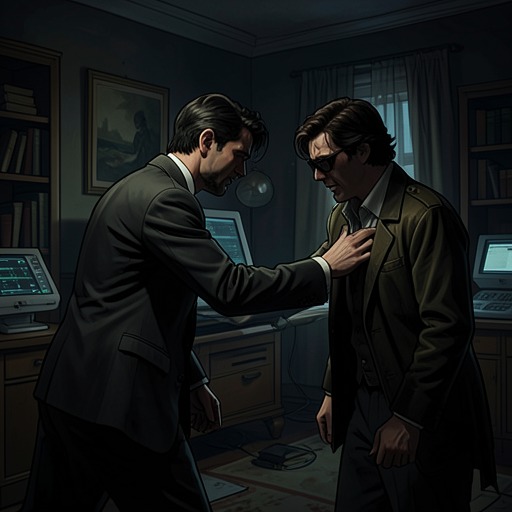
On the day Julia understood as the day the affair would happen, Kirsty was at the house on wedding-related business. Julia left Kirsty occupied with preparations and took Frank upstairs, saying she would show him the wedding dress. In Julia’s recollection, Frank had asked to see it. She put on the veil and laughed at the incongruity of seeing herself in white; Frank lifted the veil from behind her. Her laughter did not deter him, and the encounter quickly became aggressive rather than tender. The narration describes it as joyless and coercive, while distinguishing the question of Julia’s acquiescence from the violence of the encounter. Its account therefore resists treating her later attachment as evidence that the experience was simply mutual or romantic.
The wedding lace and veil become part of the memory’s lasting imagery. Years afterward, Julia identified the first faltering of her resolve with the moment she lay on a bed of wedding lace while Frank kissed her neck. The setting ties the affair to the marriage she was about to enter: the dress and veil signify the future she was preparing for, even as she turned away from Rory toward his brother.
Departure and Marriage
Frank disappeared the day after the encounter. Julia imagined that he had fled to Bangkok, Easter Island, or somewhere else beyond the reach of his debts; the destination remains uncertain. She mourned him despite the briefness of their affair. His abrupt departure turned the encounter into an absence, leaving Julia with a memory she could revisit but no continuing relationship with Frank.
The affair’s consequences extended into Julia and Rory’s marriage. Although the subject was never explicitly discussed, Julia wondered whether their relationship began to deteriorate when she thought of Frank while making love to Rory. This remains her suspicion rather than a confirmed explanation for the marriage’s decline. Still, the thought makes the affair more than a concealed episode: in Julia’s account, it enters the marriage as an unspoken third presence.
Memory and Later Significance
Four years and five months after that afternoon, Julia had replayed the encounter often. Memory had softened its character: she came to treat the bruises as trophies of passion and her tears as proof of her feelings for Frank. That transformation does not erase the earlier description of the encounter. Instead, the contrast reveals how Julia’s recollection accommodates both its coercive character and her continuing desire. She treasures the memory even while the narration makes clear that its tenderness is partly a product of what she later wants it to mean.
When Julia encounters old family photographs among Rory’s belongings, her response is fury rather than regret. The photographs prompt her to recognize that she has somehow lost herself, and she locates the beginning of that loss in the affair. Later, when she discovers Frank’s presence in the Damp room, the old memory becomes a motive for wanting him back. She recalls his forcefulness and imagines restoring him through blood, hoping that renewed access to him might also give her power over him. The affair thus reaches beyond the wedding and the marriage: it supplies the emotional history through which Julia understands her longing, her grief, and the increasingly destructive choices she makes in Frank’s name.