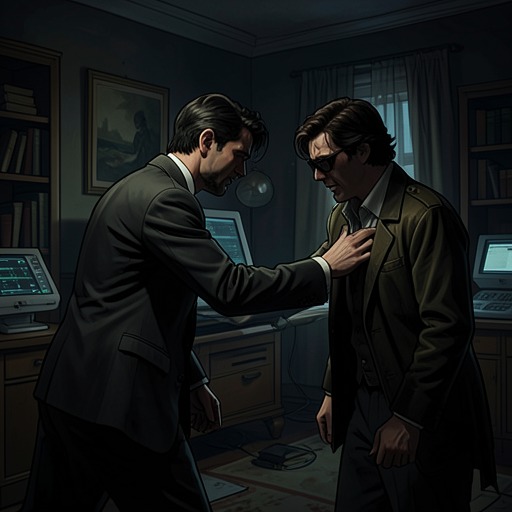
Julia discovers Frank trapped in the wall
The Hellbound HeartJulia’s discovery of Frank Cotton inside the wall of the Damp room turns a hidden presence in the house into a desperate, actionable secret. The encounter reveals that he is alive, or at least capable of communicating, and that blood can reach him through the wall; Julia’s response converts recognition and pity into a decision to provide him with more.
The Room and the First Sign
Before she finds Frank Cotton, Julia is already withdrawing from the ordinary life of the house. While Rory entertains their guests downstairs, she retreats from their laughter and from her contempt for the company she has been enduring. She wants darkness and quiet. The Damp room, away from the gathering, seems to offer both.
On entering, Julia notices that the boards where Rory’s blood had fallen have been cleaned. The detail gives the room an unsettling recent history before anything supernatural appears: blood was there, but no trace of it remains. She closes the door behind her and stands in near-darkness. From the far side of the room comes a small sound, stops, and returns with a pattern that seems almost like a code. Its faintness makes the discovery gradual rather than immediate; Julia first has to listen, then locate the sound in the room.
She feels along the wall and finds a place markedly colder than the surrounding surface. When the scratching stops, the silence briefly leaves her disoriented. The wall then appears to change: a cold light shows through it, and its sections seem to shift and open into further concealed spaces. The scene makes the familiar interior of the house behave like a boundary with something hidden beyond it. Julia watches the wall’s apparent rearrangement, unsure what she is seeing, until movement gives the display a more definite and threatening presence.
Frank Cotton Behind the Wall
The shifting stops, and Julia sees a human figure in the wall. She understands that it is Frank Cotton, though what she can make out is incomplete and altered. The encounter is frightening in its strangeness, but Julia’s first response is not fear. She judges the figure weaker than she is and recognizes that it is suffering; that perception brings pity, and with pity her frozen body releases its breath again.
The figure manages to speak her name. The single word identifies Julia as the person Frank Cotton is trying to reach, but it does not yet explain how he came to be there, what has happened to him, or how he might be helped. The wall closes over him again. By the time Julia has recovered enough to look, the light and the visible figure have disappeared, leaving the ordinary surface of the room in their place.
The disappearance does not undo the recognition. Julia is convinced that Frank Cotton is in the house and has been there all along, shut away from the world she inhabits but close enough to make a fragile contact. She cannot determine why he is trapped or exactly what state he is in. The gap in her knowledge matters: she has learned that he is present, but not how to reach him or whether he can be restored. When the wall opens again, he identifies himself and gives her a further clue: blood. His brief communication supplies a means of action without an explanation of its full consequences.
Blood as Clue and Decision
Julia connects Frank Cotton’s request to the blood that had been on the Damp room floor. That blood came from Rory, and its disappearance now appears to her to have a cause: Frank Cotton has fed on it, gaining enough strength to reach out through the wall. Her conclusion is an inference rather than a complete account of what sustains him, but it changes the discovery from an isolated apparition into a process she believes she can influence.
The room’s evidence gives the inference weight. The floorboards had been cleaned, and the blood was gone; now Frank Cotton has made contact and named what he needs. Julia considers whether a larger supply might do more for him. In her mind, blood is not merely a clue to his condition but a possible route back to the person she remembers. She realizes that she has remained in love with him and has been mourning him. That recognition aligns the supernatural mystery with her private attachment: helping Frank Cotton becomes, for her, a chance to recover a lost relationship.
Julia also imagines that if she provides the nourishment he needs, he will be grateful and responsive to her. The possibility of his return is entwined with a wish to control the terms of that return, whether he proves docile or brutal. The encounter therefore does not simply restore her hope; it turns hope toward a dangerous bargain she has made with herself. She resolves to supply blood without considering the consequences for the people from whom it will come.
From Revelation to Action
The discovery shapes Julia’s conduct after she leaves the room. She does not sleep well that night or on the nights that follow. Yet the revelation is not visible to Rory. In the days afterward Julia regains her smile, and Rory mistakes the change for happiness in their new house. He returns to redecorating with renewed energy and talks of addressing the dampness upstairs. Julia tells him there is no hurry to make the room into a bedroom. What looks to him like domestic contentment is, for her, concealment of the secret she has discovered and the plan she is forming.
She begins killing men to provide Frank Cotton with blood. In one encounter, she uses a slaughtering knife against a man who has been drinking with her; the account establishes the killing without making its physical details the focus. Afterward, the room responds: blood moves toward the wall, and the dead man’s body is drained of what could nourish Frank Cotton. The remains are left without useful sustenance. Julia watches the process and understands that her inference has produced an effect. Frank Cotton’s need is no longer an abstract possibility, and the violence she has chosen becomes a repeated means of feeding him.
The discovery’s significance lies in the chain it sets in motion. A quiet withdrawal from guests leads Julia to a sound in a wall; the brief encounter gives her a name and a demand; Rory’s vanished blood supplies her with a theory; and that theory becomes murder. The house’s familiar room conceals a presence that Julia treats as both a suffering captive and the object of her love. Her pity initiates the change, but it does not restrain it: once she believes blood can restore Frank Cotton, she makes other lives the price of that hope.