Kirsty exposes Frank and enables the Cenobites to reclaim him
The Hellbound HeartKirsty exposes Frank’s assumed identity as Rory and enables the Cenobites to reclaim him in the final confrontation. Her recognition turns the apparent return of a familiar person into a trap: once she names the deception, Frank’s bid to approach her is interrupted, and the beings he had escaped take possession of him again.
Background: Frank’s Return to the House
The confrontation has its roots in the Damp room, where Julia discovers a figure trapped behind the wall. The room is part of her home, but the familiar boards and bricks open onto a hidden, radically altered reality. What appears is only a ruined remnant of a person, unable to explain itself fully. It manages to identify itself as Frank and communicate one decisive need: blood.
Julia understands that the blood Rory had lost in the room has given Frank enough strength to make contact. She also realizes that a larger supply might help him further. When she later kills men, the room’s response confirms the connection: the blood moves toward the wall, and the bodies are depleted as Frank draws nourishment from them. Each act gives him resources with which to recover, though the evidence presents his restoration as incomplete rather than a return to ordinary life.
That history makes the house’s final crisis more than a sudden attack. Frank has been present within it, first hidden and barely able to communicate, then increasingly able to take form and act. The evidence of his dependence on blood also explains the violence surrounding his return. By the time Kirsty faces him, the man before her can wear the recognizable face of Rory, but that appearance conceals both Rory’s death and Frank’s continued presence.
Recognition: Rory’s Face and Frank’s Identity
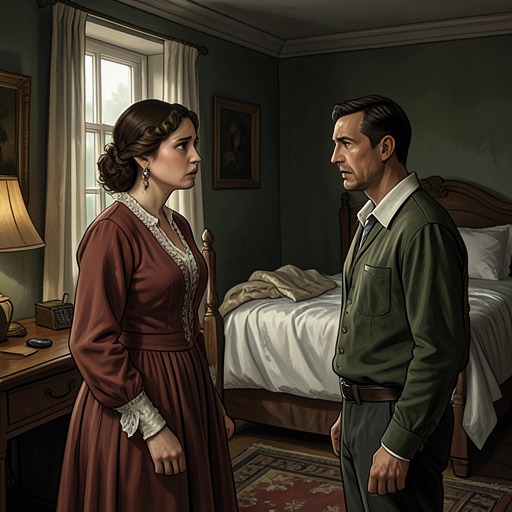
Kirsty is confronted by a figure speaking and reaching toward her as though he were Rory. Yet the familiar manner and appearance do not settle the matter. The bells grow louder, and she holds to the recognition that the speaker is Frank. Her certainty is grounded in what she knows of the bodies: Rory’s corpse is upstairs, still in Frank’s discarded bandaging, while the figure before her wears Rory’s skin.
The substitution makes recognition the decisive action of the scene. Frank’s outward resemblance to his brother offers him a way to approach Kirsty, but the contradiction between the living figure and Rory’s corpse exposes the disguise. Kirsty refuses to accept the appearance as proof of identity. As Frank continues to speak, she moves toward him and identifies him, turning what he presents as a familiar reunion into an accusation made visible to the Cenobites.
The confrontation also returns the story to the relationship between blood and bodily identity. Frank’s recovery has depended on other people’s bodies, and his assumption of Rory’s appearance makes that dependence literal in the most intimate possible way: he has taken the identity of his own brother. The revelation is not simply that Frank has survived. It is that the apparent Rory is a constructed presence, and that the true Rory is already dead.
The Cenobites Reclaim Frank
Frank recognizes that Kirsty has brought about the Cenobites’ arrival and blames her. Their return is announced when one of them speaks his name. The call makes clear that they have not forgotten him or relinquished their claim. Behind the speaker, three more Cenobites appear, and Frank’s momentary attempt to move toward Kirsty ends when hooks and chains hold him in place.
Kirsty is told to leave: the Cenobites declare that the matter is no longer hers. Frank turns his anger toward her, but she continues to the door. He comes close with a knife and still cannot reach her. The hooks restrain him, and the chains draw taut as the Cenobites pull him back. In this reversal, the apparent hunter becomes the captive. Frank had gained enough strength to act in the house and to approach Kirsty, yet his renewed bodily power cannot overcome the beings who have returned to claim him.
The scene does not make the reclaiming merciful. Frank is dragged back and subjected to renewed torment. Kirsty looks behind her before leaving and sees him held beneath the bare bulb, while his screams give way to silence. Even then he responds with a defiant gesture rather than an apology or plea. His body finally comes apart, and Kirsty shuts the door on the impact from within. The Cenobites have recovered him, but the conclusion is presented as an act of punishment and destruction, not a peaceful restoration of their former custody.
Escape and Significance
Kirsty leaves while the house groans and plaster falls from the ceiling. The bells remain in turmoil, and the sounds and disturbances in the walls make the building itself seem unstable. Her escape is therefore both physical and urgent: she has made the identity of the figure before her unmistakable, survived his attempt to kill her, and left him in the Cenobites’ hands before the house can collapse around the confrontation.
The action brings together the story’s recurring conflicts over identity, bodies, and the boundary between the ordinary home and a concealed world. The Damp room first makes Frank’s presence visible through a wall; later, Rory’s face makes that presence harder to recognize. The false familiarity is undone not by appearance but by Kirsty’s knowledge of the dead Rory and her willingness to name Frank. Her disclosure changes the balance of power: it gives the Cenobites the opening to reclaim him, while ending his immediate threat to her.
The event also completes the reversal set in motion by Frank’s gradual recovery. Blood has helped him move from a hidden, dependent presence to a figure able to pass as Rory and attack Kirsty. But this progress does not free him from the Cenobites. Once Kirsty exposes him, his assumed identity offers no protection, and the force of the beings who first claimed him proves stronger than his restored ability to act. The final separation of Frank from Kirsty is thus an escape for her and a renewed captivity for him, ending his pursuit while leaving the house—and the world of the story—far from restored.