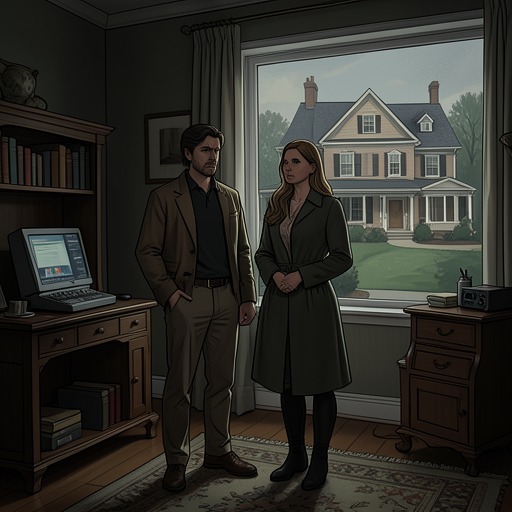
The final confrontation on Lodovico Street
The Hellbound HeartThe final confrontation on Lodovico Street brings Kirsty back to the house to challenge Frank and determine Julia’s part in what has happened. Its first turn is a contest over knowledge: Kirsty says she witnessed the events, while Frank claims that he and Julia acted together against Rory.
Causes and Background
Kirsty approaches the house without a settled plan. She looks for the Cenobite but sees no sign of him, and she cannot know whether Julia will be there or how deeply Julia is involved with Frank. Kirsty considers that Julia might have acted out of fear, but finds it impossible to regard her as an innocent bystander. The unanswered questions lead her to the house on Lodovico Street, where she rings the bell and waits.
When Kirsty faces Julia, she blurts out that she was there that afternoon and saw what happened. The statement makes her witness to the house’s hidden violence, not merely an outsider asking for an explanation. Frank counters by describing himself and Julia as having destroyed Rory together. He says Rory trusted him because they were brothers, then rejects that trust as no guarantee of loyalty. His account exposes Julia’s participation and makes the confrontation a reckoning over both Rory’s fate and the alliances formed within the house.
Recognition and Escalation
Kirsty’s uncertainty breaks when she connects Frank to what remains of Rory upstairs: Rory’s body lies abandoned in Frank’s discarded bandages, while Frank has taken on his brother’s appearance. The disguise turns the brothers’ relationship into a literal means of concealment, but Kirsty recognizes the substitution and understands that the man before her is Frank.
She reaches for him, and her nails catch his cheek; the recently attached skin shifts, exposing the deception. At that instant, the bells that had overwhelmed Kirsty’s thoughts become audible throughout the house and the surrounding world. The change marks a decisive turn: Frank’s assumed identity is no longer secure, and the Cenobites’ presence presses into the confrontation.
Frank draws a bloodied knife and points it at Kirsty. As she reaches the foot of the stairs, Julia seizes her and holds her in place, leaving her exposed to Frank’s attack. The encounter’s conflict is now physical as well as evidentiary: Kirsty has identified Frank, but Julia’s intervention gives him the opportunity to silence her.
Reclamation and Aftermath
Frank turns from Kirsty to Julia, whose intervention had helped expose Kirsty to his attack. When Julia calls for help, he approaches her; she reaches toward him as if expecting tenderness, but he instead consumes her. The reversal ends their alliance on Frank’s terms: Julia had helped him conceal and sustain his return, yet she is not spared once she is vulnerable.
The Cenobites then reclaim Frank. His admission of his identity confirms what Kirsty has already recognized, and they restrain him and draw him away. As they take him, the body he had reconstructed comes undone. Kirsty is told to leave; she accepts the opening, escaping while Frank screams behind her and the house fills with bells and other uncanny sounds.
On her way out, Kirsty discovers Julia again in the dining room, beneath the folds of a dress. Julia’s head speaks despite her condition, and a light grows beneath the bridal veil. Rather than wait for the spectacle to intensify, Kirsty backs into the hall and runs for the front door as the ceiling begins to give way. Her escape is not a return to ordinary safety: the house is collapsing around her, while spectral birds crowd the air and wolves howl within its walls.
At the threshold, Kirsty collides with something and finds Lemarchand’s box in her hand. Its surfaces have been resealed and polished, with no visible clue to its solution. Kirsty understands that another person may someday discover and open it, and that she has apparently become its keeper. The confrontation thus ends with Frank taken back by the Cenobites, Julia dead, and Kirsty carrying the very object that first opened the way to the other world.
The House as a Hidden Threshold
Before the confrontation, the house has already turned concealment into part of its architecture. When Julia enters the Damp room, the boards where Rory’s blood fell have been cleaned, the room beyond the landing light is dark, and the door locks behind her. The wall’s strange movement gives way to a substantial flicker; Julia recognizes that Frank has been in the house all along, hidden within it. The final encounter brings that long concealment into the open: what had seemed an empty room and a familiar home prove to be barriers around Frank’s return.
That reversal gives the confrontation a spatial as well as familial force. The Lemarchand’s Configuration had opened a passage to a world beyond the room in which Frank first used it; now the house itself becomes the site where the Cenobites reclaim him and Kirsty escapes with the box. The movement from an invisible doorway to the exposed deception in Frank’s borrowed appearance binds the plot’s supernatural crossing to its intimate betrayal, making the house both hiding place and passage out.