Evidence required before arrest
The Hidden StaircaseEvidence required before arrest is the practical threshold the sheriff applies when Nancy Drew accuses Nathan Gombet of the crimes at The Mansion. The rule creates a distinction between a convincing explanation and proof that can justify police action: the sheriff accepts Nancy’s account, but will not arrest Gombet on the account alone.
Suspicion and the demand for proof
Gombet’s grievance over his land provides an early reason to suspect him, but not evidence of the later thefts. Carson Drew explains that land belonging to Gombet was condemned for a railroad right of way and that Carson, serving on the land commission, saw to it that Gombet was well paid. After the bridge was built, Gombet pressed the commission for more money, claiming that the bridge had damaged his remaining property. Carson regarded the claims as ridiculous, while Nancy reported that Gombet had made threats, including talk of blowing up the bridge. The episode establishes hostility and a possible motive for conflict; it does not establish that Gombet entered The Mansion or stole anything. Gombet later makes the dispute explicit, saying that he had been cheated and demanding either the return of the deed or the price he believed his land was worth. His attempt to obtain the deed from Carson’s desk further connects his grievance to the Drew family. These actions strengthen suspicion, but the sheriff’s standard requires evidence of the crimes under investigation, not merely a history of resentment or a possible motive.
Nancy’s explanation and the sheriff’s threshold
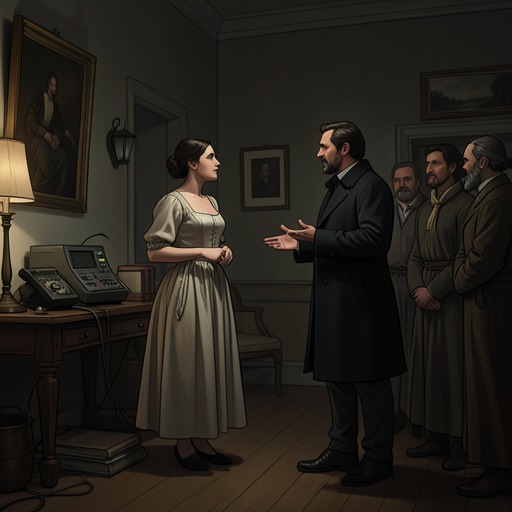
Nancy’s reasoning gathers force as separate clues begin to fit one account. An apparent mystery involving birds prompts her to ask whether Gombet keeps birds; Rosemary says his house contains parrots and that their cries can be heard from nearby. After piecing together what she has learned, Nancy concludes that Gombet used a secret route between his house and The Mansion to make repeated visits and take the sisters’ valuables. She identifies the pocketbook, silver spoon, silver urn, pin, and Floretta’s dresses as losses that his entries could explain. The hidden route and the pattern of theft give her accusation coherence, but the sheriff still asks for tangible confirmation, suggesting that finding the silver urn in Gombet’s house would supply the kind of proof he needs. When Nancy presents her case, Rosemary and Floretta corroborate her account, and Nancy offers to show the sheriff the staircase. He says that he believes their story, yet insists that he cannot proceed without evidence that Gombet is guilty. His caution is not the same as disbelief: it is a boundary between accepting a plausible account and acting against a person. That distinction makes the inquiry’s delay consequential. Nancy is certain of the culprit, while the sheriff remains responsible for deciding whether certainty has been supported sufficiently to justify a search and arrest.
From hesitation to action
The sheriff’s reluctance persists even at Gombet’s house. After Nancy warns that entering a man’s home is serious business unless they are sure they have the right person, he admits that he still doubts the case and does not want to ram the door. Nancy assumes responsibility for the decision, and he agrees to proceed. The scene shows the rule operating as a restraint on police discretion, while also showing how the sheriff’s caution can leave the next step to Nancy’s insistence when she considers the evidence conclusive. The search changes the situation from accusation to discovery. Carson is found captive, and he explains that Gombet tricked him into coming to the house and had been trying for several days to make him sign over money. The sheriff says Gombet has been caught in the act, then examines a paper from the table. Carson confirms that it is the agreement Gombet wanted him to sign: it demanded a large sum and a promise not to prosecute. Gombet’s grievance about compensation thus stands in sharp contrast with the attempt to obtain money through confinement and forced agreement. The paper and Carson’s account provide concrete support for the accusation, and the sheriff now treats guilt as established rather than speculative.
Role in the mystery
The evidence threshold gives the investigation a staged structure. Nancy’s explanation first turns scattered clues into a compelling theory; the sheriff’s refusal to act on theory alone marks what remains unproved. The search then produces a captive witness and a written agreement, converting her inference into evidence tied directly to Gombet’s conduct. In that sequence, the rule does not resolve the mystery by itself. Instead, it supplies the standard the mystery must meet before suspicion can become an arrest, and the discovery at Gombet’s house provides the decisive change.