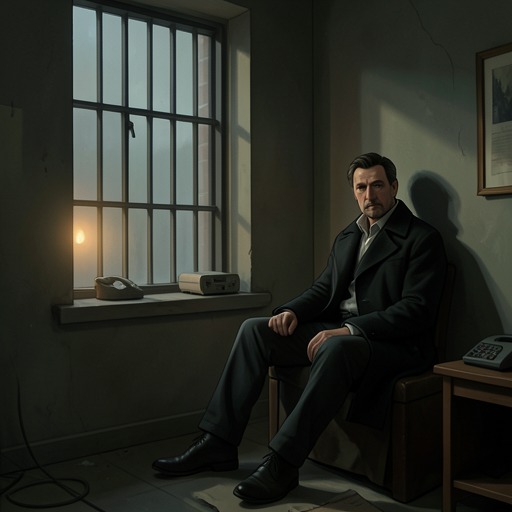
Gombet holds Carson Drew captive and tries to extort him
The Hidden StaircaseGombet holds Carson Drew captive and tries to extort money from him, turning a long-running property grievance into a crime of confinement and coercion. The episode connects Nathan Gombet’s anger over land acquired for a railroad with his efforts to force Carson to sign a financial agreement; it ends when Nancy Drew and the sheriff find Carson, free him, and secure the proposed agreement as evidence.
Causes and Background
Gombet’s grievance began when land he owned was condemned for a railroad right of way. Carson had served on the land commission and said he had ensured that Gombet was well paid. Gombet initially seemed satisfied with the settlement, but after the bridge was built he returned to the commission seeking additional compensation, arguing that the bridge had damaged the remainder of his property. Carson regarded these later claims as unfounded. The disagreement therefore began as a dispute about the value and consequences of a compulsory land acquisition, not as a demonstrated entitlement to money from Carson personally.
Gombet’s own account sharpened the conflict: he said the land had been worth several times what he received and demanded either the return of the deed or the price he believed it deserved. The narrative establishes his sense of having been cheated, but his grievance does not validate the methods he later uses. Carson had already heard that Gombet made threats, including talk of blowing up the bridge, and resolved to keep an eye on him. This earlier warning places the captivity within a pattern of escalating hostility, while leaving the bridge threat distinct from the later attempt to extort Carson.
Captivity and Coercion
Gombet induced Carson to come to his house by trickery, then kept him there for several days while trying to make him sign over money. Carson later explained that the confinement had involved sustained coercion. During the captivity, Gombet withheld food and drink for more than twenty-four hours. When Nancy found her father, Carson was bound to a chair, pale and visibly weakened; his condition made clear that the dispute had moved far beyond an argument over compensation.
The immediate threat centered on a document. Nancy heard Gombet give Carson a minute to sign, then entered the room before she could hear the rest of the threat. She found Gombet bending over her bound father and demanding the signature. He threatened that Carson would not get out unless he signed. The demand was therefore not merely for repayment or renewed negotiation: Gombet was using Carson’s confinement to compel a written financial concession.
Carson later identified the paper’s terms more fully. It required him to turn over a large sum of money and promise not to prosecute Gombet. The agreement combined an attempted transfer of money with an effort to block legal consequences for the man demanding it. Gombet’s silence when questioned did not alter the significance of the document or the circumstances in which he had tried to obtain Carson’s signature.
Discovery and Rescue
The rescue followed Nancy’s effort to persuade the sheriff to act on the Turnbull sisters’ account of the strange events at their house and the discoveries she had made there. Nancy named Gombet as the guilty party, but the sheriff initially insisted that he could not proceed without proof. He said that a recovered stolen object, such as the silver urn, would provide the kind of evidence he needed. The episode thus sets Nancy’s certainty against the sheriff’s demand for corroboration: a persuasive account alone had not yet settled the question of arrest.
At Gombet’s house, the evidence became immediate. Nancy recognized Gombet’s voice and heard his ultimatum to Carson. She pointed the sheriff toward the room, and when the door opened she saw the captivity directly. Nancy moved ahead of the sheriff and confronted Gombet; he turned and retreated as she advanced. The sheriff and his party could now act on what they had found, rather than on accusation alone.
Nancy immediately turned from Gombet to her father. With a deputy’s knife, she cut the ropes binding Carson to the chair. He could not stand steadily and had to sit again, weakened by the confinement. Nancy brought him water, which he drank at once. Rosemary Turnbull and Floretta Turnbull, who had been waiting in the roadster, came inside after Nancy called them and joined her in hearing Carson explain how Gombet had lured and held him.
Evidence and Consequences
The sheriff announced that Gombet would be taken into custody and challenged him about the attempted demand for money. Gombet muttered nothing in response, and Carson did not need to rely on a claim about the paper’s terms alone: the sheriff picked up the agreement from the table and asked Carson to identify it. Carson confirmed that it required him to surrender a large sum and promise not to prosecute. The sheriff folded the document and kept it as evidence.
The paper gives the episode a legal as well as personal resolution. Gombet’s initial land claim concerned compensation for property taken for a railroad; his later conduct involved trickery, confinement, deprivation, and an attempt to secure money under pressure. Nancy’s discovery brings that distinction into view, while the sheriff’s earlier caution and later seizure of the agreement show the importance the story assigns to proof. Carson is freed, and the instrument Gombet meant to use to secure his demands becomes part of the case against him.