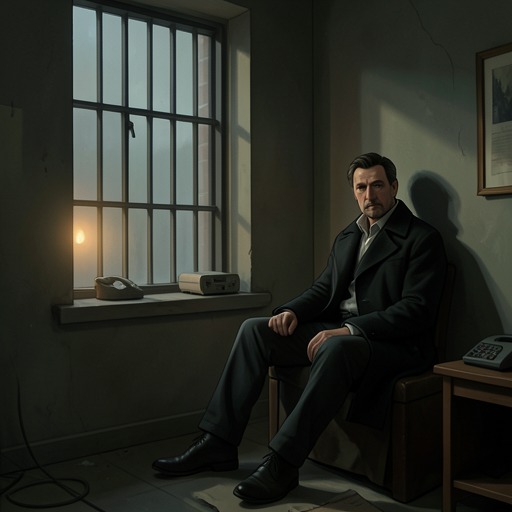
Gombet kidnaps Carson Drew
The Hidden StaircaseNathan Gombet kidnaps Carson Drew by turning Carson’s love for Nancy into the means of his capture. A fabricated report that Nancy has been badly injured draws Carson from the railway station to Gombet’s house, where the promised rescue becomes imprisonment. The reversal exposes the abduction as a coercive move in Gombet’s property dispute: he means to make Carson yield where argument has failed.
Causes and Background
Carson arrives by train before seven in the morning, expecting Nancy to meet him. He is eager to see his daughter again and initially assumes that her absence may be a delay. Instead, before he has walked a dozen steps toward the waiting room, he sees Nathan Gombet hurrying toward him. Carson already knows Gombet as an unwelcome opponent who has argued with him about supposed property rights on the river; he expects another confrontation over that claim, not an emergency involving Nancy.
Gombet approaches in a state of conspicuous excitement, then announces that Nancy has been injured and that Carson must come quickly. The lie is tailored to overcome Carson’s suspicion and his knowledge of their dispute. It also supplies a reason for Gombet’s urgency: Carson is told that Nancy is badly hurt, though the doctors believe she may survive. With the report turning his attention wholly to his daughter, Carson demands to be taken to her rather than stopping to verify what he has been told.
The Abduction
Gombet directs Carson into a battered automobile waiting near the platform. Carson, bewildered and shocked by the supposed news, obeys without question; Gombet gets in after him, takes the wheel, and drives away. The station on that side is practically deserted, and nobody sees the car depart. The scene therefore joins emotional deception to physical isolation: Carson is first persuaded to leave the public station, then carried away in a vehicle that attracts no witness to his departure.
During the drive, Carson asks where Nancy is. Gombet answers that she is at his house. Carson is surprised that she has not been taken to a hospital, and Gombet explains that she is too badly injured to be moved. The claim keeps the false emergency intact while redirecting Carson toward the very place where he will be confined. Carson remains so worried that he asks no further questions and keeps his eyes fixed on the road. Gombet drives furiously, and they soon reach the outskirts of Cliffwood.
They pass within sight of two large stone houses, and Gombet turns into one, identifying it as his home. Carson pays the house no casual attention: as soon as the car stops, he springs out and heads for the door, still intent on reaching Nancy. Gombet is quicker and leads him inside, through the kitchen, where a woman is working over the stove. Carson’s haste is thus part of the trap’s operation. Each step toward the supposed injured girl brings him farther into Gombet’s control, while the ordinary domestic entrance disguises the prison awaiting him.
The Trap and Its Purpose
Carson asks anxiously whether going in will frighten Nancy, and Gombet assures him that it will not. Carson then opens the door and steps into a room that is dark, its windows covered by drawn curtains. As his eyes adjust, he realizes that the room is not a bedroom at all. It has every appearance of a prison. The false destination is now unmistakable: Nancy is not there, and Carson has been lured into confinement.
Carson turns to face Gombet, who is standing in the doorway and watching him with evident satisfaction. When Carson demands an explanation and asks where Nancy is, Gombet identifies the situation plainly: Carson is his prisoner, and Gombet intends to force him to terms over the property. The stated purpose connects the kidnapping directly to their earlier dispute about river rights. What began as an argument over a claim becomes a threat backed by confinement; Gombet is using Carson’s freedom as leverage.
Gombet slams the door before Carson can act and turns the key in the lock. He then walks down the corridor, his hollow laughter echoing through the house. That sequence gives the abduction a decisive end point: the deception has delivered Carson into a locked room, and Gombet has made his coercive purpose explicit. The locked door and the laughter replace the invented story about Nancy with the real condition of Carson’s captivity.
Consequences and Narrative Significance
The abduction converts a familiar dispute into an immediate personal crisis. Gombet does not persuade Carson to reconsider the property question or confront him openly at the station. He invents a danger to Nancy, exploits Carson’s concern, and removes him from a public place before revealing the demand. The difference between Carson’s expectation of a reunion and the prisonlike room sharpens the reversal: the urgency that appears to serve a father’s rescue instead serves his captor’s leverage.
The scene also establishes the terms of the danger that follows. Carson is imprisoned at Gombet’s house, while the threat to Nancy that caused him to come there has been exposed as a lie. Gombet’s own declaration makes the property dispute the motive he intends Carson to face in captivity. The episode therefore marks the point at which the river-property conflict becomes kidnapping and coercion, and leaves Carson’s freedom dependent on what Gombet hopes to extract from him.