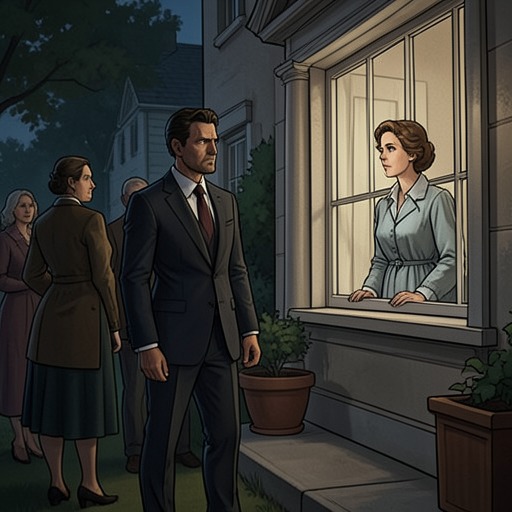
Gombet’s attempt to drive the Turnbull sisters from their home
The Hidden StaircaseGombet’s attempt to drive Rosemary and Floretta Turnbull from The Mansion turns a property offer into the culmination of a campaign of intimidation. By making the sisters’ home seem unbearable and then offering to buy it on his own terms, he sought to profit from the pressure he had created. The scheme nearly worked: Rosemary says the sisters would have given up their home without Nancy Drew’s intervention.
The Offer and Its Motive
At the confrontation following Gombet’s capture, Rosemary insists that he tried to force the sisters from their home and says they intend to file a charge against him. Gombet responds that he meant no harm, but then gives a more revealing account: he saw an easy way to make money and offered to buy the house. Floretta’s pointed reply makes clear that the offer was at his price, not a neutral proposal. Carson Drew calls the attempt to cheat the two women cowardly, identifying the transaction as the intended payoff to coercion rather than an ordinary negotiation.
The exchange clarifies the relationship between threat and purchase. Gombet did not merely want the property; he wanted the sisters to surrender it under conditions he controlled. His admission presents financial gain as his motive, while Rosemary and Floretta’s responses expose the imbalance built into the bargain: the person making the offer had also helped create the distress that might compel them to accept it.
Intimidation and the House
The proposed purchase belongs to a wider campaign involving the apparent haunting of The Mansion and repeated thefts. The apparent supernatural disturbance gave the sisters a reason to fear remaining in their home; the thefts added a material form of violation to that unease. Together, these acts applied pressure without initially presenting themselves as a straightforward attempt to take the property. The final explanation recasts the frightening incidents as part of a scheme with a concrete financial objective.
The effort had a practical and emotional consequence. Rosemary says the sisters could not have endured the house for another day and would have been forced to give it up if Nancy had not helped them. Her statement measures the scheme’s near success in terms of displacement: Gombet’s pressure had made continued residence seem impossible. The house was therefore not just the object of a prospective sale but the ground on which the sisters’ security and control over their home were contested.
The Servant’s Role
The servant at Gombet’s house appears in scenes that connect the property scheme to his criminal operation. When Carson Drew arrives, intent on reaching his daughter, Gombet leads him through the kitchen. The servant receives a significant nod from Gombet and, once the two men have passed into the next room, quietly locks the outside door. That small, deliberate action establishes coordination between them before Nancy Drew later encounters her alone in the house.
On a rainy night, Nancy sees the servant washing dishes in the kitchen while Gombet is away. Her presence makes Nancy’s planned entry more dangerous. In the cellar, the servant searches with a flashlight after hearing a noise, bringing Nancy close to discovery as she hides. During the later police attempt to enter, the sheriff opens the door onto the muzzle of a sawed-off shotgun held by the servant. These episodes show that Gombet’s scheme did not depend on his actions alone: the servant helps secure the house, searches for an intruder, and directly confronts the officers. Nancy subsequently identifies her as Gombet’s partner in crime, although the woman denies the accusation in the exchange shown.
The book presents this unnamed Black woman through racialized descriptions and caricatured dialect, while also assigning her a consequential role in the criminal plot. Her actions, rather than Nancy’s accusation alone, connect her to the operation: she locks the door after Gombet’s nod and later faces the sheriff armed. The contrast matters to the scene’s construction. The narrative marks her as threatening before the police encounter, then makes that threat literal at the threshold, where the expected arrest is briefly checked by the weapon.
Exposure and Consequences
The scheme’s underlying purpose becomes clearest after Gombet has been apprehended, when the sisters can answer his claim that he meant no harm with the history of his nightly visits and attempted purchase. Rosemary’s sarcasm rejects the idea that those visits were friendly; Floretta’s response identifies the price as part of the deception. Carson’s judgment and Gombet’s own admission leave little distance between the supposed offer and the intimidation that preceded it.
The sisters’ intended complaint and the evidence held by the sheriff place the dispute within a legal aftermath, not merely a personal quarrel. For Rosemary, however, the decisive consequence is immediate and domestic: she believes Nancy’s intervention kept the sisters from losing their home. The ending thus links the resolution of the wider mystery to the thwarting of Gombet’s property scheme. What had looked like a sequence of frightening disturbances is exposed as pressure toward a cheap purchase, and the sisters remain able to assert that the house is theirs to keep.