Gombet’s campaign to frighten the Turnbull sisters
The Hidden StaircaseGombet’s campaign to frighten the Turnbull sisters turns the disturbances at The Mansion into a calculated pressure tactic: apparent supernatural events and increasingly personal thefts are meant to make Rosemary Turnbull and Floretta Turnbull abandon their home and accept a low offer. What begins as a pattern of unnerving but ambiguous incidents becomes a material crime, and Nancy Drew’s reconstruction of the concealed passage between the houses exposes the human agent behind the supposed haunting.
The disturbances and their growing effect
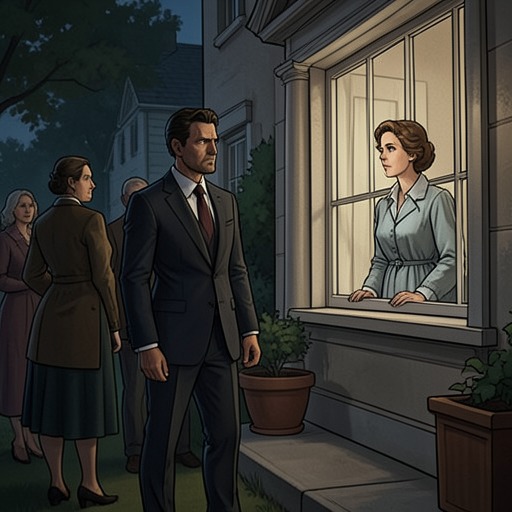
The sisters first describe a house that has changed without an obvious explanation. Flies have appeared in large numbers despite their care in keeping doors and windows closed, and strange shadows move across the walls. Floretta believes she once saw a human shadow; Rosemary is skeptical of ghosts, but admits that the accumulating incidents are getting on her nerves. Their account establishes the campaign’s method: everyday details are made disturbing, while the source remains unseen.
The apparent haunting also reaches beyond what can be seen. Rosemary reports hearing someone play a stringed instrument one night the previous week, a sound that unsettled her. Floretta has become so anxious that she says she cannot remain in the house another week and does not want Rosemary to leave her alone even for a few hours. The fear therefore has a practical consequence before its cause is understood: it strains the sisters’ sense of safety and gives urgency to Floretta’s wish to sell.
Rosemary resists that conclusion. The Mansion has belonged to the Turnbull family for decades, and she does not want to hand it over to a stranger. She does not believe the house is haunted, even as the incidents wear down her confidence. That difference between the sisters matters to the scheme: Floretta’s distress favors leaving, while Rosemary’s attachment to the family home keeps the question of selling open rather than settled.
From unsettling signs to thefts
Alongside the shadows, flies, and music, possessions begin to disappear. The first losses seem small enough to invite doubt: the sisters miss a silver spoon, then discover that a pocketbook is gone. They search for the spoon and consider whether it might have been misplaced, but the missing purse makes that explanation harder to sustain. The thefts give the disturbances a concrete cost and turn the haunting from a matter of nerves into an intrusion into the sisters’ home.
The losses become more personal. Floretta returns to find that her diamond bar pin is gone, and later discovers that three of her best black silk dresses have been taken from her room while the sisters were at breakfast. Her distress over the pin shows how the campaign threatens not only property but also objects she cannot bear to lose. The removal of three dresses from a particular bedroom makes the intruder’s access especially difficult to dismiss as coincidence.
The missing dresses are accompanied by an extraordinary sight: two live canaries are perched on the picture frame above Floretta’s bed. The birds deepen the apparent strangeness of the house, but Nancy later treats their presence as something the concealed route might explain. She considers two possibilities rather than claiming certainty: Gombet may have left an entrance open, allowing the birds to fly through, or he may have brought them himself. The scene’s oddity thus becomes part of the mystery’s evidence rather than proof of anything supernatural.
The theft of Rosemary’s silver urn sharpens the pattern further. During a nighttime search of the library, Nancy notices a ladder-back chair pushed against the bookcase, out of keeping with the sisters’ careful housekeeping. Rosemary notices it too and realizes that her urn has disappeared from the top of the bookcase. The displaced chair is a small physical irregularity with investigative force: it suggests someone has disturbed the room, while the missing urn confirms that the intrusions have reached one of Rosemary’s prized possessions.
The property motive
Nancy’s interpretation changes when she learns that the sisters have received offers for The Mansion. They had not intended to sell unless they could obtain their price, but the apparent haunting has made them fear that no buyer will want the property. Nancy recognizes the economic logic connecting the fear to the losses: someone may be trying to frighten the sisters into selling cheaply.
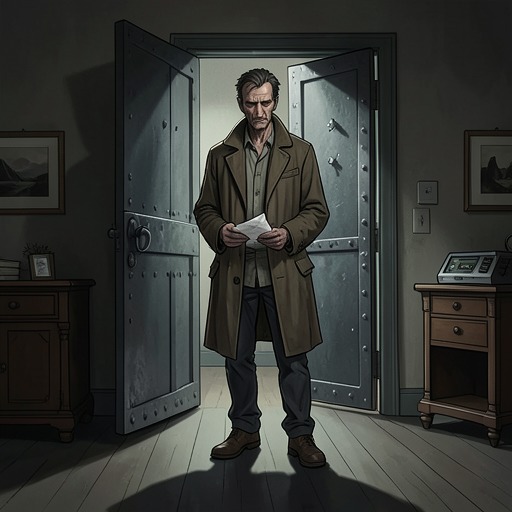
Nathan Gombet’s offer makes that possibility more specific. The sisters had not taken it seriously, but the information catches Nancy’s attention because Gombet is a neighbor who wants the very house the incidents are making difficult to keep. Nancy is already persuaded that the goal is to drive the Turnbulls away; learning of his interest gives her a candidate whose desired purchase aligns with the campaign’s effect. The sale is not merely an anxious possibility raised by the sisters but the apparent end point of a deliberate strategy.
The concealed route and Nancy’s explanation
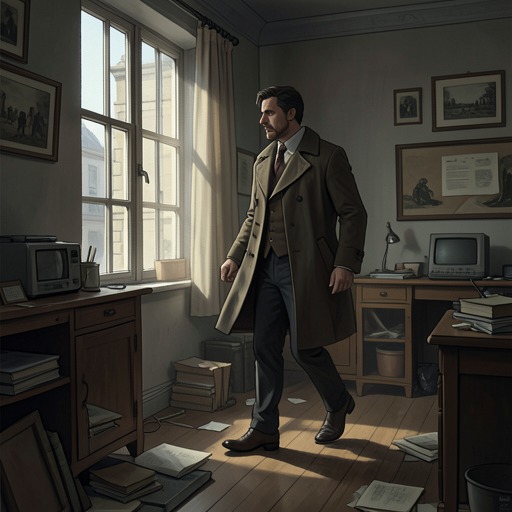
Nancy’s later reconstruction joins the separate clues. She concludes that Gombet has repeatedly entered The Mansion and stolen the pocketbook, spoon, silver urn, pin, and dresses through a secret staircase. She also connects the concealed access to the otherwise baffling ease with which someone could appear in different parts of the house without being discovered. The pattern of disturbances no longer requires a ghost: it can be produced by an intruder with a hidden way in and out.
The passage itself carries a possible family history, though Nancy presents that history as an inference. She supposes that the tunnel between the Gombet and Turnbull residences may have been built before the American Civil War as protection against marauders, when the Turnbull brothers were friendly. In her reconstruction, the brothers later became enemies during the war, the passage was closed, and its existence eventually passed from memory. The abandoned connection between the neighboring houses helps explain how an old domestic space could conceal a route unknown to its current occupants.
Nancy also links the anonymous warning telling her not to meddle in the Turnbulls’ affairs to Gombet. She reasons that he may have overheard Rosemary and Floretta discussing the letter and thereby learned that Nancy was expected. This remains part of her explanation of how the campaign adapted to her arrival; it is distinct from the physical evidence of the route and thefts that she says she can show to the sisters.
Exposure and significance
When Rosemary asks whether there is really a ghost, Nancy answers that Gombet is the supposed ghost, as she had suspected. She explains the purpose: he wanted to frighten the sisters into selling at his price. Floretta says she had considered Gombet mean but had not imagined he would behave this way, and she and Rosemary remain unwilling to accuse him without proof. Nancy responds that she has proof and invites them to see it. The conversation marks the campaign’s decisive reversal: the sisters’ fear is redirected toward an explanation they can investigate, and the apparent supernatural threat becomes an accusation against their neighbor.
The campaign’s structure depends on keeping cause and effect apart until Nancy can connect them. Shadows, music, flies, missing objects, and the canaries initially accumulate as separate disturbances; the low offer supplies a motive, and the secret passage supplies a means. Together, these elements expose how the house’s apparent haunting has been used to undermine the sisters’ attachment to their home. The menace lies not in a ghost but in the conversion of private space into a route for surveillance, intimidation, and theft.