Nancy Drew
The Hidden StaircaseNancy Drew is the perceptive, resourceful young detective at the center of the Turnbull mansion case. Her decisive strength is not simply courage: she gathers information, distinguishes suspicion from proof, and then acts quickly enough to turn a private discovery into a rescue and an arrest. By the end, her father has recognized her as a professional equal in the making, promising to give her his mystery cases.
Identity and Formation
Nancy is Carson Drew’s only child. Although he has indulged her, she has not been spoiled; the narrative describes her as fair-skinned, with friendly blue eyes and golden, curly hair, and notes that her friends consider her clever as well as attractive. More consequentially, the death of her mother years earlier has required her to become resourceful and efficient. She manages the Drew household and takes a keen interest in her father’s legal work, particularly cases that involve a mystery.
Her detective ability has a history before the events at The Mansion. Nancy has sat in on interviews with noted detectives, and Carson believes she has a natural talent for investigating. In an earlier case, she took responsibility for finding Josiah Crowley’s missing will when capable lawyers had failed, helping Abigail Rowen and Allie Horner. That prior success establishes that her work in the present mystery is not a sudden departure from ordinary life but the continuation of skills already tested under pressure.
The story first finds her alone at home: Carson has been called away on an important law case, while the housekeeper, Hannah Gruen, has a day off. Nancy cannot settle into her book and feels inexplicably uneasy. At the living-room window, she notices the old-fashioned mantel clock she received as a reward for solving a previous mystery. The clock’s place in the scene joins her domestic surroundings to her detective past, before the new case has even begun.
Taking Up the Turnbull Case
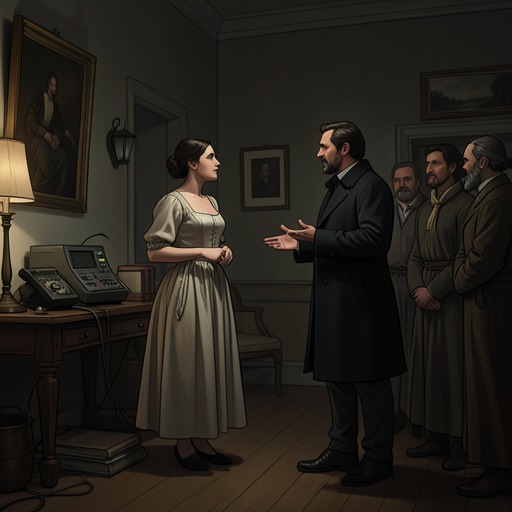
When Rosemary Turnbull describes the strange events at The Mansion, Nancy is immediately interested, but she does not pretend to know in advance whether she can help. She says she would like to visit the house, and when Rosemary presses her to come soon, Nancy pauses to consider the time. Her willingness develops into a deliberate choice after she recounts the case to Carson. She wants to help Rosemary and Floretta Turnbull avoid the tragedy of selling their family home, but Carson warns that the house may be dangerous.
Nancy answers his concern by applying his own professional standard to her situation: if he had been assigned to the case, he would not hesitate to stay in the house overnight. Carson reluctantly concedes the point. Nancy also reminds him that he has often said he wants her to become self-reliant and brave. The exchange makes her independence relational rather than absolute: she seeks her father’s permission, but argues that the principles he has taught her require him to trust her judgment.
As she investigates Nathan Gombet, Nancy’s method depends on keeping a theory separate from a case that can be proved. She has reason to suspect him: he wants to buy the Turnbull property at a ridiculously low price, and she believes he has been making the frightening nighttime visits and stealing valuables. But suspicion alone cannot be taken to the authorities. Her rainy-night approach to Nathan Gombet’s house brings her face to face with the servant Rosemary and Floretta had described. Nancy sees the woman washing dishes in the kitchen and realizes that Gombet’s absence has not left the house empty. Later, hiding in the cellar, she hears the servant say that she thought she heard something downstairs and sweeps the basement with a flashlight. Nancy crouches against the wall, acutely aware that discovery could leave her trapped as an intruder.
The danger of that night yields the missing proof. As Nancy pieces together what she has learned from different sources, she concludes that Gombet has been entering The Mansion through the underground passage and using the apparent haunting to frighten its residents while stealing their possessions. She has also learned of his attempt to buy the property cheaply. Nancy considers the passage’s possible history: it may have been built before the American Civil War as protection from marauders, used when the Turnbull brothers were friendly, then closed after they became enemies and eventually forgotten. She presents that history as a reconstruction, not as a fact needed to establish Gombet’s guilt; the decisive change is that she now believes she has the proof previously missing from her case.
From Discovery to Police Action
When the Turnbull sisters thank her for uncovering the hidden staircase, Nancy refuses to dwell on repayment. She insists that the next task is bringing Gombet to justice. The shift matters: discovery is not an endpoint for her but the beginning of a responsibility to act on what she has found. Floretta agrees that he should be locked up, and Nancy sets out with the sisters for the sheriff’s office.
Nancy drives them there in exactly twelve minutes. The sheriff has been relaxed among several men, but he gives the arrivals respectful attention. Nancy quickly lays out the strange events at the house and her discoveries, while Rosemary and Floretta corroborate her account. She directly asks for Gombet’s arrest. When the sheriff’s party reaches Nathan Gombet’s house, however, the servant’s sawed-off shotgun blocks the front-door entry. The officers are unwilling to risk shooting her or a stray bullet hitting her.
Nancy supplies the alternative. She knows that The hidden passage connects The Mansion to an upstairs room in Gombet’s house, and proposes entering by that route with two men while the others keep watch. She also suggests making occasional noise outside to hold the servant’s attention. The plan changes the house’s own concealed architecture into a tactical advantage: the passage that once allowed Gombet to reach the Turnbull home unseen now gives the police a way in. Nancy does not merely provide information to the sheriff; she organizes the approach that makes a safer entry possible.
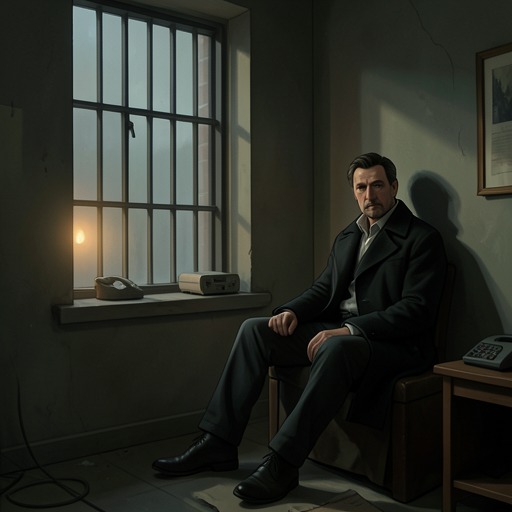
After the servant is detained, Nancy asks to question her. She challenges her claim of ignorance, accuses her of being Gombet’s partner in crime, and presses her to say where he is. When the woman’s answers indicate that there is a prisoner, Nancy immediately sees the danger that Gombet may hear the commotion and escape through the passage. She urges the sheriff to move upstairs and follows the deputies rather than waiting behind. When the servant identifies the room where Carson is held, Nancy is ahead of the sheriff and flings open the door without thinking of her own safety. Inside, she sees her father bound to a chair, pale and haggard, while Gombet leans over him and threatens him into signing a paper.
Family, Representation, and Recognition
Nancy’s rescue of Carson brings the personal stakes of the investigation into direct view. Earlier, he had worried that his daughter might be endangered by staying at The Mansion; now she leads the effort to reach him when he is in immediate danger. Her action is not presented as the product of physical force but of attention, nerve, and command of the case’s geography. She recognizes the passage’s usefulness, persuades the sheriff to take the route, and refuses to remain behind once she knows her father is upstairs.
The account of Gombet’s unnamed servant is also shaped by the book’s racialized language. The narration describes her through demeaning racial terms and caricatured physical features, and renders her speech in stereotyped dialect. Her first appearance is as an obstacle Nancy fears may discover her; later, she holds a shotgun against the sheriff’s party and is treated as Gombet’s accomplice. This framing makes her serve the machinery of suspense and danger while giving her little individual characterization. Nancy’s accusation is part of that encounter, but the distinction between accusation and established proof remains important to the detective’s broader method: she has to uncover Gombet’s connection to the thefts and secure grounds for action, not simply rely on an adversary’s threatening appearance.
After the case is resolved, Rosemary gives Nancy the silver urn as a reminder of her adventure. Nancy accepts it as her second trophy and says she will place it on the mantel with the old clock. The two objects bring her earlier and latest investigations together in the home where the story opened. On the journey back, Carson praises her detective work. Nancy admits that while crossing the dark tunnel she had told herself she would never investigate another mystery if she got out alive, but her response does not close the door on future cases. Carson says he is proud of her and intends from then on to turn his mystery cases over to her. The final change is explicit: Nancy’s independence, first argued for at home and then demonstrated before the sheriff, becomes a promise of professional trust.