Nancy discovers and traverses the underground passage
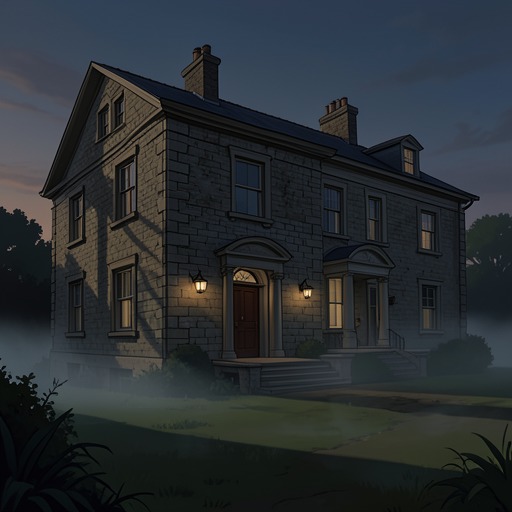
The Hidden StaircaseNancy Drew discovers and traverses the underground passage between Nathan Gombet's house and the Turnbull Mansion. What begins with a tiny, unexplained closet knob becomes a dangerous journey through darkness, ending with proof that the apparently separate houses are linked beneath the ground. The route changes the mystery from a search for concealed openings into a physical connection Nancy has personally followed from one house to the other.
The Closet Panel and the Fall
In a closet at Nathan Gombet's house, Nancy notices that a small knob is too tiny to serve any ordinary purpose. Turning it seems to produce a click. She examines the wall, finds a long crack, and hears a hollow sound when she taps it. These details give her a reason to test the knob more forcefully: when she pushes with all her might, a spring clicks and the entire side of the closet wall drops away.
The opening is not a doorway she can simply step through. Nancy topples forward and falls headlong down a steep flight of stone steps. The closet wall swings shut behind her, concealing the entrance again. Before she reaches the bottom, her head strikes a hard object and she loses consciousness. The mechanism therefore both reveals the route and immediately removes the visible point of entry, leaving her below ground without a clear way back.
When Nancy regains consciousness, she is in darkness at the foot of the stairs. Her memory returns only gradually: she remembers pressing the closet knob, but not the fall itself. She retrieves her flashlight, which still works, though its weak beam illuminates only a small area. The staircase ends at a solid wall, and searching it by hand does not reveal the spring. Rather than spend valuable time trying to reopen the panel, she decides to investigate the passage first.
A Deliberate Descent into the Unknown
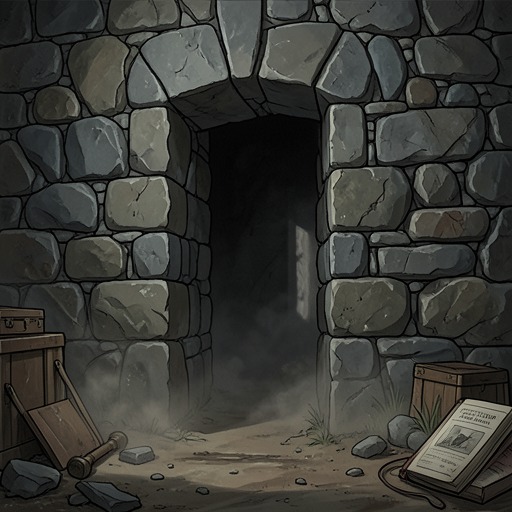
The stone steps are crudely cut and lead almost straight down into deep darkness. Beyond them, a passage stretches onward. Nancy does not know where it leads and recognizes that proceeding may put her in danger, but she chooses to chance it rather than turn back. That decision makes the discovery an exploration, not merely an accidental fall: once she can move again, she commits herself to following the route.
The tunnel offers little certainty. Nancy tries to keep track of its turns but eventually gives up, realizing that if she must return she may have to rely on instinct. With only the flashlight to see by, she continues through the dark passage until her foot strikes a hard object. Turning the beam on it, she finds another stone step and then sees a long flight of steps rising ahead. The possibility that they lead to an exit gives her renewed courage, and she climbs them; the air grows warmer and less damp as she ascends.
At the top, however, she faces another solid wall. Near the upper step she spots a tiny knob like the one in the closet at Nathan Gombet's house. Pushing it opens a concealed panel, which swings back slowly; Nancy passes through, and the panel grates shut behind her. The repeated use of a small, easily overlooked knob makes the two openings legible as parts of a concealed route, even before she knows where she has emerged.
The Attic Exit and the Route’s Significance
Nancy does not emerge directly outdoors. Beyond the panel is a steep flight of wooden stairs, and she continues through the hidden structure until she reaches a trapdoor. A metal ring offers a possible way to open it. Pulling with both hands, she makes the trapdoor fall back so suddenly that she nearly loses her balance and tumbles down the stairs; only her grip on the ring keeps her from falling. The passage demands close attention not only because it is dark, but because its concealed openings and steep changes in level make movement hazardous.
The room above is dimly lit by a window. Moonlight on the casement tells Nancy that she has been underground long enough for the rain to stop. Unable to make out the room clearly, she feels her way forward until her hand touches a piece of furniture. The old highboy is familiar: she remembers seeing it when she searched the Turnbull attic. Recognition replaces her uncertainty with a specific location.
Nancy understands that she has traveled underground from Nathan Gombet's house to the Turnbull Mansion. The stairs she climbed have brought her up along the side of the house to its attic, and she infers that other flights she passed may lead to other parts of the old house. The passage is thus more than a single concealed corridor: the stairs and panels suggest a network of routes within the building, although Nancy has not yet explored or confirmed those other connections.
The discovery also changes the meaning of Nancy's earlier search. She had examined the attic thoroughly without finding the trapdoor, so its presence makes clear that the exit was concealed in a way she did not then detect. She cannot investigate further in the darkness and expects to wait until morning. Even so, the journey has established the central fact: an underground route joins the two houses, and its hidden panels allow passage between them while closing out of sight. The once inexplicable architecture now offers a concrete path for further investigation.