Nathan Gombet
The Hidden StaircaseNathan Gombet is the criminal behind the supposed haunting and thefts at the Turnbull Mansion, and his pursuit of the property ultimately leads him to imprison Carson Drew. Introduced as an ill-mannered visitor from Cliffwood, he comes to embody the material motive beneath the mystery: he wants the Turnbull sisters gone so he can acquire their home at a sharply reduced price. His secret route between the houses turns that ambition into a sustained campaign of intimidation and theft, but also provides the means by which Nancy Drew uncovers and defeats him.
Identity and Reputation
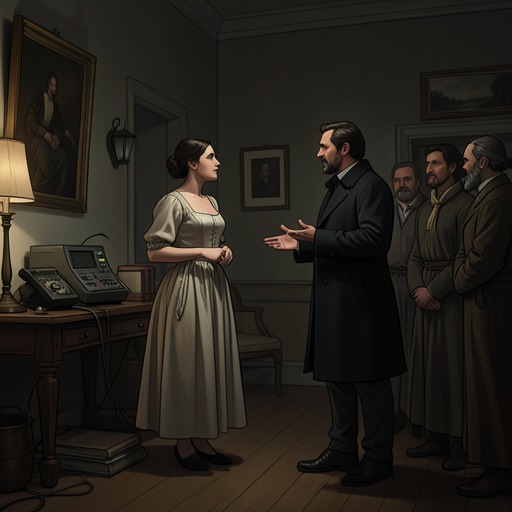
Gombet first appears at the Drew home asking for Carson Drew. He enters without waiting for an invitation, and his tall, thin frame, ill-fitting clothes, and sharp eyes give Nancy an immediate impression of an unpleasant and miserly man. His blunt manner reinforces that impression: when Nancy says her father is away, Gombet immediately demands to know where he is. The encounter establishes both his discourtesy and his focused interest in Carson.
His reputation is confirmed from another direction when a local egg and chicken seller recognizes his name. The seller says Gombet used to buy from him until he was told not to return, calling him a miser and recounting that, after purchasing five dozen eggs, Gombet tried to slip an extra dozen into the crate when the seller turned away. The episode gives concrete form to the petty dishonesty suggested by Nancy’s first impression. It also foreshadows a character whose acquisitiveness is not confined to small bargains: later, the same readiness to take what is not his becomes theft on a much larger scale.
Gombet lives in a large stone house in Cliffwood. When he brings Carson there, he leads him through the kitchen, where his servant is working. Gombet gives her a significant nod as he passes; once the men have gone into the next room, she quietly locks the outside door. The small, coordinated actions disclose that his household is not merely a setting for the crimes: at least one person in it helps secure his control over the people he brings inside.
The Property Scheme and Hidden Route
Gombet’s crimes are tied to his desire to obtain the Turnbull property cheaply. Nancy understands that he has been visiting the Turnbull Mansion at frequent intervals, frightening the sisters and stealing their valuables. She had already suspected that he was responsible because she knew of his wish to buy the property for a ridiculously low figure, but suspicion alone was not enough to take the case to the authorities. Her discoveries eventually connect the apparent haunting, the repeated thefts, and the proposed purchase as parts of one design to drive the sisters from their home.
The physical link between Gombet’s house and the Turnbull residence is a concealed underground passage. Nancy reasons that it may have been built before the American Civil War, when the families were on friendly terms, and that the passage was later closed and forgotten after the brothers became enemies. This history is presented as Nancy’s explanation, not as a confession by Gombet. What the evidence does establish is that Gombet found the hidden spring by accident two months before his confession and discovered where the staircase led. The overlooked passage gave him private access to the mansion and allowed his visits to appear inexplicable to its occupants.
The route also reverses the advantage Gombet believes secrecy gives him. Nancy learns the passage’s connection to his house and later guides the sheriff and a deputy through it, descending the stone steps and entering the tunnel toward the bird room. By the time they reach Gombet’s house, the concealed architecture that enabled his scheme has become a route for the authorities to enter it. Gombet’s method of concealment thus supplies the means of his exposure.
Imprisoning Carson Drew
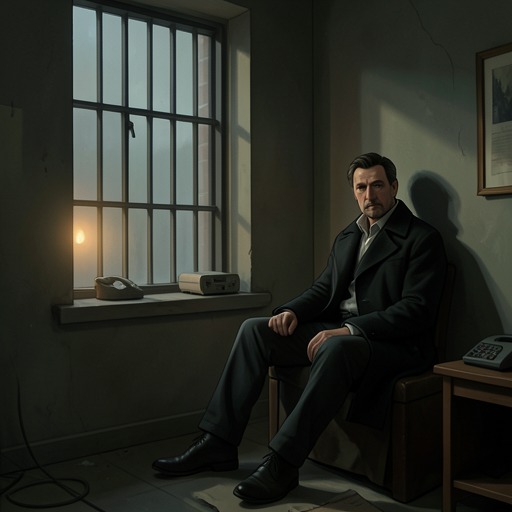
Gombet’s campaign escalates when he induces Carson to come to his house by trickery. Carson, intent on reaching his daughter, does not pause to inspect the building as Gombet leads him inside. After the servant locks the outside door, Gombet reveals that Carson is his prisoner and says that he expects him to come to terms about the property. He then locks Carson in a room. The shift is decisive: Gombet is no longer only deceiving the Turnbull sisters from a distance but using confinement to pressure a lawyer directly.
Carson later explains that Gombet has held him for several days and tried to force him to sign over money. During the rescue, Nancy hears Gombet press him to sign a paper, with the threat that he will not get out if he refuses. She and the sheriff find Carson bound to a chair, pale and visibly suffering, while Gombet stands over him. Gombet’s attempt to make a document secure his demands fails when Nancy opens the door and the officers intervene.
The servant initially denies knowing where Gombet is and rejects Nancy’s accusation that she is his partner in crime. Yet when the sheriff opens the kitchen door during the attempted police entry, he finds the servant holding a sawed-off shotgun. That discovery confirms that Gombet’s control of the house depends on assistance as well as secrecy. After the rescue, Carson identifies the deception that brought him there, and the sheriff announces that Gombet will be taken to jail. Gombet has nothing to say in his defense.
Exposure and Narrative Role
Nancy’s evidence transforms the case from a collection of disturbing incidents into an account of purposeful crimes. She tells the sheriff what happened at the Turnbull house and describes what she discovered; Rosemary Turnbull and Floretta Turnbull corroborate her story. Although the sheriff is initially uncertain because he has not heard of Gombet harming anyone, Nancy’s account and the physical evidence eventually overcome that hesitation. The failed attempt to enter through the front of the house gives way to the secret passage, while the servant’s resistance and Gombet’s presence with Carson reveal the danger and urgency of the operation.
After Gombet is captured, the group finds the stolen valuables. The sheriff examines the articles and identifies the case as theft, ordering that Gombet be taken to jail; Carson adds that the servant is an accomplice and asks that she be taken as well. These consequences complete the exposure of the household’s criminal arrangement and recover the objects taken from the Turnbull sisters.
As an antagonist, Gombet is defined less by mystery about his ultimate objective than by the gradual revelation of how far he will go to secure it. His miserly reputation begins in an anecdote about an extra dozen eggs; the plot enlarges that small-scale cheating into repeated theft, a plan to acquire the Turnbull property cheaply, and an effort to extort Carson. The hidden passage gives the haunting its apparent supernatural shape while preserving a material explanation, and Gombet’s arrest restores the mystery to human responsibility. His defeat is therefore both personal and structural: Nancy exposes the man behind the disturbances and turns his private route into the route by which the law reaches him.