Parrots
The Hidden StaircaseThe parrot is a caged bird encountered by Nancy Drew during her investigation of a room containing other live birds and stuffed specimens. Its sudden squawk gives away her presence and changes the scene from quiet observation to an urgent attempt to avoid discovery. The bird’s importance lies less in what Nancy learns from it than in what its voice sets in motion: a woman approaches, and the investigator’s route out is blocked.
Appearance and Setting
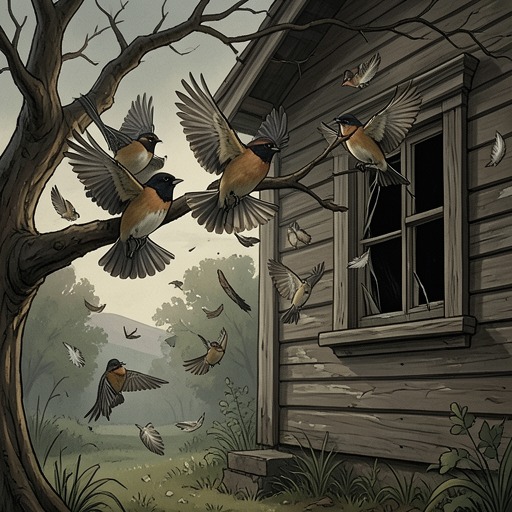
Nancy first notices the parrot when her flashlight beam falls on a large cage near the door. The bird is brilliantly colored, visually distinct from the golden Canaries in their gilded cages elsewhere in the room. Around them are ugly stuffed specimens on the walls and pedestals, so the chamber combines living birds with mounted ones. The parrot is not merely part of the room’s background: its cage and sudden movement draw Nancy’s attention at the moment she is preparing to leave.
The light makes the parrot visible, but Nancy quickly recognizes that visibility carries a risk. As the bird begins to stir restlessly, she turns the flashlight toward another part of the room, apparently trying not to provoke it or draw attention to herself. The attempt comes too late. The distinction between the parrot’s brightly colored appearance and the room’s stuffed specimens is therefore also a practical one: this bird is alive, responsive, and capable of changing the course of Nancy’s investigation.
The Encounter
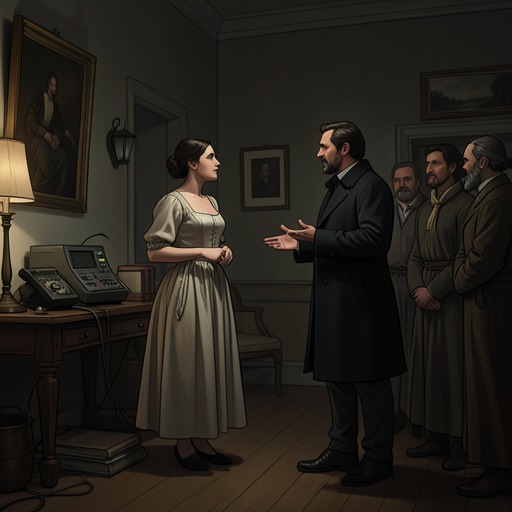
The parrot squawks just as Nancy is nearing the door. Its cry is followed by the repeated phrase, “Go ’way! Go ’way! Polly wants a cracker!” The words are conspicuous in the darkness, and Nancy immediately understands that the sound may bring someone to investigate. She rushes toward the door, but hears a heavy step on the stairs as she opens it. A woman is coming to find out what happened, leaving Nancy with no clear way to slip into the corridor unnoticed.
Nancy’s response makes the bird’s immediate effect plain. She is thoroughly alarmed and blames the parrot for putting her in trouble. Rather than risk going out as the woman approaches, she softly closes the door. A glance toward the stairway confirms that escape into the corridor is no longer a realistic option. The woman, carrying an oil lamp, has nearly reached the landing; Nancy’s only advantage is that the older woman is fat and awkward and cannot move swiftly.
The parrot continues to complicate the situation after Nancy shuts the door. Now fully awake, it flutters angrily around its cage and squawks louder than before, repeating “Go ’way! Go ’way!” Nancy murmurs for it to be quiet. Her whispered rebuke cannot undo the earlier alarm, and the bird’s renewed noise threatens to keep drawing attention while the woman is nearby.
Narrative Function
The parrot’s role is sharply concentrated in this encounter: it is an unintentional alarm. Nancy’s investigation depends on moving quietly and leaving before anyone discovers her, but the bird interrupts that plan without warning. Its cry connects a small, local occurrence—the movement of a caged animal—to the larger danger of being caught inside the room. The heavy stairway step supplies the consequence at once, so the sound is not an incidental bit of animal behavior; it creates the scene’s immediate obstacle.
The episode also contrasts the bird’s repeated, familiar-sounding phrase with Nancy’s urgent circumstances. The parrot’s words do not provide her with a clue or explain the room. Instead, they draw attention to the gap between its routine vocalization and the danger that sound creates for a person trying to remain concealed. Its restless fluttering and louder squawks extend that danger even after Nancy has closed the door. In this brief appearance, the parrot is neither an ally nor a deliberate adversary: it is a living presence whose ordinary noise has consequences Nancy cannot control.