Rosemary Turnbull
The Hidden StaircaseRosemary Turnbull is one of the two elderly sisters at the center of the mystery surrounding The Mansion. She first brings the problem to Nancy Drew through Abigail Rowen, and remains an active participant as the investigation moves from unexplained disturbances to evidence against Nathan Gombet. Her story joins personal attachment to place with practical courage: she worries over the danger Nancy faces, but later accompanies her to demand that the authorities act.
Identity and Introduction
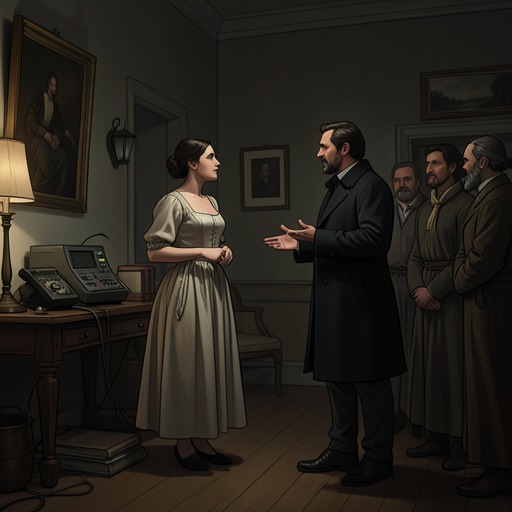
Rosemary is an elderly unmarried woman who lives in Cliffwood with her twin sister, Floretta Turnbull. When Nancy meets her at Abigail’s home, Rosemary is described as tall and rather thin, dressed in an old-fashioned high-necked gown with a long, wide skirt. Her appearance might suggest severity, but the narrative emphasizes her kind face and Nancy’s immediate attraction to her. Abigail presents Nancy as a capable young woman who has already helped her, making Rosemary’s introduction also the beginning of a request for assistance.
Rosemary’s bond with Floretta defines the stakes of the mystery from the outset. The sisters have shared their home for thirty years, and the strange events threaten the security of a life established there together. Rosemary does not describe herself as living alone: when Nancy asks about the household, she explains that her twin lives with her. Their joint presence continues throughout the investigation, with the sisters accompanying one another and confirming each other’s account.
The Mansion and the Disturbances
Rosemary explains that The Mansion was built before the Civil War, an age that makes its setting seem suited to a ghost story. The sisters had lived there undisturbed for three decades. Only in the recent weeks before Nancy’s involvement had strange, inexplicable events begun. The sounds were not confined to the attic; Rosemary says they seemed to come from all parts of the house. Her account therefore establishes both the long quiet that preceded the mystery and the unsettling breadth of its new disturbances.
The disturbances are frightening partly because they invade a familiar home. Rosemary and Floretta know the house as the place where they have lived together for years, yet its noises make ordinary rooms seem uncertain. The old building’s age invites a supernatural explanation, but Rosemary approaches Nancy for help rather than treating the haunting as solved. Her account gives the mystery a human stake: the question is not simply what makes the noises, but whether the sisters can remain safe in their home.
Trust in Nancy and Fear for Her Safety
Rosemary’s confidence in Nancy is accompanied by anxiety about the risks of investigating. Before Nancy proceeds with a dangerous undertaking at the house, Rosemary asks whether she is certain she wants to continue and says that she would never forgive herself if anything happened to her. Nancy assures her that she does not expect anything serious to happen, but Rosemary admits that she cannot share that confidence. The exchange marks a distinction between Nancy’s determination to solve the case and Rosemary’s protective concern for the person helping her.
Her worry does not become an attempt to take control away from Nancy. Rosemary voices the danger plainly, then continues to work with her and Floretta. That combination—fear without withdrawal—recurs in her role: she is not the detective, but she is neither passive nor indifferent. Her concern reflects the personal trust formed between the women, while her continued participation helps carry the sisters’ knowledge into the investigation.
From Householder to Advocate
After Nancy has made her discoveries, Rosemary and Floretta accompany her to the sheriff. Nancy quickly explains the strange events and what she has found; both sisters corroborate her account. Rosemary is impatient when the sheriff hesitates because he has never heard of Nathan Gombet doing harm. Her sharp response that there is always a first time cuts through his reliance on reputation. She treats the sisters’ experience as evidence that deserves attention, not as a ghost story to be dismissed.
The sheriff accepts that Nancy’s account is credible but says he cannot proceed without proof. Nancy offers to show him the staircase, and the sisters’ presence gives the discoveries a direct connection to the house and the people affected by them. Rosemary’s participation thus helps convert private fear into a public accusation. She stands beside Nancy in asking the authorities to act, even as the sheriff insists on the distinction between believing their story and having evidence sufficient for an arrest.
Rosemary also notices an unresolved practical detail in the theft of The silver urn. She cannot understand how Gombet could have taken it from the library and reached the staircase without passing the sisters’ bedrooms, where they might have heard him. Nancy shares the puzzle and proposes that another opening to the staircase may exist on the floor below. Rosemary’s question keeps attention on the mechanics of the crime: the hidden route must explain not only the apparent haunting but also how valuable objects disappeared without detection.
Recovery, Accountability, and Gratitude
Once Gombet is confronted, Rosemary makes clear that the sisters intend to charge him with trying to force them out of their home. The threat to their property is therefore distinct from the thefts: the sisters accuse him not only of taking their belongings but of trying to make them leave. When Gombet denies knowing what has been stolen, Floretta names The silver urn and a diamond pin; Rosemary adds a pocketbook, a silver spoon, and Floretta’s silk dresses. Her precise list restores the crimes to the scale of household losses rather than leaving them as a general accusation.
The sisters’ possessions are found in Gombet’s house. Nancy hurries to the bedroom, with Rosemary and Floretta following, and the two women find The silver urn standing on a dresser. Rosemary rushes forward and takes it up, relieved that it has not been disposed of. Floretta finds an armful of dresses in a closet. These recoveries give the sisters direct confirmation that the thefts were not imagined and that the objects taken from their home can be returned.
Rosemary’s final gesture is to offer Nancy the urn as a remembrance rather than a monetary reward. Nancy protests that it is a valuable heirloom the sisters prize, while Floretta insists that they want her to have it and would feel hurt if she refused. The offer expresses the gratitude both sisters feel toward Nancy, but the evidence leaves Nancy’s eventual response unresolved. Rosemary’s arc ends, accordingly, not with a change in her attachment to the family heirloom but with her attempt to turn it into a lasting token of the help that secured their home and recovered their possessions.