The Mansion
The Hidden StaircaseThe Mansion is the ancestral home of Rosemary Turnbull and Floretta Turnbull in Cliffwood, a decaying stone residence where a recent run of unexplained disturbances gives the sisters’ old house a new, threatening aspect. Its history, secluded setting, and concealed staircase make it more than a backdrop: the building’s layered past and unexplored spaces shape both the mystery and the way its inhabitants experience it.
Setting and Appearance
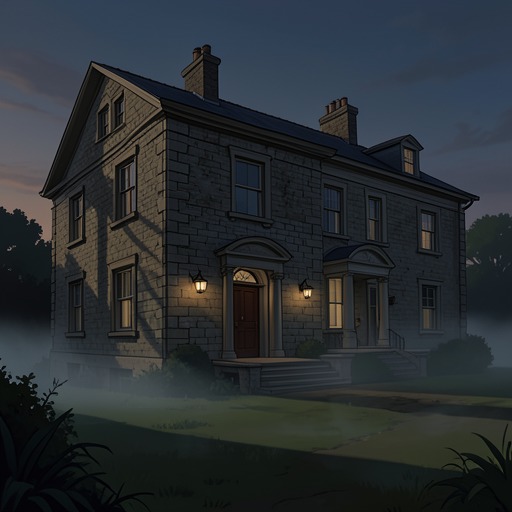
The Mansion stands in an isolated spot on the outskirts of Cliffwood. A winding driveway leads to it through tall oak and maple trees that partly screen the house from the road. Nancy Drew first sees it near dusk, when the trees cast shifting shadows on the stone walls. The two large turrets at the front make the residence resemble a ruined castle, an impression reinforced by the building’s age and its weathered exterior.
The house is a massive structure of white stone, now blackened and crumbling with the passage of decades. Its scale recalls a time when the Turnbull family could sustain a grand residence; by the time Nancy visits, the mansion’s former glory has ebbed alongside the family fortune. The contrast between imposing form and visible decline gives the house a double character: it still suggests status and permanence, yet also appears vulnerable to time and neglect.
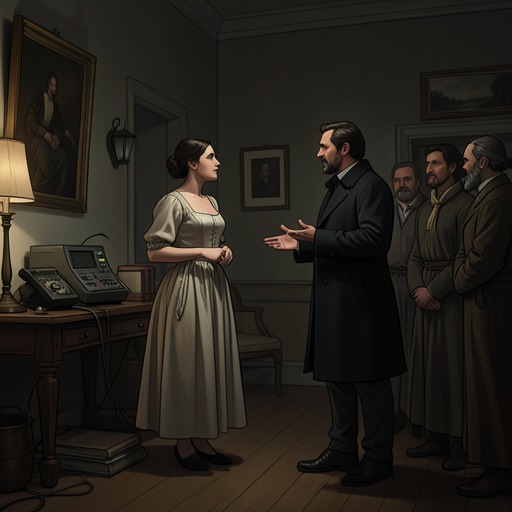
Inside, the spacious rooms preserve the signs of an earlier prosperity. The living room contains old-fashioned Colonial furniture, while massive gold-framed portraits of Turnbull ancestors line the walls. The sisters keep the house locked during the recent period of disturbances. These details make its grand domestic past tangible even as its present condition and the sisters’ limited means show how much has changed.
Family History and Inhabitants
Rosemary and Floretta, twin sisters, live together in The Mansion. They have lived there for thirty years, and the property has never passed out of the Turnbull family. Rosemary explains that the house was built in the early days, when stone houses were unusual, and that it has been remodeled many times while retaining its original walls. She thinks it possible that a concealed feature was installed during a remodeling in Civil War times as a protective measure, although neither sister knows of any secret panels or trapdoors.
The portraits give Nancy a view of the family’s former standing in Cliffwood: the Turnbulls had once been the town’s leading family. Rosemary and Floretta are the last of the line, and the family fortune has dwindled until their income is sufficient for their needs but little more. Their family name nevertheless continues to secure them a welcome in the best of society. One portrait depicts Rosemary’s great-great-grandfather, who fought in the American Revolution. The sisters’ continued residence in the family home therefore joins inherited status to a more modest present, while the old walls preserve a history far longer than either sister’s knowledge of the building’s concealed features.
The Disturbances and Nancy’s Visit
Rosemary does not claim that the house is truly haunted; she says she does not believe in ghosts. What unsettles her and Floretta is that strange things have begun happening only in the last few weeks, including noises at night. The sisters describe the incidents as mostly little things, but their accumulation wears on them. The old, secluded house offers an apt setting for such fears, without establishing that anything supernatural is taking place.
When Nancy arrives, the physical setting initially deepens the unease: the trees throw ghostlike shadows across the stone, and she feels unsettled as she drives up to the house. The atmosphere belongs to her first impression, not to proof of a haunting. Once she enters, the evidence of a lived-in family home—the spacious rooms, familiar furniture, and ancestral portraits—sits alongside the sisters’ anxiety and the locked doors. The house thus brings together ordinary domestic life and the frightening uncertainty of its recent disturbances.
Nancy’s presence soon affects the sisters’ mood. After she arrives, they become more cheerful; Floretta, who has been feeling unwell, says she feels much better, gets dressed, and comes downstairs in notably good spirits for luncheon. The change marks the house not only as a source of fear but also as a place where the sisters’ apprehension can ease through Nancy’s company and investigation.
Hidden Architecture and Narrative Role
The Mansion’s history makes a secret feature plausible without confirming one. Rosemary knows of no trapdoor or panel, but admits that the sisters have not carefully examined the entire house. Her suggestion that a concealed construction might date from the remodeling in Civil War times gives the possibility a specific historical context while leaving it unresolved. The original walls have endured through repeated alterations; the house’s long continuity has not made every part of it known to its present occupants.
That gap between familiarity and knowledge becomes concrete when Nancy discovers a hidden staircase. She shows the open trapdoor to Rosemary and Floretta, who are astonished to find it in their own house. Rosemary recalls rumors of a staircase but says she never believed them; both sisters realize that they have been in the attic many times without noticing the entrance. The discovery overturns the assumption that decades of residence amount to full knowledge of a home. The sisters’ ordinary attic, repeatedly visited but never fully understood, becomes the threshold to a concealed part of the building.
The Mansion’s significance therefore rests on a contrast between what it shows and what it withholds. Its turrets, portraits, and declining stone exterior expose the visible history of the Turnbull family, while the hidden staircase reveals that even the family’s most familiar space contains an overlooked secret. The haunting fears first make the old house seem uncanny; Nancy’s discovery redirects attention from ghosts to concealed architecture. In that movement, The Mansion remains mysterious without needing a supernatural explanation: its age, family history, and undiscovered spaces supply the mystery’s real substance.