The Mansion’s alleged haunting
The Hidden StaircaseThe Mansion’s alleged haunting makes the Turnbull sisters’ home seem subject to supernatural danger, but the story ultimately directs attention away from ghosts and toward human deception. Nancy Drew’s investigation, the servant’s role in Nathan Gombet’s crimes, and Floretta’s closing joke about ghosts all recast the haunting as an atmosphere manufactured around a mystery that can be solved.
Appearance and Investigation
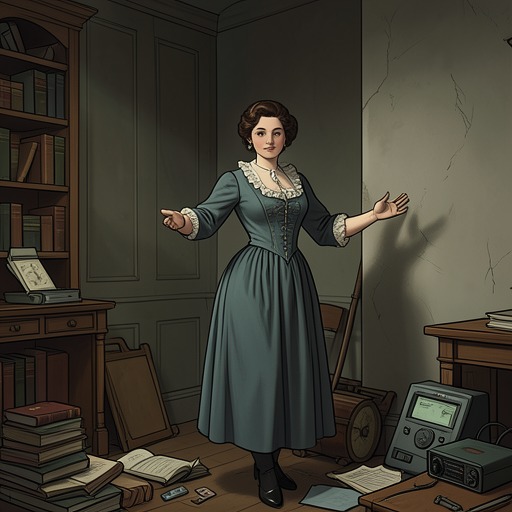
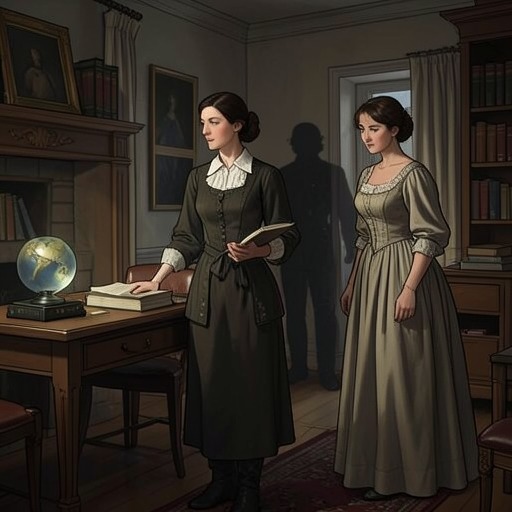
The haunting reaches the sheriff as part of a larger pattern of strange events at the Turnbull home. Nancy Drew gives a direct account of those events and of the discoveries she has made, while Rosemary Turnbull and Floretta Turnbull corroborate her story. She then identifies Nathan Gombet as the guilty man and asks the sheriff to arrest him. The contrast is central to the haunting’s function: what might initially seem to demand a supernatural explanation is presented to the authorities as a set of incidents with a human suspect and investigable causes.
The investigation’s danger is made concrete at Gombet’s house in Cliffwood. When Carson Drew arrives there, intent on reaching his daughter, Gombet leads him through the kitchen, where a woman is working at the stove. Gombet gives her a significant nod as he passes; once the two men enter the next room, she quietly locks the outside door. The action links the apparent haunting’s wider criminal context to deliberate cooperation and concealment, rather than to anything otherworldly.
The Servant and the Criminal Scheme
Nancy encounters the same servant during her nighttime approach to Gombet’s house. With Gombet gone, Nancy had hoped to find the house empty, but through the kitchen window she sees the woman washing dishes. Her presence makes Nancy’s mission more dangerous and forces her to consider the risk of discovery. The episode shifts the suspense from an unseen haunting to a person who may be guarding the house and its secrets.
In the cellar, the servant searches with a flashlight after hearing a noise. Nancy, hidden nearby, fears that the woman will come down and find her. Later, when the sheriff opens a door at Gombet’s house, he finds the servant holding a sawed-off shotgun. The weapon gives physical form to the threat that had earlier been experienced as suspense and suspicion: the danger is not a ghostly presence but a human defender of the criminal household.
Nancy questions the captured woman about Gombet and accuses her of being not merely his servant but his partner in crime. The woman denies knowing where he is and presents herself as an ordinary worker; Nancy rejects this account and warns that she will be jailed if she does not tell the truth. Her denial, set against the earlier locked door and the shotgun, underscores how the haunting’s mystery depends on concealed human actions and misleading appearances.
Resolution and Meaning
The story’s final treatment of ghosts is deliberately light. After Carson Drew has been rescued and is staying at The Mansion to recover, Floretta jokes that there will be no ghosts to trouble him. The line turns the house’s former menace into a subject for laughter and implies that the haunting no longer has power over its residents. Nancy, for her part, says that she enjoys a mystery, though for a time she thought this one would prove her undoing. Her retrospective comment preserves the real suspense of the haunting while locating it in the risks of investigation rather than in supernatural forces.
The alleged haunting thus works as a mystery structure: it makes the home’s strange events frightening enough to demand explanation, then redirects attention toward clues, accomplices, and physical threats. The available evidence does not detail every incident behind the Turnbull sisters’ account, but it does establish the decisive change in interpretation: the story’s concluding assurance is not that ghosts have been appeased, but that the danger associated with them has passed with the exposure of the human criminal scheme.