The Mansion’s apparent haunting
The Hidden StaircaseThe Mansion’s apparent haunting is a sustained appearance of supernatural disturbance that threatens to drive Rosemary Turnbull and Floretta Turnbull from their family home. Its noises, shadows, and disquieting music initially resist explanation, but Nancy Drew’s investigation connects them to Nathan Gombet’s secret access through the passage between the two houses. The haunting therefore works both as a source of genuine fear for the sisters and as the disguise for a human campaign of intrusion and theft.
The Signs and Their Setting
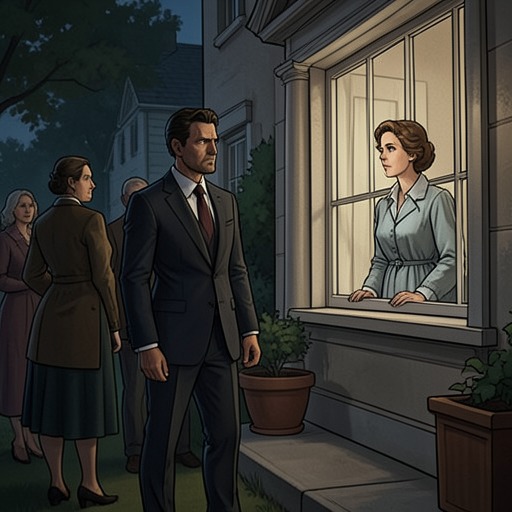
Rosemary introduces the trouble as a haunted-house problem, while making clear that she does not believe the house is literally haunted. That distinction defines the uncertainty at the center of the account: the sisters cannot explain what is happening, but Rosemary resists treating ghosts as the explanation. The Mansion, their old family residence, offers a setting in which such fears can take hold. It was built before the American Civil War, and Rosemary presents its age as the kind of circumstance that makes a ghost story seem plausible.
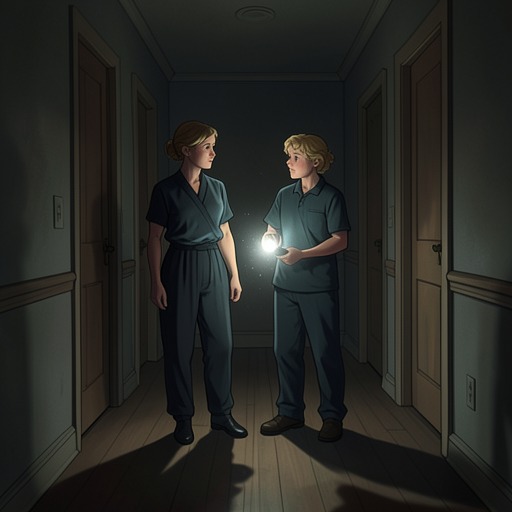
The disturbances have a specific recent onset. Rosemary says that she and Floretta have lived in the house for thirty years without being troubled, and that the unexplained events began only in the last few weeks. Sounds occur at night and, contrary to Nancy’s initial suggestion, are not confined to the attic: the sisters hear them in different parts of the house. They have inspected the property and are careful to keep doors and windows closed, so ordinary entry through those points does not readily account for what they hear.
The phenomena include visual as well as auditory disturbances. Rosemary reports strange shadows moving across the walls; Floretta believes that she once saw a human-shaped shadow. The report belongs to Floretta’s perception, not to a confirmed apparition, and Rosemary’s account preserves that difference. The shadows nevertheless help turn unexplained activity into an apparent presence: something seems to move inside a house whose residents cannot identify an intruder.
Music adds a more distinct and unsettling sign. Rosemary says that, one night the previous week, she clearly heard someone playing a stringed instrument. When the music is heard again on the night before Nancy’s arrival, Rosemary again identifies its likely source only tentatively, suggesting that it might have been a guitar. The recurrence makes the sound more than a single misheard event in the sisters’ account, while leaving its maker unseen.
Fear and the Threat of Departure
The disturbances have different effects on the two sisters. Floretta is increasingly persuaded that the house is haunted and is frightened enough to say she will become a nervous wreck if she stays another week. She does not want Rosemary to leave her alone even for a few hours, and she wants Rosemary to agree to sell the house. The supposed haunting thus changes daily life: it restricts the sisters’ freedom of movement and makes remaining in their own home feel intolerable.
Rosemary is more skeptical, but skepticism does not protect her from strain. She does not believe in ghosts, yet admits that the events are getting on her nerves. Her face is strained when she recounts them, and she appears not to have slept for several nights. By the time Nancy arrives, the ordeal has worn her down enough that the sisters have decided to leave if Nancy does not come that day. Fear has therefore brought the possibility of selling or abandoning the house close to reality, despite Rosemary’s attachment to it.
That attachment is substantial: The Mansion has belonged to the Turnbull family for decades, and Rosemary does not want to turn it over to a stranger. The conflict is not simply between belief and disbelief. Floretta’s fear presses toward sale, while Rosemary’s skepticism and family loyalty pull against leaving; the unexplained activity threatens to make fear decide what happens to their home.
The Human Explanation
Nancy’s later understanding turns the apparent haunting into evidence of a concealed route and a deliberate intruder. After piecing together what she has learned, she identifies Nathan Gombet as the person who has visited The Mansion repeatedly, frightened the sisters, and stolen their valuables. The house’s apparently sealed boundary has not prevented entry: a secret passage connects it with Nathan Gombet's house, allowing movement between the properties without ordinary doors or windows being opened.
The passage’s history remains partly conjectural. Nancy thinks it may have been built before the American Civil War as protection against marauders, when the Turnbull brothers and the Gombet brothers were friendly. She imagines that the brothers used it to travel between the houses, then closed it after becoming enemies during the war; with time, it was forgotten. The account presents this as Nancy’s reconstruction rather than a fully documented history. She believes Nathan discovered the entrance by accident and then used what he had found to advance his schemes.
The hidden route supplies a practical explanation for how the disturbances could appear throughout the house. Nancy considers it likely that there are openings on each floor, which would let Nathan move from room to room without being discovered and perhaps listen to conversations. She also connects the passage to the threatening note warning her not to interfere in the Turnbulls’ affairs: Nancy is convinced that Nathan learned of her expected arrival after overhearing Rosemary and Floretta discuss the letter.
The thefts likewise cease to look like isolated losses inside a haunted house. Nancy accounts for the pocketbook, silver spoon, urn, pin, and Floretta’s dresses as items Nathan took after entering by the secret staircase. The connection to the passage makes the noises, shadows, intimidation, and missing property parts of one human pattern rather than separate supernatural mysteries.
Narrative Function and Resolution
The apparent haunting depends on a gap between what the sisters experience and what they can see. The closed doors and windows, sounds in multiple rooms, shifting shadows, and unseen music make the house feel occupied by an invisible presence. The later discovery of secret access does not make their fear imaginary: they were responding to real intrusion, but lacked the information needed to identify its source. The supernatural interpretation is thus displaced by a criminal one without erasing the pressure the sisters endured.
The house’s age and forgotten passage give the mystery a historical dimension, but the danger is not an ancient ghost returning. A piece of the property’s past has become useful to a present-day intruder, and its concealed architecture allows him to turn ordinary sounds and movements into seeming evidence of haunting. Nancy’s investigation changes the meaning of the signs by finding a coherent cause for them. Once she has the necessary proof, the pattern that had threatened to drive the Turnbull sisters away can be understood as Nathan Gombet’s calculated use of their home’s hidden connection to his own.