Escape from Wood-elves
The HobbitThe Escape from the Wood-elves, also known as the Barrel Escape, is the pivotal event in which Bilbo Baggins, acting alone and invisible, drugs the Elvenking's butler and the chief guard, steals the keys to the dwarves' cells, and conceals all thirteen dwarves inside empty wine barrels that are then rolled into the Forest River, carrying them out of the Elvenking's halls and through Mirkwood to the eastern edge of the forest, thereby rescuing the entire company from indefinite imprisonment and enabling the quest to continue toward the Lonely Mountain.
Background and Imprisonment
After the battle with the spiders in Mirkwood, Bilbo and the dwarves, starving and exhausted, stumbled upon a group of Wood-elves feasting in the forest. Despite the warnings of Gandalf and Beorn, hunger drove them to approach the elves, and on the third attempt, Thorin Oakenshield stepped into the circle of light and was immediately enchanted and captured. The other dwarves were soon taken as well, bound and blindfolded, and led across a bridge over the Forest River to the Elvenking's halls—a great cave with stone doors, lit by red torches, and filled with twisting passages. Only Bilbo escaped capture by slipping on his magic ring and following unseen. Inside the palace, the Elvenking questioned the dwarves about their purpose, but they refused to reveal their quest for the dragon's treasure. The king ordered each dwarf placed in a separate cell, giving them food and drink but forbidding them to leave until one of them spoke. Thorin was kept in a specially deep, dark dungeon, and the dwarves remained imprisoned for weeks, growing surly and despairing. Bilbo, meanwhile, lived a furtive existence, always wearing his ring, stealing food from the king's stores, and wandering the palace to learn its layout. He eventually discovered Thorin's location and passed secret messages among the dwarves, urging them to remain silent and trust him to devise an escape plan.
The Plan and the Drugging of the Guards
Bilbo's plan took shape when he discovered a water-gate beneath the palace: a stream flowed out from the lowest cellars through a portcullis, and empty barrels were regularly cast through trapdoors into the current, floating down the Forest River to a collection point near the eastern edge of Mirkwood, where they were roped together and sent to Lake-town. The barrels were used to transport wine and goods from the south, and the Elvenking's butler, Galion, was responsible for clearing the cellars. One evening, Bilbo overheard Galion inviting the chief of the guards to taste a new shipment of wine—a potent vintage from the gardens of Dorwinion, meant only for the king's feasts. Seeing his chance, Bilbo followed the two elves into a small cellar, where they drank deeply from large flagons. The wine soon overcame them: the chief guard laid his head on the table and fell fast asleep, and the butler, still talking and laughing to himself, soon followed, snoring beside his friend. Bilbo crept in, took the heavy bunch of keys from the guard's belt, and hurried through the passages, his heart pounding as the keys clinked and clanked despite his efforts to muffle them.
The Escape Through the Barrels
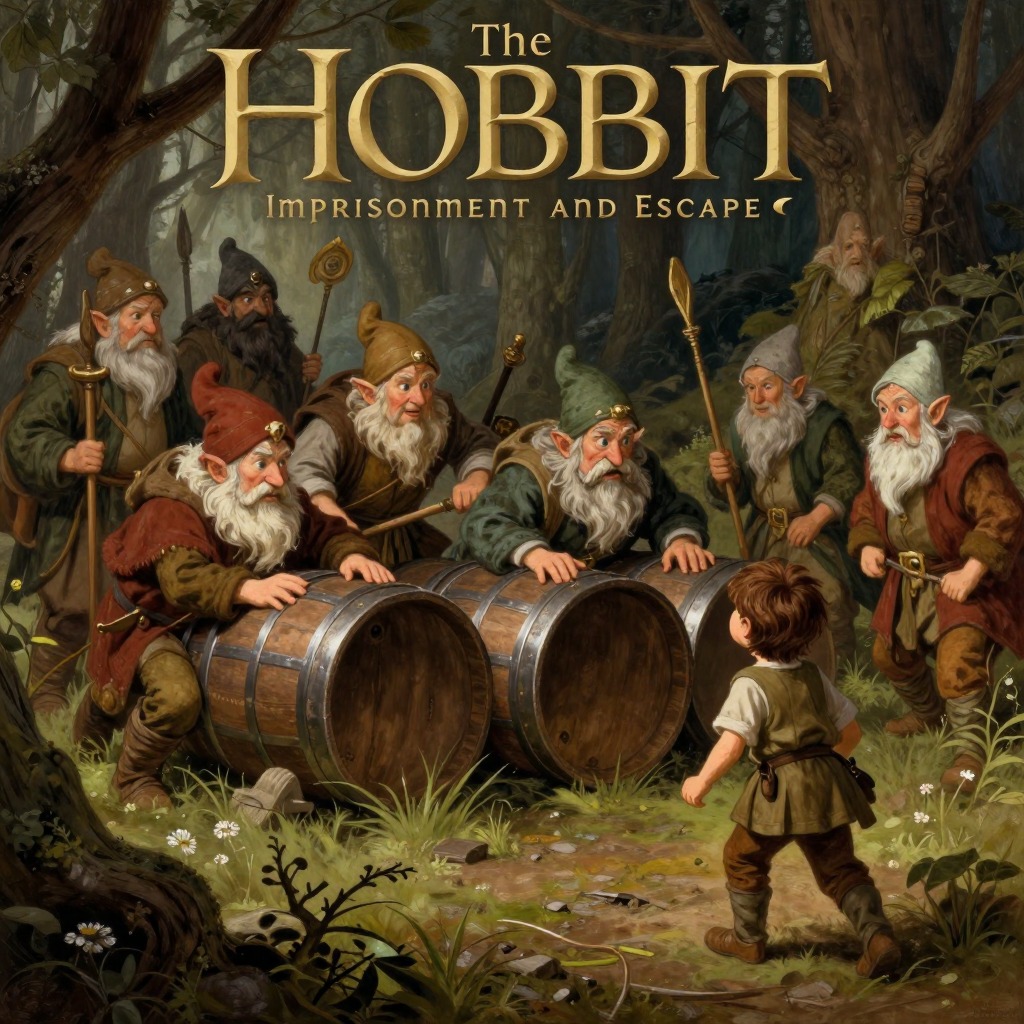
Bilbo unlocked each dwarf's cell in turn, starting with Balin, and led them through the dark, silent corridors to the lowest cellars, where rows of empty barrels stood waiting. The dwarves were horrified when Bilbo explained his plan: they were to climb inside the barrels, and he would close the lids, trusting that the elves would roll them into the river as part of their regular work. Thorin, in particular, grumbled and twisted in his tub, and Balin complained of stifling before his lid was fastened. Bilbo packed straw around the dwarves as best he could and sealed the lids, but he soon realized the fatal flaw in his scheme: there was no barrel for himself, and no one to pack him in. When the elves arrived, laughing and singing, they rolled the barrels—some empty, some containing a dwarf each—to the dark opening and pushed them over the edge into the cold water below. In desperation, as the last barrel was being rolled to the doors, Bilbo caught hold of it and was pushed over with it, falling into the icy river with the barrel on top of him. He came up spluttering, clinging to the wood like a rat, but could not climb onto it; the barrel rolled and ducked him under repeatedly. The trapdoors boomed shut, and he was alone in the dark tunnel, floating among the bobbing casks. The water-gate creaked open, and the barrels passed under the low arch, scraping against the roof, and emerged into the open Forest River. Bilbo managed to scramble onto his barrel when it lodged against a root, and he rode it downstream, shivering and miserable, as the current carried the whole company of casks and tubs away from the Elvenking's halls.
Arrival at the Eastern Edge and Aftermath
The barrels floated down the Forest River until it widened and joined the main watercourse, then swept toward the north bank, where a shallow bay with a shingly shore had been formed. There, the barrels ran aground, and men from the lakeside village—raft-elves and boatmen—poled them together, roped them, and left them for the night. Bilbo slipped ashore, wet and cold, and used his ring to steal food from the huts, though he was nearly caught by his sneezes and dripping clothes. The next morning, the raft-elves lashed the barrels into a raft and poled it down the river toward Lake-town, with Bilbo clinging unseen to the casks. The dwarves, bruised, cramped, and half-drowned, were eventually unpacked on the shore of the Long Lake, where Thorin, despite his misery, acknowledged Bilbo's resourcefulness. The escape not only freed the company from captivity but also brought them to the very edge of Mirkwood, setting them on the final stage of their journey to the Lonely Mountain. The Elvenking, upon learning of the escape, guessed the dwarves' true errand and sent spies to watch the lake, but he did not pursue them, believing they would come to a bad end. The event marked a turning point in Bilbo's reputation among the dwarves: they now regarded him with genuine respect, and Thorin himself admitted that Gandalf had spoken truly about the hobbit's worth.