Gollum
The HobbitGollum is a small, slimy, dark-dwelling creature who lives on a subterranean lake deep under the Misty Mountains, and his encounter with Bilbo Baggins in the chapter "Riddles in the Dark" is a pivotal turning point in the story, as it leads to Bilbo's discovery of the One Ring and sets the stage for the larger conflicts of Middle-earth.
Identity and Background
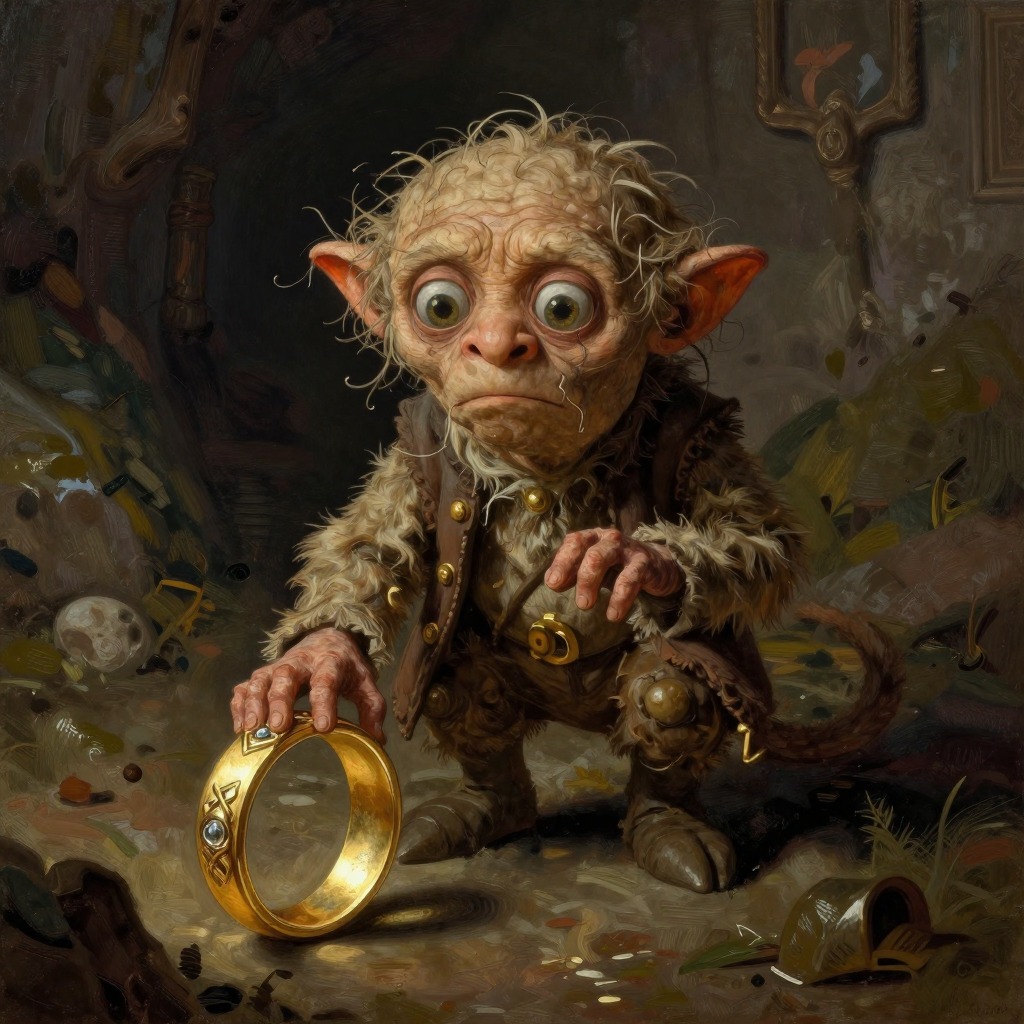
Gollum is described as a "small slimy creature," as dark as the darkness around him except for two big round pale eyes in his thin face. He lives on a slimy island of rock in the middle of a wide, deep, and deadly cold lake, where he rows about quietly in a little boat, paddling with large feet dangling over the side, never making a ripple. He survives by catching blind fish with his long fingers, but he also likes meat, particularly goblin, which he throttles from behind if they come down alone near the water. His name comes from the horrible swallowing noise he makes in his throat when he says "gollum," though he always calls himself "my precious." His origins are mysterious: he once lived with his grandmother in a hole in a bank by a river, long ago, before he lost all his friends and was driven away, alone, and crept down into the dark under the mountains. He has been underground for so long that he has forgotten ordinary above-ground things like the sun on daisies.
The Riddle-Game and the Ring
When Bilbo, lost and alone in the goblin tunnels, stumbles upon Gollum's lake, Gollum approaches him with the intention of eating him, but he is curious and not very hungry at the moment, so he proposes a riddle-game. The rules are simple: if Bilbo asks a riddle and Gollum cannot answer, Gollum will show him the way out; if Gollum asks and Bilbo cannot answer, Gollum will eat him. The game is sacred and of immense antiquity, and even wicked creatures are afraid to cheat at it. Gollum asks riddles about mountains, wind, dark, time, and a devouring force, while Bilbo answers with riddles about teeth, chestnuts, eggs, fish, and a box without hinges. The game reaches a crisis when Bilbo, unable to think of a riddle, asks aloud, "What have I got in my pocket?"—a question that is not a genuine riddle according to ancient laws. Gollum, furious, demands three guesses, but fails each time. He is bound by his promise, but he is angry and hungry, and he has a plan. He goes to his island to fetch his "birthday-present," a golden ring that makes its wearer invisible. He intends to use it to murder Bilbo. However, he discovers the ring is missing; Bilbo had found it earlier in the tunnel and put it in his pocket without knowing its power. Gollum, in a rage of loss and suspicion, realizes Bilbo must have it and attacks him. Bilbo, fleeing, accidentally slips the ring on his finger and becomes invisible, allowing him to escape Gollum and follow him to the back-door of the goblin tunnels.
Relationship with Bilbo and the Ring
Gollum's entire existence is centered on the ring, which he calls "my precious" and his "birthday-present." He has had it for ages, using it to become invisible and hunt goblins, and he is terrified of losing it. When Bilbo takes it, Gollum is consumed by hatred and despair, crying out, "Thief, thief, thief! Baggins! We hates it, we hates it, we hates it for ever!" This moment establishes a deep, personal enmity between them, one that will echo through the later history of Middle-earth. Bilbo, for his part, feels a sudden understanding and pity mixed with horror for Gollum—a glimpse of endless unmarked days without light or hope of betterment, hard stone, cold fish, sneaking and whispering. This pity stays his hand when he could have killed Gollum, a decision that proves crucial in the later story of the Ring.
Thematic Significance
Gollum serves as a dark mirror to Bilbo, embodying the corrupting power of the Ring and the consequences of a life lived in isolation and obsession. He is a creature of pure appetite and possessiveness, whose humanity has been eroded by centuries of darkness and the Ring's influence. His encounter with Bilbo is a test of the hobbit's character: Bilbo's mercy, his cleverness, and his ability to resist the Ring's immediate temptation (he does not use it to kill Gollum) mark him as a different kind of hero. Gollum's cry of "Thief!" also foreshadows the moral complexities of the Ring's ownership, a theme that will dominate the sequel. In the end, Gollum is defeated, but not destroyed; he remains a lurking threat, a reminder that the adventure is not truly over, and that the Ring's power will continue to shape the fate of all who come near it.