Lake-town
The HobbitLake-town, called Esgaroth by the elves, is a human settlement built entirely on wooden piles driven into the Long Lake, a vast body of water fed by the Forest River and the Running River. The town is not built on the shore but out on the surface of the lake, protected from the swirl of the entering river by a promontory of rock that forms a calm bay. A great bridge made of wood runs out to the town, which is constructed on huge piles made of forest trees. It is a busy wooden town, not of elves but of Men, who still dare to dwell here under the shadow of the distant dragon-mountain. They thrive on the trade that comes up the great river from the South and is carted past the falls to their town. In the great days of old, when Dale in the North was rich and prosperous, they had been wealthy and powerful, with fleets of boats on the waters, some filled with gold and some with warriors in armour, and there had been wars and deeds which were now only a legend. The rotting piles of a greater town could still be seen along the shores when the waters sank in a drought. Men remember little of all that, though some still sing old songs of the dwarf-kings of the Mountain, Thror and Thrain of the race of Durin, and of the coming of the Dragon, and the fall of the lords of Dale. Some sing too that Thror and Thrain would come back one day and gold would flow in rivers, through the mountain-gates, and all that land would be filled with new song and new laughter. But this pleasant legend does not much affect their daily business.
Arrival of Thorin and Company
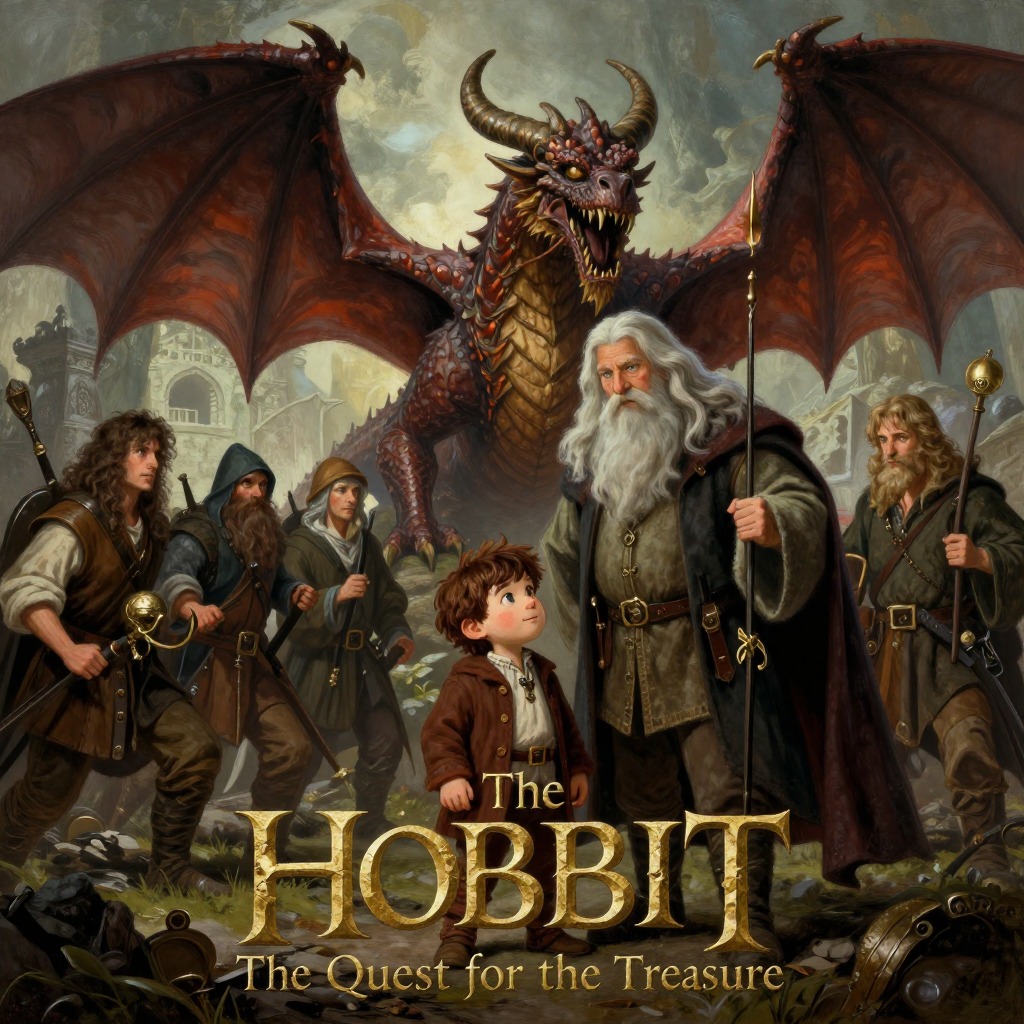
When Thorin Oakenshield, Fili, Kili, and Bilbo Baggins arrive at the great bridge, the guards are drinking and laughing by a fire in their hut, not keeping very careful watch, for it is so long since there had been any real need. Their astonishment is enormous when Thorin steps in through the door and announces himself as "Thorin son of Thrain son of Thror King under the Mountain!" The news spreads like fire through all the town. People begin to sing snatches of old songs concerning the return of the King under the Mountain; that it is Thror's grandson not Thror himself that has come back does not bother them at all. The Master of Lake-town, who gives his mind to trade and tolls, to cargoes and gold, hesitates and looks from one to another, wishing for no enmity with the powerful Elvenking. But the general clamour forces him to obey, and he gives up to Thorin his own great chair, setting Fili and Kili beside him in places of honour. Even Bilbo is given a seat at the high table. Soon the other dwarves are brought into the town amid scenes of astonishing enthusiasm. They are all doctored, fed, housed, and pampered in the most delightful and satisfactory fashion. A large house is given up to Thorin and his company; boats and rowers are put at their service; and crowds sit outside and sing songs all day, or cheer if any dwarf shows so much as his nose. Some of the songs are old ones; but some are quite new and speak confidently of the sudden death of the dragon and of cargoes of rich presents coming down the river to Lake-town. These are inspired largely by the Master and do not particularly please the dwarves, but in the meantime they are well contented and quickly grow fat and strong again. Within a week they are quite recovered, fitted out in fine cloth of their proper colours, with beards combed and trimmed, and proud steps. Thorin looks and walks as if his kingdom is already regained and Smaug chopped up into little pieces.
The Master's Pragmatism and the Town's Enthusiasm
The Master of Lake-town is a practical man who owes his position to his habit of giving his mind to trade and tolls, to cargoes and gold. He does not think much of old songs, and he is surprised and a little frightened when Thorin begins to think of departure, wondering if Thorin is after all really a descendant of the old kings. He had never thought that the dwarves would actually dare to approach Smaug, but believed they were frauds who would sooner or later be discovered and be turned out. He is not sorry at all to let them go. They are expensive to keep, and their arrival has turned things into a long holiday in which business is at a standstill. "Let them go and bother Smaug, and see how he welcomes them!" he thinks. When Thorin speaks to him and his councillors, the Master says, "You must claim your own. The hour is at hand, spoken of old. What help we can offer shall be yours, and we trust to your gratitude when your kingdom is regained." So one day, although autumn is now getting far on, and winds are cold, and leaves are falling fast, three large boats leave Lake-town, laden with rowers, dwarves, Mr. Baggins, and many provisions. Horses and ponies have been sent round by circuitous paths to meet them at their appointed landing-place. The Master and his councillors bid them farewell from the great steps of the town-hall that go down to the lake. People sing on the quays and out of windows. The white oars dip and splash, and off they go north up the lake on the last stage of their long journey. The only person thoroughly unhappy is Bilbo.
Smaug's Attack and the Town's Destruction
When Smaug, enraged by the theft of a cup and by Bilbo's riddling talk, flies south towards the Running River, the men of Lake-town are mostly indoors, for the breeze is from the black East and chill. A few are walking on the quays, watching the stars shine out from the smooth patches of the lake. Suddenly a great light appears in the low place in the hills and the northern end of the lake turns golden. People shout, "The King beneath the Mountain! His wealth is like the Sun, his silver like a fountain, his rivers golden run! The river is running gold from the Mountain!" But a grim-voiced man runs hotfoot to the Master. "The dragon is coming or I am a fool!" he cries. "Cut the bridges! To arms! To arms!" Warning trumpets are suddenly sounded, and echoed along the rocky shores. The cheering stops and the joy is turned to dread. So it is that the dragon does not find them quite unprepared. Every vessel in the town is filled with water, every warrior is armed, every arrow and dart is ready, and the bridge to the land is thrown down and destroyed, before the roar of Smaug's terrible approach grows loud, and the lake ripples red as fire beneath the awful beating of his wings. Amid shrieks and wailing and the shouts of men he comes over them, sweeps towards the bridges and is foiled! The bridge is gone, and his enemies are on an island in deep water—too deep and dark and cool for his liking. Roaring he sweeps back over the town. A hail of dark arrows leaps up and snaps and rattles on his scales and jewels, and their shafts fall back kindled by his breath burning and hissing into the lake. Fire leaps from the dragon's jaws. He circles for a while high in the air above them lighting all the lake; the trees by the shores shine like copper and like blood with leaping shadows of dense black at their feet. Then down he swoops straight through the arrow-storm, reckless in his rage, taking no heed to turn his scaly sides towards his foes, seeking only to set their town ablaze. Fire leaps from thatched roofs and wooden beam-ends as he hurtles down and past and round again, though all had been drenched with water before he came. Once more water is flung by a hundred hands wherever a spark appears. Back swirls the dragon. A sweep of his tail and the roof of the Great House crumbles and smashes down. Flames unquenchable spring high into the night. Another swoop and another, and another house and then another springs afire and falls; and still no arrow hinders Smaug or hurts him more than a fly from the marshes. Already men are jumping into the water on every side. Women and children are being huddled into laden boats in the market-pool. Weapons are flung down. There is mourning and weeping, where but a little time ago the old songs of mirth to come had been sung about the dwarves. Now men curse their names. The Master himself is turning to his great gilded boat, hoping to row away in the confusion and save himself. Soon all the town would be deserted and burned down to the surface of the lake.
Bard's Slaying of Smaug and the Aftermath
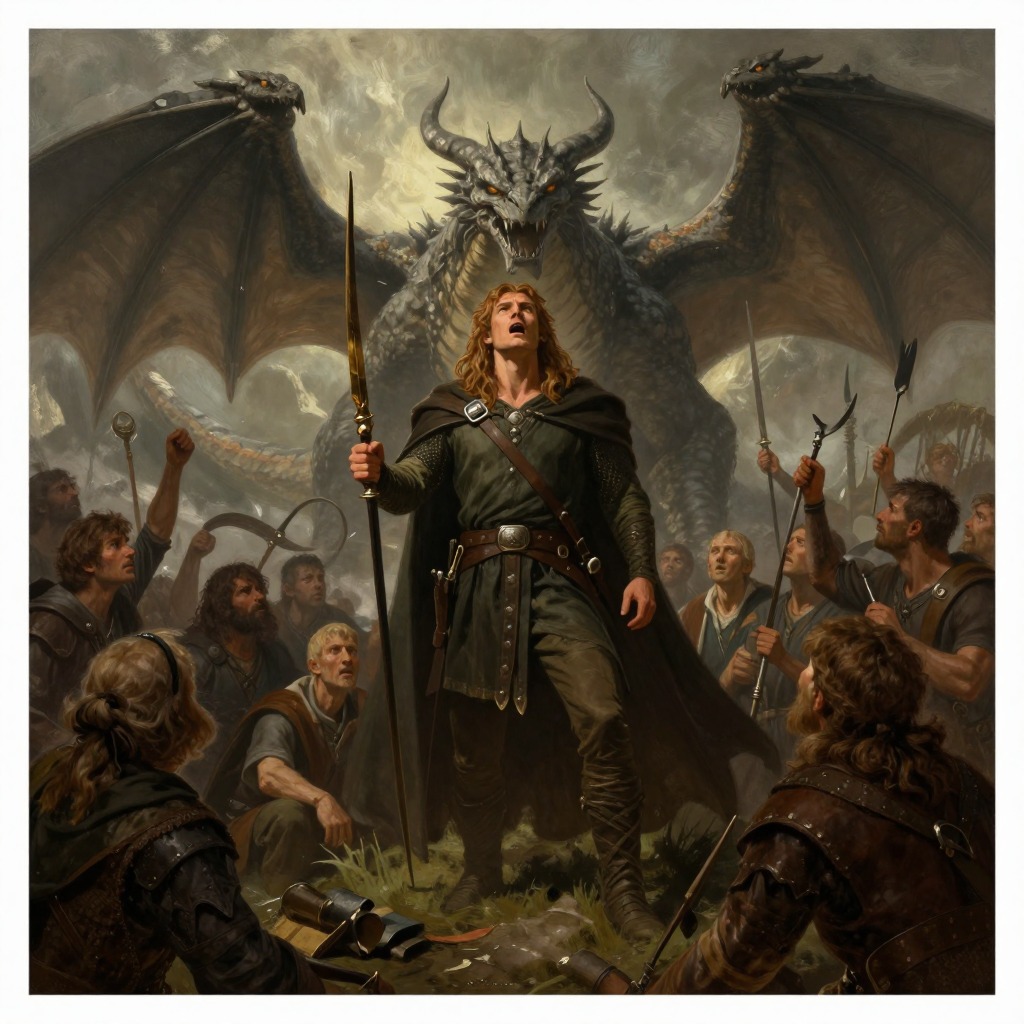
But there is still a company of archers that holds their ground among the burning houses. Their captain is Bard, grim-voiced and grim-faced, a descendant in long line of Girion, Lord of Dale, whose wife and child had escaped down the Running River from the ruin long ago. He shoots with a great yew bow, till all his arrows but one are spent. The flames are near him. His companions are leaving him. He bends his bow for the last time. Suddenly out of the dark something flutters to his shoulder—an old thrush. Unafraid it perches by his ear and brings him news. Marvelling he finds he can understand its tongue, for he is of the race of Dale. "Wait! Wait!" it says to him. "The moon is rising. Look for the hollow of the left breast as he flies and turns above you!" And while Bard pauses in wonder it tells him of tidings up in the Mountain and of all that it has heard. Then Bard draws his bow-string to his ear. The dragon is circling back, flying low, and as he comes the moon rises above the eastern shore and silvered his great wings. "Arrow!" says the bowman. "Black arrow! I have saved you to the last. You have never failed me and always I have recovered you. I had you from my father and he from of old. If ever you came from the forges of the true king under the Mountain, go now and speed well!" The dragon swoops once more lower than ever, and as he turns and dives down his belly glittered white with sparkling fires of gems in the moon—but not in one place. The great bow twangs. The black arrow speeds straight from the string, straight for the hollow by the left breast where the foreleg is flung wide. In it smites and vanishes, barb, shaft and feather, so fierce is its flight. With a shriek that deafens men, fells trees and splits stone, Smaug shoots spouting into the air, turns over and crashes down from on high in ruin. Full on the town he falls. His last throes splinter it to sparks and gledes. The lake roars in. A vast steam leaps up, white in the sudden dark under the moon. There is a hiss, a gushing whirl, and then silence. And that is the end of Smaug and Esgaroth, but not of Bard. The people gather in mournful crowds upon the western shores, shivering in the cold wind, and their first complaints and anger are against the Master, who had left the town so soon, while some were still willing to defend it. They praise the courage of Bard and his last mighty shot. "If only he had not been killed," they all say, "we would make him a king. Bard the Dragon-shooter of the line of Girion! Alas that he is lost!" And in the very midst of their talk a tall figure steps from the shadows. He is drenched with water, his black hair hangs wet over his face and shoulders, and a fierce light is in his eyes. "Bard is not lost!" he cries. "He dived from Esgaroth, when the enemy was slain. I am Bard, of the line of Girion; I am the slayer of the dragon!" "King Bard! King Bard!" they shout; but the Master grinds his chattering teeth. The Master argues that Girion was lord of Dale, not king of Esgaroth, and that in Lake-town they have always elected masters from among the old and wise. But the people near at hand shout in reply, "We will have King Bard! We have had enough of the old men and the money-counters!" The Master, seeing the general clamour, rises to his feet and speaks very loud and clear, deflecting blame onto the dwarves: "Who aroused the dragon from his slumber, I might ask? Who obtained of us rich gifts and ample help, and led us to believe that old songs could come true? What sort of gold have they sent down the river to reward us? Dragon-fire and ruin!" The result of his words is that for the moment the people quite forget their idea of a new king, and turn their angry thoughts towards Thorin and his company. Bard, however, takes the lead, ordering things as he wishes, though always in the Master's name, and he has a hard task to govern the people and direct the preparations for their protection and housing. He sends speedy messengers up the river to the Forest to ask the aid of the King of the Elves of the Wood, and these messengers find a host already on the move. The Elvenking, when he receives the prayers of Bard, has pity, for he is the lord of a good and kindly people; so turning his march, which had at first been direct towards the Mountain, he hastens down the river to the Long Lake. Only five days after the death of the dragon they come upon the shores and look on the ruins of the town. Their welcome is good, and the men and their Master are ready to make any bargain for the future in return for the Elvenking's aid. Plans are soon made. With the women and the children, the old and the unfit, the Master remains behind; and with him are some men of crafts and many skilled elves, and they busy themselves felling trees, and collecting the timber sent down from the Forest. They set about raising many huts by the shore against the oncoming winter; and also under the Master's direction they begin the planning of a new town, designed more fair and large even than before, but not in the same place. They remove northward higher up the shore; for ever after they have a dread of the water where the dragon lies. He would never again return to his golden bed, but is stretched cold as stone, twisted upon the floor of the shallows. There for ages his huge bones could be seen in calm weather amid the ruined piles of the old town. But few dare to cross the cursed spot, and none dare to dive into the shivering water or recover the precious stones that fell from his rotting carcase. All the men of arms who are still able, and the most of the Elvenking's array, get ready to march north to the Mountain. It is thus that in eleven days from the ruin of the town the head of their host passes the rock-gates at the end of the lake and comes into the desolate lands.
Lake-town's Role in the Siege and After the Battle
Lake-town's men, under Bard's leadership, join the Elvenking's host in the march to the Lonely Mountain, where they besiege Thorin and the dwarves. Bard parleys with Thorin, demanding a share of the treasure as recompense for the destruction of the town and as the dragon-slayer's due. Thorin refuses, and the siege begins. The men of the Lake fight alongside the elves and the dwarves of Dain in the Battle of Five Armies against the goblins and Wargs. After the battle, a fourteenth share of all the silver and gold, wrought and unwrought, is given up to Bard; for Dain says, "We will honour the agreement of the dead, and he has now the Arkenstone in his keeping." Even a fourteenth share is wealth exceedingly great, greater than that of many mortal kings. From that treasure Bard sends much gold to the Master of Lake-town; and he rewards his followers and friends freely. The old Master comes to a bad end. Bard had given him much gold for the help of the Lake-people, but being of the kind that easily catches such disease he falls under the dragon-sickness, and takes most of the gold and flees with it, and dies of starvation in the Waste, deserted by his companions. The new Master is of wiser kind, and very popular, for, of course, he gets most of the credit for the present prosperity. They are making songs which say that in his day the rivers run with gold. Lake-town is refounded and is more prosperous than ever, and much wealth goes up and down the Running River; and there is friendship in those parts between elves and dwarves and men.