Mirkwood
The HobbitMirkwood is the greatest of the forests of the Northern world, a vast and brooding woodland that stretches for many miles between the Misty Mountains and the Lonely Mountain. For Thorin and Company, it represents the most dangerous and disheartening stage of their journey after the crossing of the Misty Mountains. The forest is a place of deep shadow, enchantment, and hidden peril, where the natural rules of the outside world cease to apply and where the company's resolve is tested to its breaking point. It is a realm of the Wood-elves, but also of giant spiders, an enchanted stream, and a pervasive, suffocating darkness that grinds down the spirits of all who enter.
Geography and Atmosphere
Mirkwood is described as a dark and dangerous wood, barring the way to the East. Its outer trees are huge and gnarled, with twisted branches and dark, long leaves, and ivy trails along the ground. The forest floor is thick with piled leaves, and the air is still, stuffy, and without movement. The path the company must follow is narrow and winds in and out among the trunks, and the light at the gate soon becomes a little bright hole far behind them. The silence is so deep that their own feet seem to thump along while all the trees lean over them and listen. At night, the darkness is absolute, and the only visible things are the eyes of unseen creatures—yellow, red, green, and worst of all, pale bulbous insect eyes. The forest is also home to black squirrels, queer noises, and huge bats, and the cobwebs are extraordinarily thick, often stretched from tree to tree. The company grows to hate the forest as heartily as they hated the tunnels of the goblins, for it offers even less hope of any ending.
Perils and Enchantments
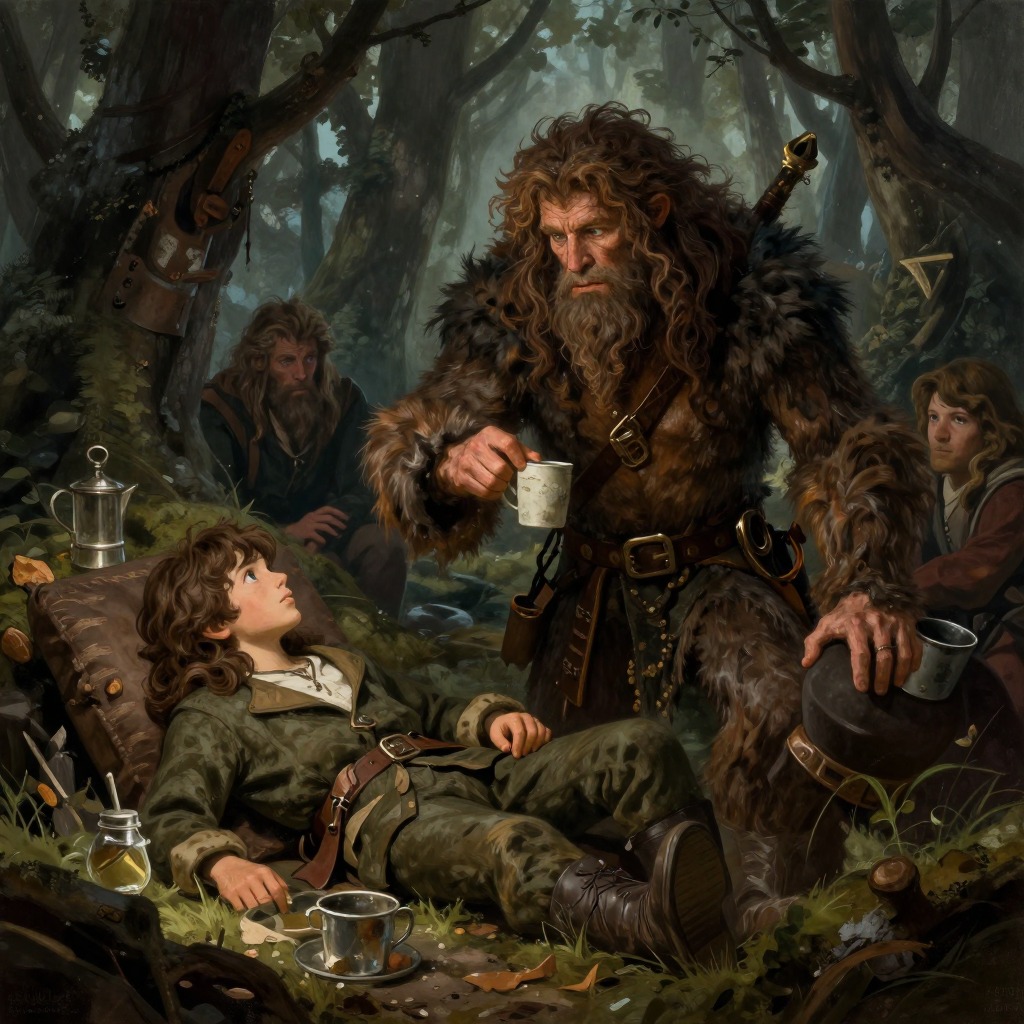
The journey through Mirkwood is marked by a series of specific, escalating dangers. The first major obstacle is the Enchanted Stream, a black, fast-flowing river that crosses the path. Beorn had warned them that its water carries enchantment and a great drowsiness and forgetfulness, and that they must neither drink nor bathe in it. They cross it with difficulty using a rope and hook, but Bombur falls in and is plunged into a deep, enchanted sleep from which he cannot be wakened. The forest itself seems to conspire against them: they are tormented by hunger and thirst, their food runs low, and they are led astray by the sight of elf-fires, which appear as feasts in the woods but vanish when approached, leaving them lost and disoriented. The most direct physical threat comes from the giant spiders of Mirkwood, which capture the dwarves one by one and bind them in cocoons, intending to eat them. Bilbo, alone and invisible, must rescue them by killing the spiders with his sword Sting and leading them away in a desperate running battle.
The Wood-elves and the King's Halls
Beyond the spiders, the company encounters the Wood-elves, who are not wicked but are distrustful of strangers. Their king, the Elvenking, lives in a great cave on the eastern edge of Mirkwood, a palace of stone with many passages and wide halls, lighter and more wholesome than any goblin-dwelling. The Elvenking's realm is a place of both hospitality and captivity: the dwarves are taken prisoner after their repeated attempts to approach the elf-fires, and Thorin is captured separately and thrown into the king's dungeon. The king's halls are also the site of Bilbo's most ingenious exploit: he steals the keys, frees the dwarves, and packs them into empty barrels that are then cast through a water-gate into the Forest River, floating them out of Mirkwood and towards Lake-town. This escape, known as "Barrels Out of Bond," marks the end of the forest's trials and the beginning of the final stage of the quest.
Narrative Significance
Mirkwood functions as a crucial threshold in the hero's journey, a place of trial and transformation where the company is stripped of its resources, its cohesion, and its hope. It is here that Bilbo fully comes into his own as a leader and a burglar, using the ring, his wits, and his courage to save his companions from the spiders and to engineer their escape from the Elvenking's halls. The forest also serves as a geographical and symbolic barrier between the relatively known world of the West and the desolate, dragon-haunted lands of the East. Its darkness and enchantment foreshadow the greater perils of the Lonely Mountain, and its crossing is a necessary ordeal that prepares the company—and especially Bilbo—for the final confrontation with Smaug. The forest's name itself, Mirkwood, evokes a sense of primeval gloom and moral ambiguity, a place where the boundaries between reality and illusion, safety and danger, are permanently blurred.