Spiders of Mirkwood
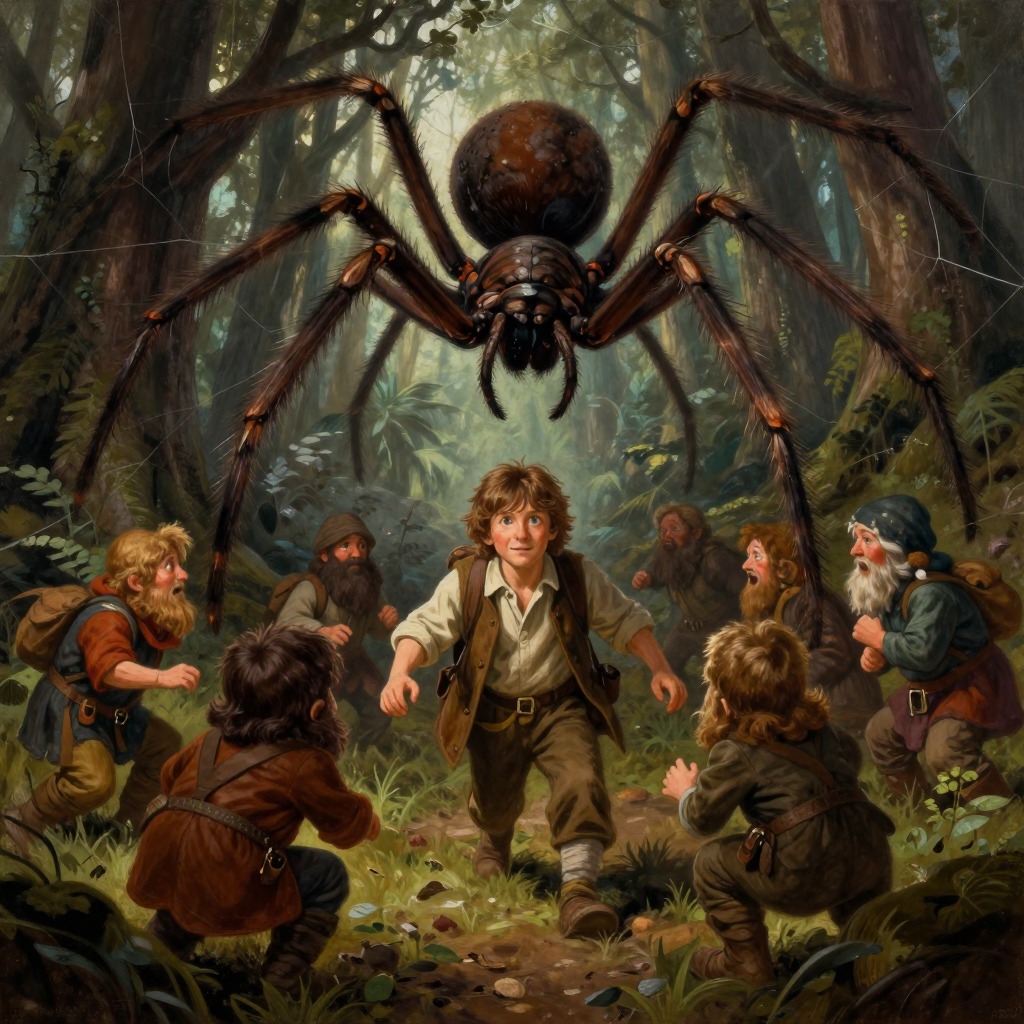
The HobbitThe Spiders of Mirkwood are a breed of enormous, predatory arachnids that dwell in the dark and tangled forest of Mirkwood, a perilous region that Thorin and Company must cross on their journey to the Lonely Mountain. These creatures are not merely oversized insects but possess a degree of intelligence, communicating with one another in a thin, creaking, hissing language that Bilbo Baggins can partially understand. They are described as having "horrible pale bulbous sort of eyes" that Bilbo finds most terrifying, and they weave "dark dense cobwebs with threads extraordinarily thick" between the trees, creating a labyrinthine trap for unwary travelers. The spiders are carnivorous and show a particular appetite for the dwarves, whom they capture and bind in cocoons, hanging them from branches to be eaten later. Their presence in Mirkwood is a constant source of dread, and the company's encounter with them marks a turning point in the adventure, forcing Bilbo to act decisively and independently for the first time.
Encounter and Capture of the Dwarves
The dwarves' troubles with the spiders begin after they stray from the forest path, lured by the sight of elf-fires and the promise of food. In the ensuing confusion and darkness, the dwarves become separated, and the spiders seize the opportunity to attack. Using their strong, sticky threads, the spiders quickly overpower the weary and hungry dwarves, binding them in cocoons and hanging them from a high branch. Bilbo, who had slipped on his magic ring and become invisible, is the only one to escape capture. He awakens to find himself alone, with a spider attempting to bind him as well. In a desperate struggle, he draws his elvish dagger, Sting, and kills the spider, an act that transforms his self-perception: "He felt a different person, and much fiercer and bolder in spite of an empty stomach." This victory gives him the confidence to rescue his companions.
Bilbo's Rescue and the Battle
Realizing the dwarves are in imminent danger, Bilbo devises a plan to draw the spiders away from their captives. He uses his ring to become invisible and begins throwing stones at the spiders, taunting them with a song that calls them "Attercop" and "Tomnoddy," which infuriates them. The spiders, unable to see their tormentor, pursue him, allowing Bilbo to lead them on a chase through the forest. Once he has lured them a safe distance away, he doubles back and, with the help of the first dwarf he frees, Fili, begins cutting the others down from the branch. The rescue is a tense and bloody affair, with Bilbo using Sting to slash through the sticky webs and stab at any spider that comes too close. The dwarves, weakened and sick from spider-poison, are barely able to fight, but Bilbo's courage and the element of surprise allow them to escape. The battle culminates in a desperate running fight, with Bilbo repeatedly charging the spiders to keep them at bay, until the company finally reaches a clearing where the spiders, apparently repelled by some lingering elf-magic, give up the pursuit.
Significance and Thematic Role
The Spiders of Mirkwood serve as a crucial test for Bilbo Baggins, marking his transition from a reluctant and often helpless participant to a true hero and leader. The encounter forces him to rely on his own wits, courage, and the magic ring, which he uses for the first time in a proactive and strategic manner. The episode also deepens the bond between Bilbo and the dwarves, who, after being rescued, "had begun to have a great respect for him" and acknowledge that they would have all died without his help. The spiders themselves embody the untamed and malevolent nature of Mirkwood, a place where the normal rules of the world do not apply and where even the most basic needs—food, water, and light—are denied. Their presence underscores the theme of the wild as a place of both danger and opportunity for growth, and their defeat is a key step in Bilbo's journey toward becoming the "burglar" and leader that Gandalf always believed he could be.