The Elvenking's Halls
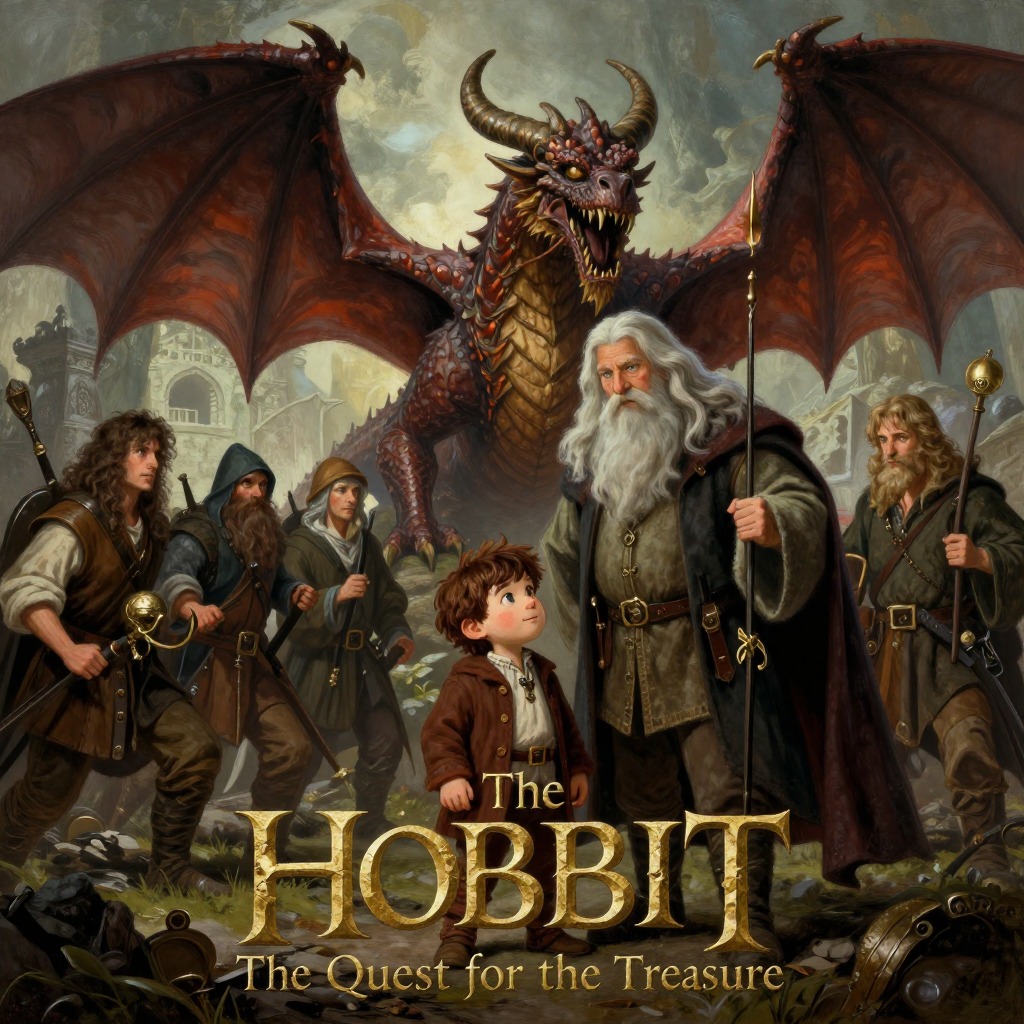
The HobbitThe Elvenking's Halls are the vast underground palace and fortress of the Wood-elves, located deep within the eastern edge of Mirkwood. This great cave, from which countless smaller ones opened out on every side, wound far underground and had many passages and wide halls; it was lighter and more wholesome than any goblin-dwelling, and neither so deep nor so dangerous. The king's cave was his palace, the strong place of his treasure, and the fortress of his people against their enemies. It was also the dungeon of his prisoners, and it was here that Thorin Oakenshield and his company were dragged after their capture in the forest, and where Bilbo Baggins, invisible and alone, would have to engineer their escape.
Architecture and Atmosphere
The Elvenking's Halls were carved from the living rock of a hillside, with a great stone door facing a river that ran out of the heights of the forest. Inside, the passages were lit with red torch-light, and the elf-guards sang as they marched along the twisting, crossing, and echoing paths. These were not like those of the goblin-cities; they were smaller, less deep underground, and filled with a cleaner air. In a great hall with pillars hewn out of the living stone sat the Elvenking on a chair of carven wood. On his head was a crown of berries and red leaves, for the autumn was come again; in the spring he wore a crown of woodland flowers. In his hand he held a carven staff of oak. The halls were not merely a prison but a functioning royal residence, with cellars, storerooms, and a water-gate through which a stream flowed under part of the lowest regions, joining the Forest River some way further to the east.
Imprisonment and the King's Justice
When Thorin was brought before the king, he was questioned sternly about his purpose in the forest. The king, who did not love dwarves and suspected them of being enemies, ordered him taken away and kept safe until he felt inclined to tell the truth, even if he waited a hundred years. The elves put thongs on him and shut him in one of the inmost caves with strong wooden doors. They gave him food and drink, plenty of both, if not very fine; for Wood-elves were not goblins, and were reasonably well-behaved even to their worst enemies. The other dwarves were each put in a separate cell and given food and drink, but not allowed to pass the doors of their little prisons until one at least of them was willing to tell the king all he wanted to know. The king did not tell them that Thorin was also a prisoner with him; it was Bilbo who discovered that by overhearing the guards.
Bilbo's Stealth and the Escape Plan
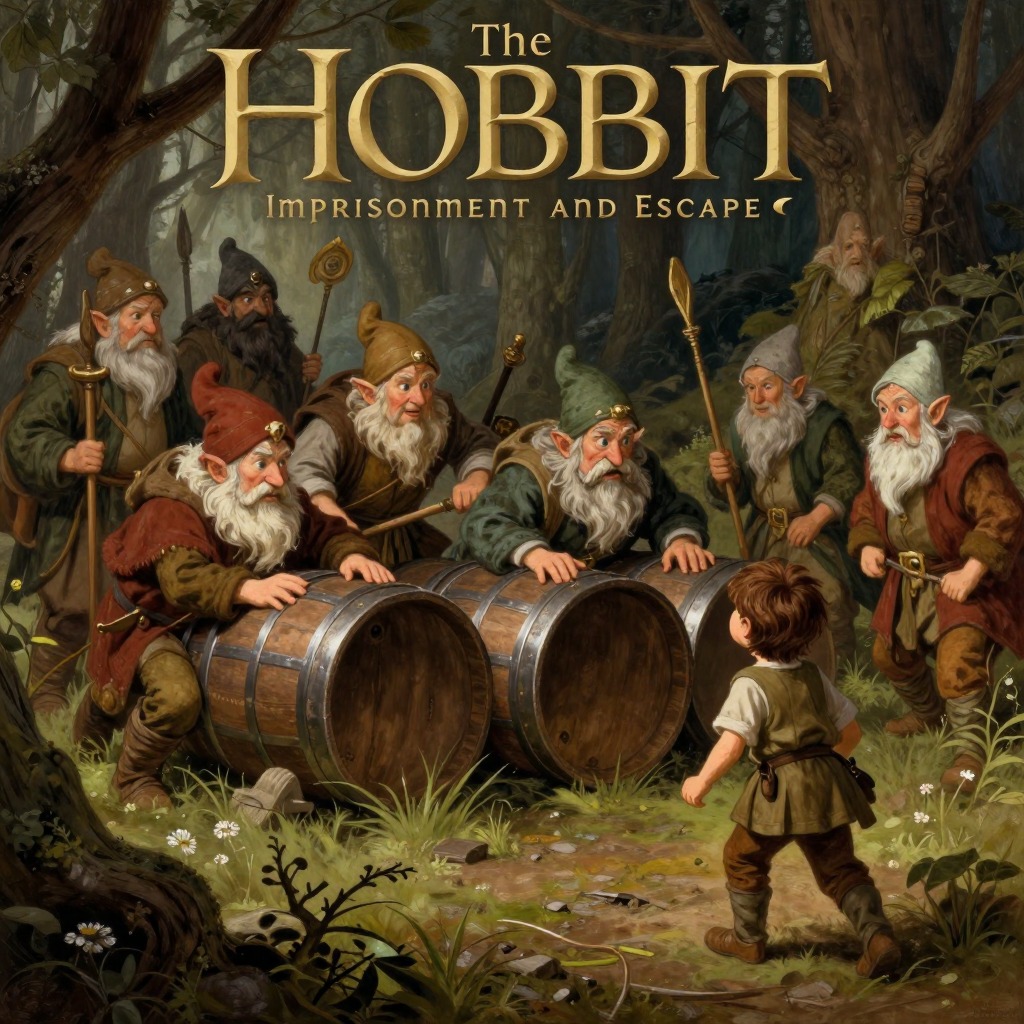
For a weary long time, Bilbo lived in the palace all alone, always in hiding, never daring to take off his ring, hardly daring to sleep. He took to wandering about the Elvenking's palace, and by watching and following the guards, he managed to find out where each dwarf was kept. He discovered the water-gate and the trapdoors leading to the king's cellars, where barrels were stored. The wine and other goods were brought from far away, and when the barrels were empty, the elves cast them through the trapdoors, opened the water-gate, and out the barrels floated on the stream, bobbing along until they were carried to a place far down the river. This gave Bilbo the desperate beginnings of a plan. He drugged the chief guard and the butler with potent Dorwinion wine, stole the keys, and unlocked each dwarf's cell. Then, despite their grumbling, he persuaded them to climb into empty barrels, which were then rolled through the trapdoors into the river. Bilbo himself clung to one of the barrels as they floated away, escaping the halls just as the elves began to sing a song about the journey down the stream.
Significance
The Elvenking's Halls represent a major obstacle in the quest, a place of captivity that tests the loyalty and resourcefulness of the company. It is here that Bilbo, acting entirely alone and unaided, proves his worth as a burglar and a leader, devising and executing the barrel escape that frees his friends. The halls also embody the complex relationship between the Wood-elves and the dwarves, rooted in ancient distrust and a quarrel over treasure, a conflict that will later resurface in the siege of the Mountain. The escape from the Elvenking's Halls is the last great trial before the company reaches the Lonely Mountain, and it marks the point at which Bilbo fully assumes the role of the expedition's true leader.