The Forest River
The HobbitThe Forest River is the principal river of eastern Mirkwood, rising within the great cave-palace of the Elvenking and flowing eastward to empty into the Long Lake. It is the only reliable route through the eastern edge of the forest, linking the Wood-elves' hidden halls to the settlements of Men and the shadow of the Lonely Mountain. The river's course, its guarded water-gate, and its use for transporting goods and prisoners alike make it a crucial artery of travel, commerce, and escape in the latter half of the dwarves' quest.
Course and Geography
The Forest River emerges from a great cave in the eastern side of Mirkwood, where the Elvenking's palace is built. Before its huge stone doors, the river runs out of the heights of the forest and flows onward into the marshes at the feet of the high wooded lands. The river then winds through the forest, and at the point where it leaves the trees, it opens suddenly wide, joined by the main water flowing down in haste from the king's great doors. There, a dim sheet of water, no longer overshadowed, reflects clouds and stars. The hurrying water sweeps all floating objects to the north bank, where it has eaten out a wide bay with a shingly shore under hanging banks, walled at the eastern end by a little jutting cape of hard rock. The river continues its course until it rushes into the Long Lake, where it has a wide mouth with stony clifflike gates at either side, whose feet are piled with shingles. The Long Lake itself is so wide that the opposite shores look small and far, and so long that its northerly end, pointing towards the Mountain, cannot be seen at all. The Forest River, together with the Running River that comes down from Dale, fills the deep waters of what must once have been a great deep rocky valley.
The Water-Gate and the Elvenking's Cellars
Within the Elvenking's palace, a stream flows under part of the lowest regions and joins the Forest River some way further east, beyond the steep slope out of which the main mouth opens. Where this underground watercourse comes forth from the hillside, there is a water-gate, with a rocky roof that comes down close to the surface of the stream. From it, a portcullis can be dropped right to the bed of the river to prevent anyone coming in or out that way, though it is often open for traffic. Anyone entering that way would find himself in a dark rough tunnel leading deep into the heart of the hill. At one point where it passes under the caves, the roof has been cut away and covered with great oaken trapdoors that open upwards into the king's cellars. There stand barrels and barrels, for the Wood-elves and especially their king are very fond of wine, though no vines grow in those parts. The wine and other goods are brought from far away, from their kinsfolk in the South or from the vineyards of Men in distant lands. The goods come up the rivers or over land to the Long Lake, and from Lake-town the barrels are brought up the Forest River, often tied together like big rafts and poled or rowed up the stream, sometimes loaded onto flat boats. When the barrels are empty, the elves cast them through the trapdoors, open the water-gate, and out the barrels float on the stream, bobbing along until they are carried by the current to a place far down the river where the bank juts out, near the very eastern edge of Mirkwood. There they are collected, tied together, and floated back to Lake-town.
The Barrels Escape
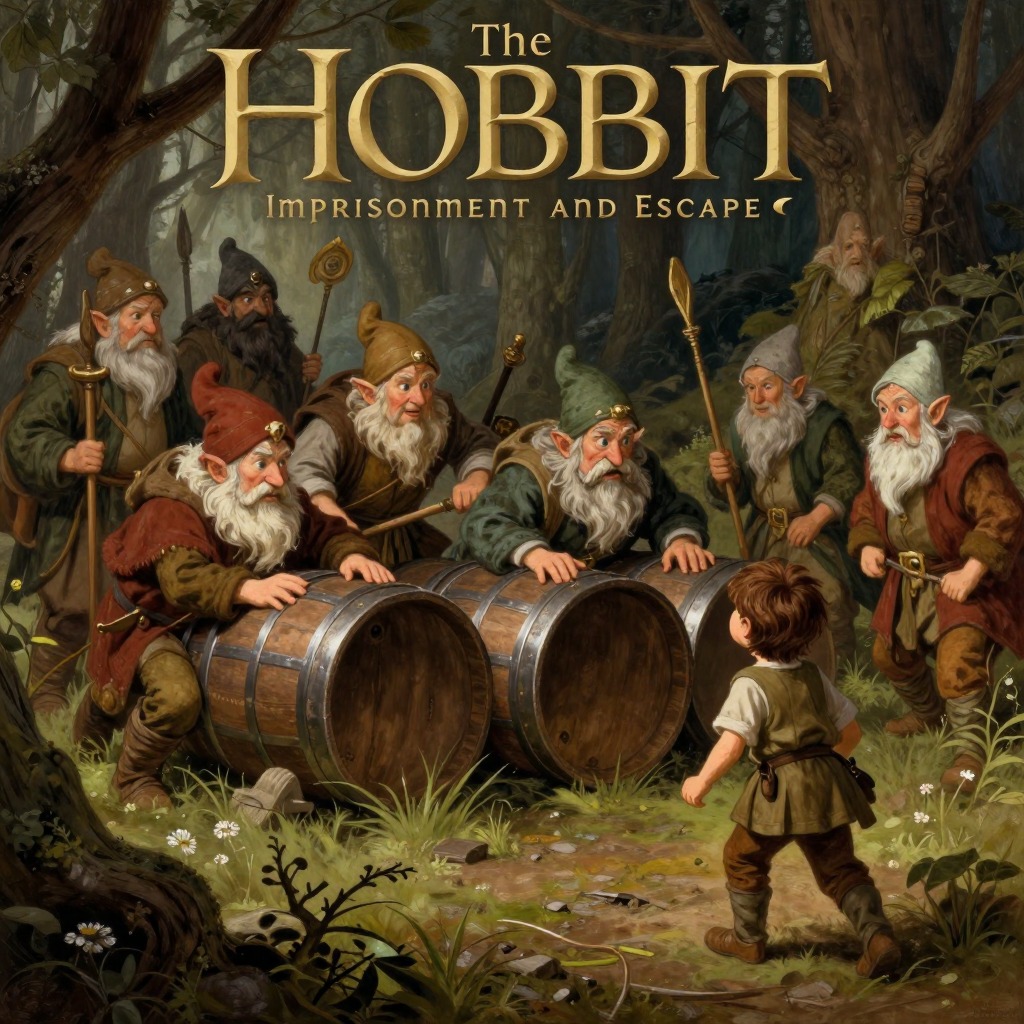
Bilbo Baggins discovers this water-gate and the barrel system while lurking in the cellars, and it becomes the foundation of his desperate plan to rescue the dwarves from imprisonment. After drugging the chief guard and the butler with the potent wine of Dorwinion, Bilbo steals the keys, frees the dwarves, and packs them into empty barrels. The elves, unaware, roll the barrels—including those containing the dwarves—through the trapdoors into the cold water below. The barrels rumble to the dark opening and are pushed over into the river, where they clash and bump, jostle against the walls of the tunnel, and bob away down the current. Bilbo himself, with no barrel to hide in, catches hold of the last barrel and is pushed over the edge with it, falling into the cold dark water. He clings to the wood like a rat, and after a miserable journey, the current carries the barrels close ashore at one point, where they stick against a hidden root. Bilbo scrambles up the side of his barrel and lies on top, spread out to keep his balance. The barrels then break free and twist off down the stream into the main current. Eventually, the Forest River sweeps all the casks and tubs away to the north bank, where they run aground on the shallow shore. People on the lookout pole and push the barrels together, rope them, and leave them till morning. Thus the dwarves escape the Elvenking's halls and are carried down to the very edge of Mirkwood.
Trade and Strategic Importance
The Forest River is the only safe way from the skirts of Mirkwood in the North to the mountain-shadowed plains beyond, and it is guarded by the Wood-elves' king. The talk of the raftmen reveals that the river is central to the trade that comes and goes on the waterways, with traffic growing as the roads out of the East towards Mirkwood vanish or fall into disuse. The bickerings of the Lake-men and the Wood-elves about the upkeep of the Forest River and the care of the banks are a constant concern. The lands have changed much since the days when dwarves dwelt in the Mountain; great floods and rains have swollen the waters, and the marshes and bogs have spread wider. The elf-road through the wood that the dwarves followed on Beorn's advice now comes to a doubtful and little-used end at the eastern edge of the forest, leaving only the river as a safe route. The river thus becomes the final stage of the dwarves' eastward journey, carrying them from the dark heart of Mirkwood to the open lands and the Lonely Mountain beyond.