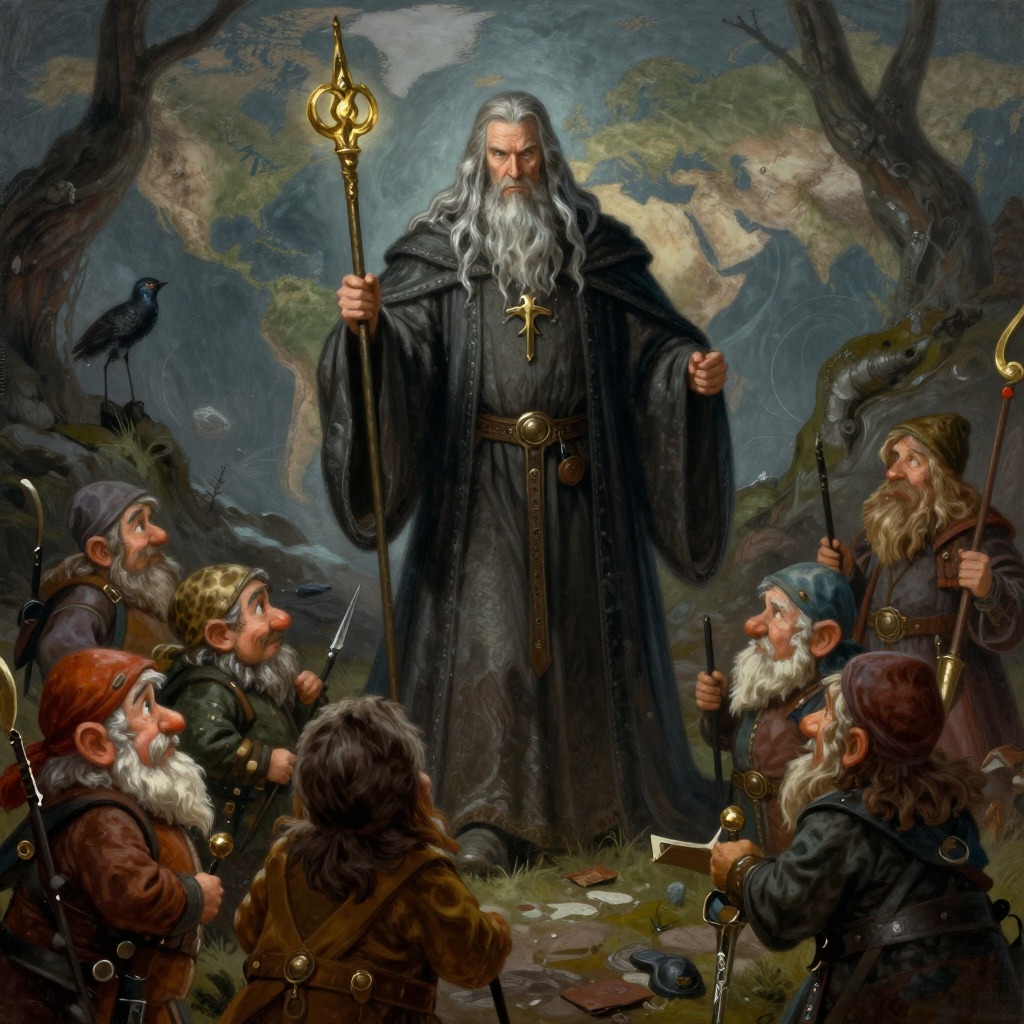
White Council
The HobbitThe White Council is a gathering of the wisest and most powerful beings in Middle-earth, a conclave of wizards and masters of lore and good magic who unite to oppose the rising shadow of the Necromancer. Though its deliberations occur largely offstage in The Hobbit, the Council's actions form a critical structural and thematic counterpoint to the dwarves' quest, explaining Gandalf's mysterious departures and ultimately reshaping the fate of the lands east of the Misty Mountains. The Council's success in driving the Necromancer from his stronghold in southern Mirkwood is the hidden victory that makes possible the more visible triumphs of the story, linking Bilbo's personal adventure to a far larger war between good and evil.
Nature and Purpose
The White Council is not a formal government but an alliance of the wise, convened to confront threats that exceed the power of any single realm or people. Its members are described as "masters of lore and good magic," suggesting that its authority rests on knowledge and spiritual authority rather than military force. The Council's primary adversary during the period of The Hobbit is the Necromancer, a dark sorcerer who has established a stronghold in the south of Mirkwood, a place of "evil things" and "dark magic" that corrupts the forest and threatens the surrounding lands. The Council's purpose is to gather intelligence, coordinate resistance, and, when the time is right, strike directly against such evils. Gandalf's membership in the Council is a key aspect of his character: he is not merely a wandering wonder-worker but a figure of immense strategic importance, whose absences from Thorin's Company are not neglect but the fulfillment of a higher duty.
Gandalf's Role and the Council's Actions
Gandalf's involvement with the White Council is the primary reason for his intermittent presence during the dwarves' quest. After guiding Thorin's Company through the Misty Mountains and to the edge of Mirkwood, he departs, citing "some pressing business away south" — a clear reference to the Council's affairs. This business is revealed at the story's end, when Bilbo, resting in Rivendell, overhears Gandalf telling Elrond that he had been to "a great council of the white wizards, masters of lore and good magic" and that "they had at last driven the Necromancer from his dark hold in the south of Mirkwood." This victory is not a minor footnote; Gandalf declares that "ere long now, the Forest will grow somewhat more wholesome" and that "the North will be freed from that horror for many long years." The Council's success thus directly improves the world Bilbo and his companions have traveled through, transforming Mirkwood from a place of active evil into a recovering land. Gandalf's dual role — as both a member of this high council and a hands-on guide to a hobbit — underscores the layered nature of the story, where a burglar's adventure and a wizard's war proceed simultaneously.
Consequences and Significance
The White Council's defeat of the Necromancer has profound consequences for the world of The Hobbit and beyond. By purging the southern reaches of Mirkwood, the Council removes a source of corruption that had long poisoned the forest, making it safer for future travelers and allowing the Wood-elves to live without the immediate shadow of the Necromancer's power. This victory also frees Gandalf to focus on the aftermath of the Battle of the Five Armies and the re-establishment of the Kingdom under the Mountain. Thematically, the Council represents the principle that the forces of good must organize and cooperate to counter evil on a grand scale, a lesson that contrasts with the dwarves' more insular and treasure-focused quest. The White Council's existence also hints at a wider world of magic and politics beyond the immediate tale, connecting The Hobbit to the larger mythology of Middle-earth. Its actions ensure that the peace won by the dwarves, men, and elves at the Lonely Mountain is not immediately undone by a greater darkness from the south, making the Council an unseen but essential ally in the story's happy ending.