Wood-elves
The HobbitThe Wood-elves are the sylvan inhabitants of the vast and dangerous forest of Mirkwood, ruled by a powerful king who dwells in a great cave palace. Unlike the High Elves of the West, they are more dangerous and less wise, descended from ancient tribes that never journeyed to Faerie. They love the stars and twilight, and their magic is strong, but they are deeply distrustful of strangers, a trait that shapes their interactions with Thorin Oakenshield and his company.
Identity and Nature
The Wood-elves are not wicked folk, but they have a fault: distrust of strangers. They differ from the High Elves of the West, being more dangerous and less wise, for most of them are descended from the ancient tribes that never went to Faerie in the West. There the Light-elves, Deep-elves, and Sea-elves lived for ages, growing fairer, wiser, and more learned, inventing their magic and cunning craft before some returned to the Wide World. In the Wide World, the Wood-elves lingered in the twilight of the Sun and Moon, but loved best the stars, and wandered in the great forests that grew tall in lands now lost. They dwelt most often by the edges of the woods, from which they could escape at times to hunt, or to ride and run over the open lands by moonlight or starlight; after the coming of Men, they took ever more and more to the gloaming and the dusk. Still elves they were and remain, and that is Good People.
The Elvenking's Realm
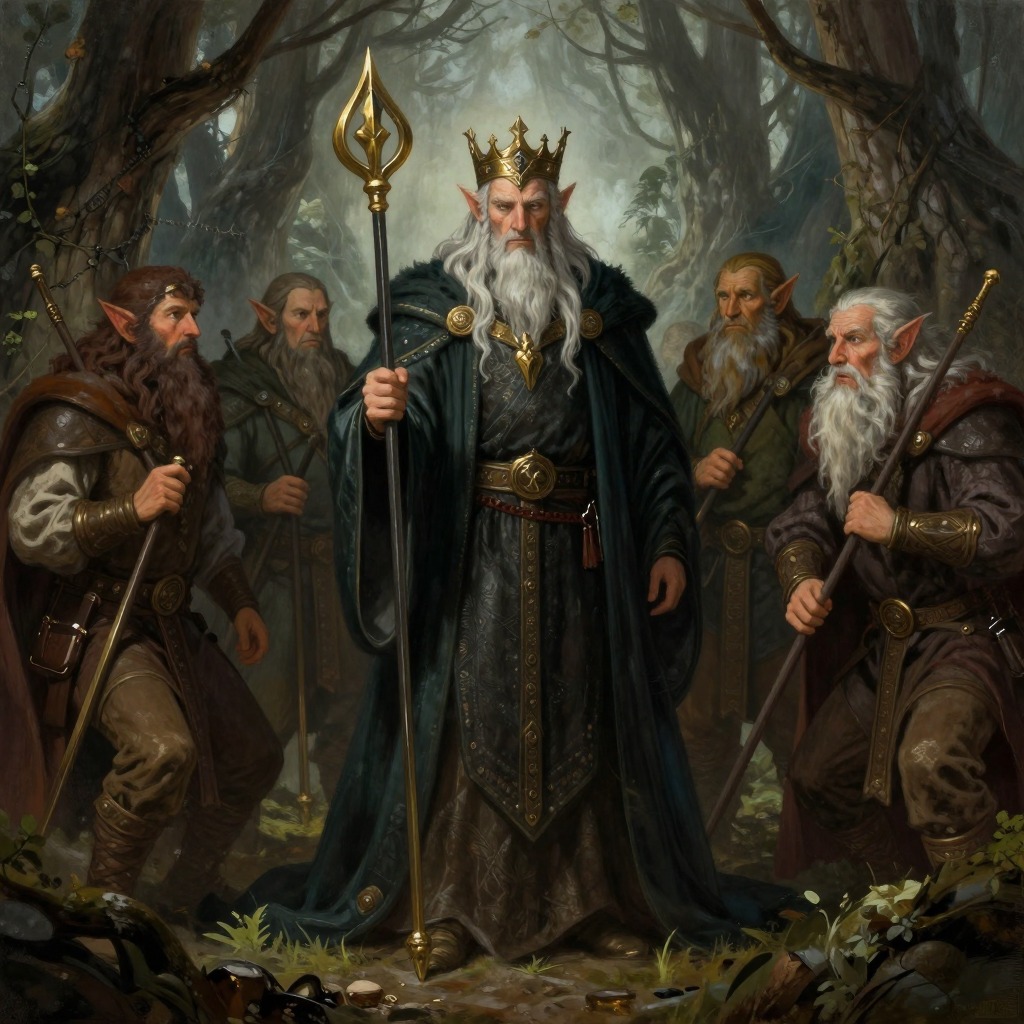
In a great cave some miles within the edge of Mirkwood on its eastern side lived their greatest king. Before his huge doors of stone a river ran out of the heights of the forest and flowed on into the marshes at the feet of the high wooded lands. This great cave, from which countless smaller ones opened out on every side, wound far underground and had many passages and wide halls, but it was lighter and more wholesome than any goblin-dwelling, and neither so deep nor so dangerous. The king's cave was his palace, the strong place of his treasure, and the fortress of his people against their enemies. Inside, the passages were lit with red torch-light, and in a great hall with pillars hewn out of the living stone sat the Elvenking on a chair of carven wood. On his head was a crown of berries and red leaves, for autumn had come again; in the spring he wore a crown of woodland flowers. In his hand he held a carven staff of oak. The king's subjects mostly lived and hunted in the open woods, having houses or huts on the ground and in the branches, with beeches their favourite trees.
Capture and Imprisonment of the Dwarves
The Wood-elves' distrust of strangers led them to capture Thorin and his company. After the dwarves, starving and lost, stumbled upon the elves' feasting in the forest three times, the elves seized them. Thorin was caught first, enchanted and carried away to the king's dungeon. The other dwarves were captured the next day as they staggered through the forest, and Bilbo Baggins, wearing his ring of invisibility, escaped notice. The king questioned the dwarves sternly, but they refused to reveal their quest for the dragon's treasure. Angered, the king ordered them imprisoned in separate cells, giving them food and drink but not allowing them to pass the doors until one of them was willing to tell him all he wanted to know. The Wood-elves were not goblins; they were reasonably well-behaved even to their worst enemies, and the giant spiders were the only living things they had no mercy upon.
Trade and the Barrel Escape
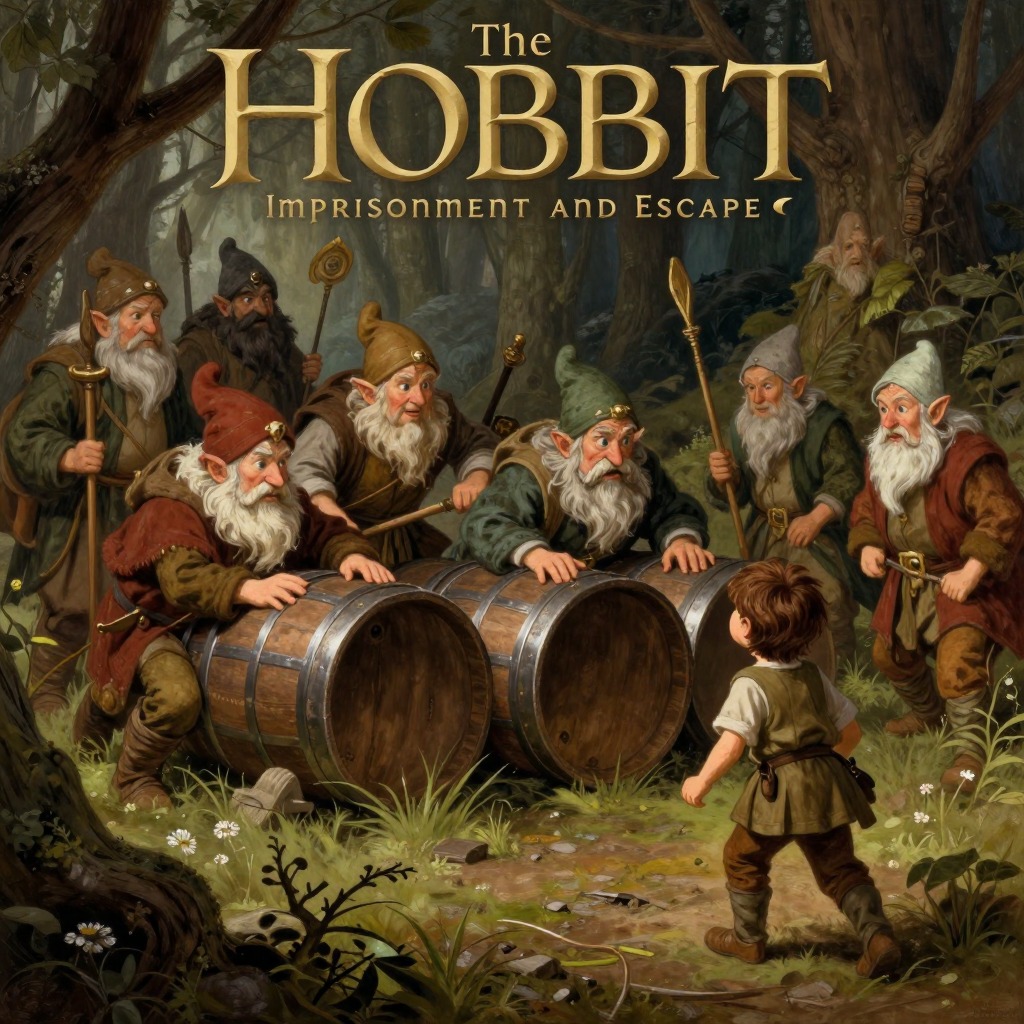
The Wood-elves, especially their king, were very fond of wine, though no vines grew in those parts. The wine and other goods were brought from far away, from their kinsfolk in the South or from the vineyards of Men in distant lands, up the rivers or over land to the Long Lake. From Lake-town, the barrels were brought up the Forest River. When the barrels were empty, the elves cast them through trapdoors in the king's cellars, opened the water-gate, and out the barrels floated on the stream, bobbing along until they were carried by the current to a place far down the river near the eastern edge of Mirkwood, where they were collected and floated back to Lake-town. Bilbo, having discovered this system, used it to orchestrate the dwarves' escape. He drugged the chief guard and the butler with potent Dorwinion wine, stole the keys, freed the dwarves, and packed them into empty barrels. The elves, thinking the barrels were empty, rolled them into the river, and the dwarves floated to freedom, though Bilbo himself had to cling to a barrel, nearly drowning.
March to the Mountain and the Battle of Five Armies
After Smaug's death, the Elvenking received news from his own messengers and from the birds that loved his folk, and already knew much of what had happened. He marched with many spearmen and bowmen towards the Lonely Mountain, but when he received the prayers of Bard for aid to the homeless people of Lake-town, he had pity, for he was the lord of a good and kindly people. He turned his march and hastened down the river to the Long Lake, sending great store of goods ahead by water. Though elves are light-footed, they were not in those days much used to the marches and treacherous lands between the Forest and the Lake, but their going was swift. Only five days after the death of the dragon, they came upon the shores and looked on the ruins of the town. The Elvenking then led his host north to the Mountain, where they joined with the Men of Lake-town to besiege Thorin and his dwarves. When the goblins and Wargs attacked, the Elvenking fought alongside Bard and Dain, and his spearmen and archers played a crucial role in the battle. After the victory, the Elvenking laid the elvish sword Orcrist upon Thorin's tomb, where it would gleam ever in the dark if foes approached, ensuring the fortress could not be taken by surprise. He then returned to his realm, accepting a gift of emeralds from Bard and a necklace of silver and pearls from Bilbo, whom he named elf-friend and blessed.