David Angkatell
The HollowDavid Angkatell is the young Oxford- or Cambridge-educated relative whose arrival at The Hollow brings an openly hostile intellectual gaze into the Angkatell family circle. He initially appears to be merely an awkward, censorious student, but his contempt for the household, his rejection of its social and economic assumptions, and the later speculation about his mother’s illness make him an important figure in the novel’s atmosphere of suspicion. He is both an outsider within the family and a possible object of misinterpretation: his manner is severe enough to invite distrust, yet the evidence never establishes that his hostility makes him a murderer.
Identity and Introduction
David Angkatell has only recently come down from university when he is expected at The Hollow. Lucy Angkatell anticipates difficulty in managing him because he is “very intellectual”: she imagines him as a boy who glowers, bites his nails, speaks either not at all or too loudly, and contradicts everyone around him. Her confidence rests on Henrietta Savernake’s tact. As a sculptress who produces advanced work rather than merely carving animals or children’s heads, Henrietta is thought likely to command David’s respect, even though Lucy privately regards one of her exhibited works, Ascending Thought, as silly.
This introduction places David between two incompatible forms of judgment. Lucy interprets him through affectionate social caricature, treating his intellectualism as an age-specific nuisance; David, by contrast, will judge the family through political and cultural principles. His presence therefore threatens the easy assumptions by which the older generation understands its younger relative. The household expects Henrietta to make him comfortable, while David arrives prepared to find the entire household objectionable.
Attitude Toward The Hollow
David comes to The Hollow unwillingly. He has never before met Sir Henry Angkatell or Lady Angkatell, and his general disapproval of the Empire predisposes him to disapprove of these relatives as representatives of the society he rejects. Edward Angkatell is the exception in familiarity, but David despises him as a dilettante. The other guests are examined with the same critical severity. David thinks relations are “pretty awful,” dislikes the expectation that he should converse with people, and regards the social gathering as an imposition rather than a welcome.
His judgments are not limited to political abstractions. He discounts Midge Hardcastle and Henrietta as empty-headed, dismisses John Christow as a Harley Street charlatan whose professional manner and social success conceal worthlessness, and concludes that Gerda Christow does not count. During the meal he glowers and nervously crumbles his bread, while inwardly wishing that everyone could understand how little he thinks of them. To him, the assembled people are negligible. The contrast between his private contempt and the family’s efforts to accommodate him makes him a conspicuous observer: he refuses the emotional participation that the weekend gathering demands, yet his refusal itself becomes one of the gathering’s defining tensions.
Politics, Property, and Social Conflict
David’s hostility acquires a more concrete political form in his exchange with Edward after John Christow’s death. Edward, whose personality has begun to assert itself once it is freed from John’s dominance, speaks pleasantly to the glowering and unresponsive young man and invites him to come more often to Ainswick, promising that he should feel at home there and learn about the place. David answers coldly that large estates are completely farcical and should be split up.
The exchange exposes the material basis of their distance. Edward offers belonging through inherited place, continuity, and acquaintance with the estate; David rejects the estate itself as an absurd social structure. His response is not simply adolescent insolence. It identifies property and family privilege as institutions incompatible with his political convictions, and it transforms Edward’s conciliatory invitation into an argument about land and power. David is therefore not a picaresque outsider wandering freely through society, but a privileged relative whose own position gives his rejection an uncomfortable contradiction: he condemns the estate while being connected to it.
Suspicion After John Christow’s Death
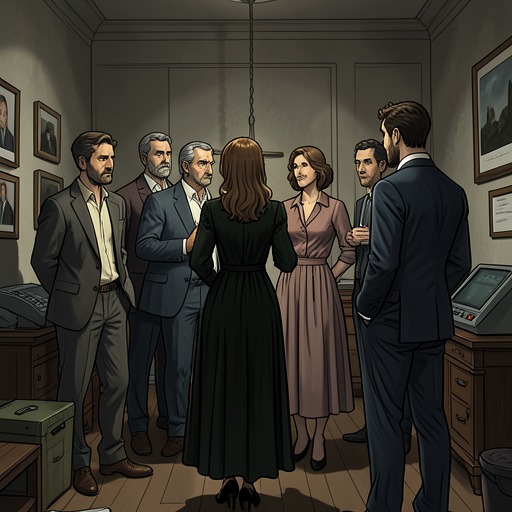
David’s manner becomes relevant to the murder investigation because it can be read in two opposite ways. Henrietta Savernake tells the investigators that David probably hates all of them and spends his time shut away in the library reading the Encyclopaedia Britannica. Her description confirms his isolation and hostility but does not identify a criminal act. The distinction matters: David’s withdrawal supplies an emotional impression of menace without supplying evidence of guilt.
Inspector Grange later considers whether David may have had a motive. Lady Angkatell has let slip that David’s mother died in an asylum with persecution mania, believing that everyone was conspiring to kill her. Grange wonders whether David might have inherited the same tendency, formed an idea that John Christow intended to certify him, and imagined that the doctor had come to The Hollow to keep him under observation. Grange also notes the young man’s extraordinary, nervous manner. This line of thought is speculative, and it is presented as an investigator’s attempt to connect family history, conduct, and motive rather than as a revealed explanation of the murder.
The suspicion is sharpened by a crucial forensic fact: the revolver Sir Henry identifies from his collection is not the weapon with which John was shot. David’s attitude may make him look psychologically plausible as a suspect, but the firearm evidence complicates every convenient theory. His apparent danger belongs partly to the atmosphere of the household and partly to the interpretive habits of those trying to make a coherent case from incomplete information.
Narrative Role and Significance
David functions as a concentrated expression of generational and ideological antagonism within The Hollow. He sees the family’s manners, estates, professional reputation, and social rituals as forms of emptiness; the family sees his silence, glowering, nervous gestures, and uncompromising opinions as evidence of immaturity or possible instability. Neither side initially recognizes the other as a serious moral or intellectual position. His contempt is therefore a counterpoint to the family’s confidence in its own civility.
At the same time, David demonstrates how quickly alienation can be converted into suspicion. His political rejection of inherited property, his refusal to socialize, his harsh assessments of the guests, and the history of his mother’s illness are assembled into a possible motive even though the evidence does not establish that he acted against John Christow. He occupies the novel’s uncertain boundary between dissenter and suspect. The character’s importance lies less in a completed transformation than in this unstable function: David makes the family’s apparently secure world visible as a structure that can be challenged from within, while the investigation shows how easily a society can mistake intellectual hostility and social discomfort for murderous intent.