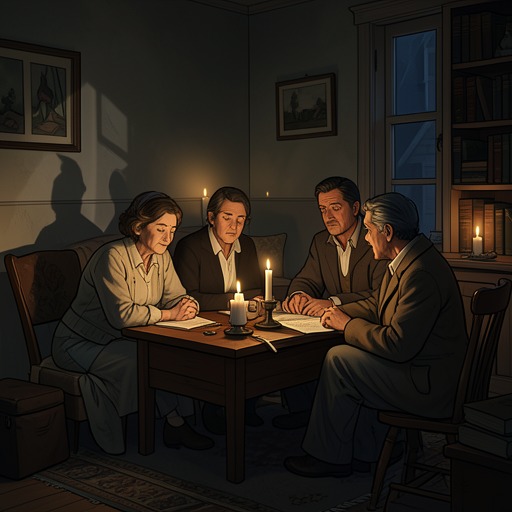
Edward Angkatell
The HollowEdward Angkatell is the heir of Ainswick and one of the novel’s most revealing figures of quiet emotional damage. He possesses the house, education, and cultivated sensibility expected of a country gentleman, yet experiences himself as ineffectual beside the forceful John Christow. His story moves from inherited belonging and unspoken attachment through humiliation and despair to a crisis that exposes how thoroughly the past has colonized his present.
Identity and Background
Edward is the heir to Ainswick under the family’s entailment. Although Lucy Angkatell is Mr. Geoffrey’s only child, she cannot inherit because she is a woman, while Henry Angkatell is only a second cousin; Edward, more closely placed in the succession, receives the estate. Ainswick is therefore both his material inheritance and the source of a complicated family imbalance. Lucy has most of the family wealth, leaving Edward comparatively poor: he has enough to maintain Ainswick, but little surplus beyond that duty.
His life has not followed a conventional professional path. He served for a time in the diplomatic service, but resigned when he inherited Ainswick and returned to live on the property. His tastes are inexpensive and intellectual. He collects first editions and writes hesitant, ironic articles for obscure reviews, activities that suggest an inward, reflective temperament rather than ambition or public authority. At Ainswick he lives alone and seldom leaves, making the estate less a social center than an enclosure in which family history and private disappointment remain constantly present.
Ainswick and the Formation of Attachment
Ainswick is central to Edward’s emotional identity, but it is also the place where his relationships with Henrietta Savernake and Midge Hardcastle become unequally fixed. Midge remembers childhood visits there as an almost heavenly experience: the small country station, the waiting Daimler, the drive through the woods, and the large white house appearing beyond the gates. Those memories center on Edward, whom she recalls as tall, gentle, diffident, and kind. Yet Edward’s attention was directed toward Henrietta, so Midge’s attachment begins in the knowledge that she was present but not chosen.
Edward’s bond with Henrietta is equally connected to Ainswick. He has proposed to her three times, and later asks whether she will come to Ainswick and make it her home. He presents the estate as something that has always been waiting for her, offering domestic peace rather than excitement or conquest. Henrietta admits that peace is what she sometimes wants more than anything, but refuses him because she cannot return to an earlier happiness and because of John Christow. Edward understands the refusal accurately: he tells her that, without John in the world, she would marry him. The recognition is calm rather than accusatory, but it confirms the emotional hierarchy that governs his life.
Edward’s appeal lies partly in his association with a lost past. Henrietta remembers herself as a long-legged girl with untidy brown hair, happy without knowing what life would do to her, and imagines returning to the time when Ainswick seemed complete. Edward offers that return, but the novel makes the offer impossible. Ainswick can preserve memory; it cannot restore the people who inhabited it or undo the choices made since then.
Marriage, Comparison, and Emotional Erosion
Edward’s response to Henrietta’s attachment to John is not simply jealousy. He is repeatedly placed beside John as a man who seems incapable of the decisive action and vivid presence that others admire. After John’s death, Edward tells Henrietta that he feels unreal, while she mourns the man who was intensely alive. His self-description is not a passing modesty but the governing judgment through which he interprets every relationship.
The contrast is sharpened by John’s marriage to Gerda Christow. John’s growing tiredness and irritability make him resent Gerda’s patience, unselfishness, and willingness to subordinate her wishes to his, even while those are the very qualities he believes he wanted in a wife. Edward occupies a different position in the same emotional system: he is not threatened by Gerda’s submissiveness, but diminished by his conviction that he lacks John’s power to command love, admiration, and action. The family’s relationships therefore form a set of painful comparisons rather than isolated romances.
Edward later proposes to Midge. His invitation that she come to Ainswick for good, if she can put up with him, is both practical and vulnerable. It offers her a home while asking her to accept the limitations he believes define him. Midge initially misreads the proposal because she thinks Edward still loves Henrietta. Her answer reveals how strongly the old triangle continues to govern the present: even when Edward turns toward her, she cannot imagine that Henrietta has ceased to stand between them.
Crisis After John Christow’s Death
John’s death does not free Edward from comparison with him. On the contrary, John’s absence becomes a new form of presence. At The Hollow, Henrietta thinks that John has been buried physically but not deeply enough; he remains there despite Edward’s wish that he should be gone. Edward and Midge imagine themselves as a possible pair, a dual entity joined against the uncertainty surrounding the murder, yet John’s memory continues to occupy the emotional space between them.
The pressure culminates when Edward attempts suicide by gas. He explains that he has finally understood himself as someone who has never been any good: a failure, ineffectual, unable to achieve a career, not much of a writer, and not fully alive. He believes that men like John do things while women admire them, whereas he has only inherited Ainswick and enough income to avoid collapse. His account gathers together every earlier wound: Henrietta did not want him, and he thinks Midge could not even put up with him for Ainswick’s sake. What appears outwardly as a quiet, harmless life is revealed as a sustained conviction of personal uselessness.
Midge’s explanation complicates the crisis without erasing it. She tells him that she had believed he still loved Henrietta, so her apparent rejection was not indifference but a mistaken response to his old attachment. The exchange exposes the destructive effect of feelings left unspoken: Edward interprets hesitation as proof that no one wants him, while Midge interprets his reserve as proof that she cannot reach him.
Change and Narrative Significance
Edward does not receive the decisive transformation that would make him rival John. His importance lies instead in the way his passivity becomes legible as suffering. He is gentle, educated, and capable of affection, but his virtues do not protect him from shame; when they are measured against John’s vitality, they become evidence in his own mind of failure. His return to Ainswick after diplomatic service is therefore not a triumphant inheritance but a retreat into a world whose beauty cannot answer him.
His relationship with Henrietta also changes in meaning after the murder. She has been trying to protect Gerda because she believes John’s final appeal required it, and Poirot eventually recognizes that the murder scene was staged by Gerda with the assistance of her relations, while Henrietta’s ingenuity helped sustain the collective deception. Edward is not the architect of that concealment, but he is one of the people forced to live in its emotional aftermath. The revelation of Henrietta’s continuing love for John makes Edward’s position still more painful: even her protective action has been organized around John’s last wish, not around Edward’s claim to a shared future.
By the end, Edward remains associated with Ainswick, memory, and the difficult possibility of survival after the dominant figure has disappeared. Henrietta drives toward London carrying the questions of what she will do and where she will go, exhausted after completing the task John laid upon her. Edward’s crisis has shown that simply remaining alive is not the same as inhabiting life fully. His tragedy is not that he lacks feeling, but that he repeatedly allows another person’s force to become the measure by which his own existence is condemned.