Entailment
The HollowEntailment is the inheritance rule that governs the succession of Ainswick. Its decisive effect is that Edward Angkatell, rather than Lucy Angkatell or her husband Sir Henry Angkatell, inherits the estate: Lucy is the only child of her father, Geoffrey Angkatell, but the property cannot pass to a woman, while Sir Henry is only a distant cousin. The rule therefore converts a family home into a legal sequence, determining not only ownership but also status, residence, marriage prospects, and the future position of younger relatives.
Definition and Operation
Entailment is explained to Midge Hardcastle by Tremlet, the head gardener, when she learns that Edward will one day possess Ainswick. Tremlet identifies Edward as the heir and says that the inheritance is “Entailed,” because Lucy cannot inherit as a female and Sir Henry is less closely related than Edward. The explanation gives the rule a practical, almost administrative force: the gardener understands the legal arrangement clearly, while the younger Midge has assumed that the house would naturally belong to Lucy or pass through her marriage.
The arrangement is complicated by the distinction between inherited property and an acquired title. Sir Henry is called “Sir” because he possesses a K.C.B., not because he has the hereditary claim to Ainswick. His title consequently does not outweigh Edward's nearer relationship to Geoffrey Angkatell. Entailment separates the social appearance of authority from the legal power of succession: Sir Henry may be the titled head of the family circle, yet Edward is the person to whom the estate is bound to pass.
Ainswick and Edward Angkatell
Ainswick had been Lucy Angkatell's actual home. Her father, old Geoffrey Angkatell, had been a prominent local character and had left most of his considerable wealth to Lucy, while Edward received the estate under the entail. Edward is Lucy's first cousin once removed and more than twenty years younger, so the rule places the property in the hands of a younger male relative rather than the daughter who had been most closely associated with it. The result is an inheritance that preserves the estate while weakening Edward's financial position: he has enough money to maintain Ainswick, but little left over afterward.
Edward's life reflects this constrained ownership. He had served in the diplomatic service, but after inheriting Ainswick he resigned and returned to live there alone, seldom leaving. He has no expensive tastes, collects first editions, and writes hesitant, ironic articles for obscure reviews. Entailment thus gives him a settled residence without making him wealthy. Ainswick is both his possession and his obligation, a place he must maintain even though the estate does not provide the abundance associated with its scale or family prestige.
Marriage and the Future Succession
Because Edward has inherited Ainswick but has not married, the entailment remains an active question rather than a settled piece of background. Edward has proposed marriage to his second cousin Henrietta Savernake three times. His repeated proposals connect private emotion with the succession of the estate: marriage could establish a household at Ainswick and determine the next generation of the family line, while Henrietta's refusal leaves the future open.
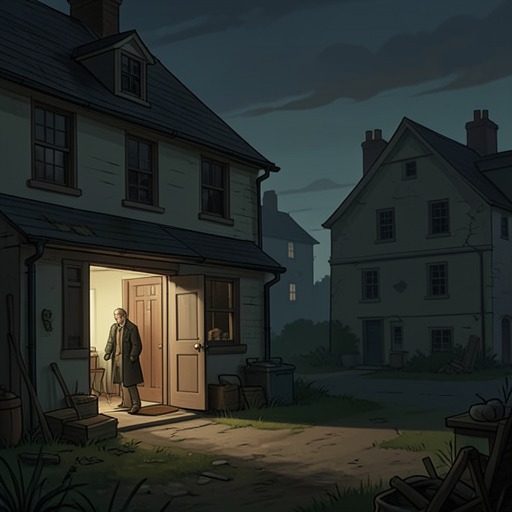
Henrietta later describes Ainswick to Hercule Poirot as the white, graceful house set among wooded hills, with a large magnolia growing up it. She distinguishes Lucy's emotional and familial home from Edward's legal possession: the family came there for holidays, but it belonged to Lucy's father and passed to Edward after Geoffrey's death. When Poirot asks who will receive it after Edward, Henrietta admits that she has never really thought about it. She then recognizes that, if Edward does not marry, it will presumably go to David Angkatell. Her pause and the shadow that crosses her face show how the inheritance silently governs the family even when no one speaks of it directly.
The possible transmission to David reveals that entailment is less a single transfer than a continuing chain. Edward's possession is conditional within the larger family structure: his failure to marry affects the estate's next destination, and David's place in the succession becomes visible through that absence. The law therefore gives Edward authority while also making his personal life consequential for relatives who may never openly claim an interest in the property.
Class, Privilege, and Social Distance
Entailment belongs to the same social world as inherited comfort, inherited authority, and the carefully maintained household at Ainswick and The Hollow. Sir Henry Angkatell worries that Lucy Angkatell does not understand there are things she cannot do, yet her charm allows her to flout traditions, disrupt official precedence, place enemies beside one another at dinner, and cause servants trouble while remaining adored. The family can treat rules as negotiable in social life even as a property rule fixes the fate of the estate with severe precision.
Midge's response exposes the economic consequences from outside that privileged circle. She feels that Lucy, Sir Henry, Edward, and even Henrietta are separated from her by an impassable gulf between the leisured and the working. They cannot understand the difficulty of finding and keeping a job, while they could readily offer her a home or an allowance. Her refusal to accept such ease, and her resistance to starting a business with borrowed family money, underline the contrast between earned independence and inherited security. Entailment is one of the institutions behind that security: it helps preserve property within the established family network, even when individual members possess unequal wealth.
Narrative Significance
The rule gives the family mystery a material structure. Ainswick is not merely a picturesque ancestral house; it is an asset whose ownership has been legally arranged across generations. Lucy's emotional attachment, Edward's solitary stewardship, Henrietta's repeated connection with Edward, and David's possible inheritance all acquire additional meaning because the property cannot simply be distributed according to affection, proximity, or ordinary parental choice.
Entailment also embodies the novel's contrast between informal family power and formal institutions. At The Hollow, Gudgeon's loyalty and Lucy's charm help preserve the household's private order even when official investigation intrudes. By contrast, the entail is impersonal and resistant to charm: it does not yield to Lucy's social magnetism, Sir Henry's title, or Edward's reticence. Its quiet operation reaches beyond the legal question of who owns Ainswick, shaping the relationships and expectations that make the family's apparent ease possible.