Gerda Christow's suicide
The HollowGerda Christow's suicide is the terminal reversal of the murder plot and the act that completes her collapse from devoted wife into murderer, would-be killer of Henrietta Savernake, and victim of her own poisoned plan. It is not presented as an isolated death: it follows the destruction of Gerda's worship of John Christow, exposes the fragility of her apparently submissive identity, and leaves Henrietta with the freedom to grieve only after the household's secrets have reached their final consequence.
Causes and Background
Gerda's suicide grows out of her discovery that the man she had trusted as morally perfect was not the man she believed him to be. She tells Henrietta that everything she had thought about John was a lie, and identifies Veronica Cray as the woman who made the deception visible to her. Gerda had known that John had once cared for Veronica before their marriage, but she had believed that the old attachment was finished. Seeing his face as he followed Veronica revived the knowledge that his emotional life had not fitted the ideal she had built around him.
Her language describes not ordinary disappointment but the collapse of an entire religious structure of devotion. She had trusted John as though he were God and regarded him as the noblest man in the world, believing him to embody everything fine and noble. Once that image failed, she says that she was left with nothing. Henrietta recognizes the transformation with terrifying clarity: the worshipper has been turned back against the object of worship. Gerda's devotion, formerly expressed through dependence and obedience, becomes dangerous when the person revered is exposed as fallible and unfaithful.
The contrast is sharpened by John's earlier awareness of the marriage. He had been irritated by Gerda's patience, selflessness, and submission, even though those were the qualities he had wanted when he married her after the summer at San Miguel. His resentment toward her virtues and her inability to assert an independent line reveal a relationship in which her apparent gentleness had been encouraged by his expectations. The suicide therefore follows not only from bereavement but from the violent collapse of a role that had organized Gerda's entire sense of safety and worth.
The Murder and the Plan
Gerda openly tells Henrietta that she had to kill John because she could not bear the disillusionment. She describes the act in an almost conversational manner, which makes the confession more disturbing rather than less. Her calmness is joined to a new, vindicated self-consciousness: she insists that she is not as stupid as people think, explaining that slowness and staring had allowed others to underestimate her while she observed them.
Her plan depended on two revolvers and on the forensic distinction between them. Sir Henry Angkatell had shown her how to load and fire a revolver that afternoon. Gerda intended to shoot John with one weapon, hide it, and then allow the police to find her holding the other. Because the bullet would not have been fired from the revolver in her hand, investigators would conclude that she had not committed the murder. She had even learned the principle from the detective story John had been reading, turning a piece of crime fiction into a practical method of evasion.
The plan was not entirely successful because Gerda forgot the leather holster in the drawer of her bedroom. That neglected object becomes the material trace capable of connecting the hidden weapon to her. Her careful staging thus contains its own weakness: the intelligence she has newly displayed is real, but it remains incomplete. The same mixture of calculation and omission governs the later poisoning, when a plan aimed at Henrietta returns upon Gerda herself.
The Poisoned Tea
After Henrietta tells Gerda to retrieve the holster, Gerda leaves the room and returns with a tea tray containing a teapot, a milk jug, and two cups. The milk jug has slopped because it is overfull, and Gerda herself is anxious about the tea, remarking that the kettle may not have been boiling. These ordinary domestic details place the suicide inside the rituals of household service rather than outside them. The tray is both a familiar instrument of hospitality and the vehicle of lethal intent.
Gerda speaks of her confusion after John's death, saying that he had always arranged everything and taken care of her. She cannot manage the children's questions, especially Terence Christow's repeated demand to know why their father was killed. Her helplessness is genuine, but it coexists with the concealed knowledge of the murder and the deliberate preparation of poison. The scene therefore refuses to separate the dependent widow from the calculating criminal; both are present in the same body and in the same domestic performance.
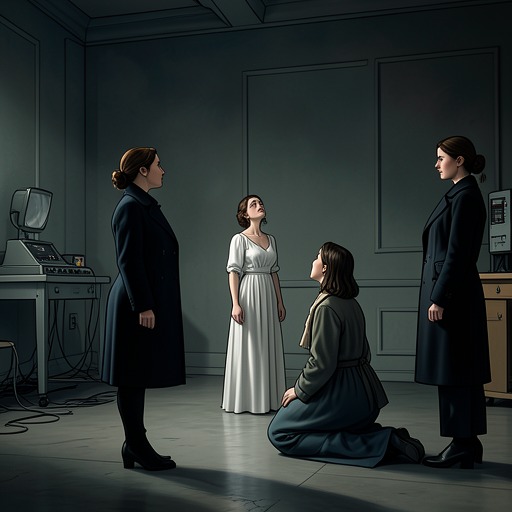
Gerda lifts a teacup and drinks. Her lips become very blue, and she says that she does not feel well before collapsing in her chair. Hercule Poirot examines her and identifies the result as an easy and comparatively painless death. Henrietta first assumes that Gerda has poisoned herself, but Poirot corrects her: the poison had been placed in Henrietta's cup. Gerda drank from it because the cups were on the tray, converting a planned killing into suicide by miscalculation.
Consequences and Aftermath
Poirot explains that he had known only that one of the cups might contain poison, not which cup it was. Once the cups were returned to the tray, it became an even chance which woman would drink from the poisoned one. His intervention does not save Gerda; it instead allows the mechanism of her final act to reveal itself. Gerda had seen that Henrietta knew her secret and concluded that Henrietta too must die, regardless of Henrietta's attempt to help her.
The death closes the immediate chain of violence but does not restore moral order. John is dead, Gerda is dead, and the children are left without the father who had organized their lives. Henrietta is spared physically but is forced to confront the fact that Gerda's last act was directed against her. The poison makes the hidden conflict between the two women literal: Henrietta's concern for Gerda's peace of mind had been sincere, yet Gerda's fear and wounded devotion transformed knowledge itself into a death sentence.
The social setting surrounding the death also exposes how convention tries to contain catastrophe. At supper, the household eats cold ducks followed by caramel custard, chosen because it is not anyone's favorite pudding and therefore seems suitably restrained after the death of a friend. Lady Angkatell treats food as a matter of delicacy and proportion, a ritual adjustment intended to make grief socially manageable. Against that polished etiquette, Gerda's blue lips and sudden collapse show a death that cannot be made tasteful, moderate, or ceremonially safe.
Meaning for Henrietta and the Ending
For Henrietta, Gerda's suicide releases the grief that she had been unable to permit herself on the night John died. She had gone to the swimming pool and told Edward Angkatell that she wanted to be alone with her dead; later, she had imagined that she should like to grieve for John, but had not dared to relax while practical dangers and concealed truths remained active. After Gerda's death, she realizes that she can finally mourn and that she has all the time there is. The possibility of grief arrives only when every immediate obligation has become irreversible.
That grief is not simple consolation. Henrietta's repeated sense of John's sudden absence had already made death seem like an emptiness that language could scarcely contain. She had contrasted the living household, eating caramel custard and calling itself alive, with John, who had seemed more alive than anyone, now dead and gone. Gerda's suicide intensifies that contrast by showing how the living are compelled to continue through meals, explanations, children, investigations, and medical work even when the emotional world has been destroyed.
Henrietta's final response turns outward toward the work John leaves behind. At St. Christopher's Hospital, Mrs. Crabtree, his patient with incurable Ridgeway's Disease, fears that she will soon be attending her own funeral. Henrietta urges her not to give up, reminding her that John had said they would make medical history and insisting that she must continue the treatment and have the courage for two. Mrs. Crabtree agrees to do her best. Henrietta understands that Mrs. Crabtree and Poirot express the same principle in different language: what is gone cannot be recovered, but the living must carry its consequences.
Gerda's suicide thus ends the novel's central cycle of worship, betrayal, murder, and concealment without offering a clean redemption. It destroys the person who could not survive the collapse of an ideal, protects no one from the pain she meant to transfer, and leaves Henrietta with an unresolved mixture of love, bitterness, responsibility, and rebellion. Only after this final death can Henrietta stop managing the scene and begin to mourn the dead as a dead man rather than as the still-active center of a crisis.