Gerda's frame-up and the collective cover-up
The HollowGerda's frame-up and the collective cover-up is the intricate deception surrounding John Christow's murder and its aftermath. Gerda Christow kills John Christow with one revolver, arranges for another to be found in her hand, and relies on the apparent contradiction between the weapon and the fatal bullet to make herself seem innocent. Henrietta Savernake then recognizes the design and actively interferes with the investigation, while the household's loyalties, evasions, and social tact turn concealment into a collective enterprise. The result is not merely a false clue but a staged interpretation of guilt, in which every indication is made to point somewhere other than the guilty woman.
Design of the False Scene
Gerda's plan depends on two revolvers and on the distinction between what appears to have happened and what forensic examination can establish. Sir Henry had shown her how to load and fire a revolver that afternoon. She intends to shoot John with one weapon, hide that weapon, and then let herself be discovered holding the other. The second gun would initially make her look guilty, but once investigators established that John could not have been killed with it, the apparent evidence against her would collapse. Her knowledge comes partly from the detective story John was reading, which had taught her that police could identify the gun from which a bullet had been fired.
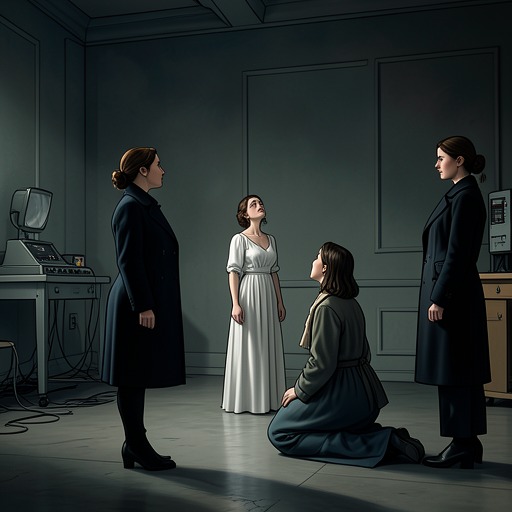
The staged scene works because Gerda understands the force of simple visual evidence. When the police arrive, she is actually holding the revolver, creating the immediate impression that she has fired the shot. Inspector Grange notes that fingerprints are no longer likely to survive on the dripping weapon, but treats that loss as unimportant because Gerda's possession of it is already so suggestive. The investigative problem is therefore framed around identification of the revolver: Sir Henry is expected to recognize it as one missing from his study. The scene offers an apparently direct answer while concealing the more important question of which weapon killed John.
Gerda's strategy is also betrayed by the leather holster. She remembers that it was in a drawer in her bedroom and worries that the police may still examine it. The holster becomes the physical remnant her elaborate substitution cannot erase, a small object linking the hidden weapon to her preparations. Its importance emerges when Poirot fits together three fragments of thick, shiny brown leather from Henrietta's raffia workbag and identifies them as the holster. The discarded fragments transform a seemingly chaotic scene into evidence of deliberate construction.
Henrietta's Counter-Deception
Henrietta quickly understands that the scene has been set, although she does not at first realize that Gerda Christow has staged it. Poirot later describes the scene as both simple and complex: simple in its visible arrangement, complex in the network of interventions required to preserve its meaning. He recognizes that Henrietta's ingenuity is the principal force opposing his investigation and that her relations begin assisting her as soon as they understand what she is trying to accomplish.
Henrietta's first practical act is to remove the revolver from Gerda and drop it into the pool, thereby obscuring the fingerprint evidence. Once she discovers that John was shot with a different gun, she searches for the fatal weapon and finds it almost immediately because she knows the sort of place where Gerda would have hidden it. She is only a minute or two ahead of Inspector Grange's men. She keeps the gun in her satchel while she takes it to London, hides it in her studio, and later returns it to a place where the police will find it. Her actions do not destroy the evidence; they control its route, timing, and interpretation.
Henrietta's motive is bound to John's final appeal. She understands his use of her name as a request to protect Gerda, because he loved Gerda more deeply than he had understood and believed Henrietta would do anything for him. Her concealment therefore presents itself to her as an act of loyalty rather than a defense of murder. Yet the same loyalty makes her an opponent of Poirot: she is not simply withholding information but engineering a competing version of the truth.
The Collective Misdirection
The household's cover-up follows a precise principle: to clear a guilty person, suspicion must be suggested elsewhere without being fixed on any one innocent person. Henrietta explains that every clue is designed to implicate everyone except Gerda Christow. The pattern includes Ygdrasil, planted to attract Poirot's attention and bring Henrietta herself under suspicion, as well as the shifting suggestions directed toward Lady Angkatell, David Angkatell, and Edward Angkatell. Each false trail looks promising, then ends without a definite culprit.
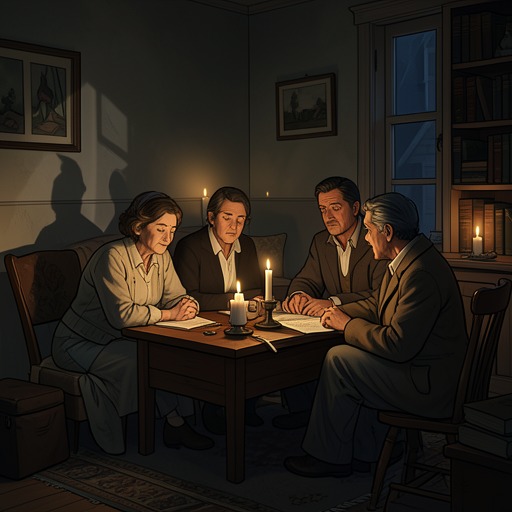
Lady Angkatell contributes through social performance rather than forensic manipulation. While Inspector Grange questions Gudgeon, she diverts attention with an elaborate, imaginary portrait of the inspector's domestic life and then invites Poirot to lunch after the ridiculous business is over. Her manner treats the police inquiry as an interruption to household sociability, reducing grave obstruction to eccentric conversation. When Gudgeon leaves after a hesitant exchange of glances with Sir Henry and Grange, Lady Angkatell calls his conduct charming and “feudal.” The word converts silence and service into a code of loyalty, making the servant's failure to speak appear honorable rather than suspicious.
The cover-up also depends on the household's willingness to preserve appearances. Lady Angkatell privately reasons that if John were removed, Henrietta might marry Edward Angkatell, and she admits that this possibility helped bring her thinking to the conclusion that John Christow must be gotten rid of. Her reasoning does not establish that she committed the murder; it reveals instead how the surrounding family interprets danger through marriage, inheritance, affection, and domestic convenience. Protection becomes a shared social reflex, even when the protected person is guilty.
Forensic Reversal and Exposure
The investigation briefly appears to confirm the outside-job theory. Inspector Grange receives jubilant news that the gun missing from Sir Henry's collection is the gun that shot John Christow and that it bears a good set of fingerprints. The apparent breakthrough is then reversed when the prints prove to belong to nobody connected with the case: not Edward, David, or Sir Henry; not Gerda, the Savernakes, Veronica Cray, Lady Angkatell, or the young dark-haired girl; not even the kitchen maid. Grange concludes that an unknown outsider must have stolen the guns, shot John, hidden the weapon in Poirot's hedge, and vanished.
This reversal demonstrates why the frame-up is so effective. The fingerprints are genuine, the weapon is correctly identified, and the police inference is methodical, yet the chain of evidence has been arranged to produce the wrong conclusion. The unknown fingerprints do not expose an outsider; they reflect Henrietta's deliberate management of the fatal gun and its discovery. The case thus distinguishes between an authentic clue and a reliable interpretation. Evidence can be real while the story built from it is false.
Poirot eventually sees the structure behind the scattered clues. He realizes that Gerda's bewildered, theatrical attitude is not spontaneous but a performance, and that Henrietta and the family have been aiding it. Gerda then states the motive and method plainly: she could not bear what John had done and had to kill him, but she also believed she could make the police misread the scene. The detective story she had read supplies the technical idea, Sir Henry supplies the practical instruction, and the two-revolver arrangement supplies the deception.
Concealment and Narrative Significance
After the confession, Henrietta asks Poirot what they are going to do about Gerda. Poirot proposes that Gerda Christow's death be recorded as suicide committed while she was of unsound mind, using the discovered holster as part of the explanation. The collective cover-up therefore reaches beyond the murder scene: it becomes a final decision about how the death will enter the official record. The household does not simply hide a crime; it manufactures a legally and socially tolerable ending for the person responsible.
The mechanism exposes a conflict between formal investigation and intimate allegiance. Inspector Grange trusts weapons, fingerprints, and the movement of an unknown intruder; Henrietta trusts her knowledge of Gerda's habits and her obligation to John's last request. Lady Angkatell translates obstruction into manners, and Gudgeon's silence is absorbed into a feudal ethic of service. Across these actions, responsibility is repeatedly softened by higher loyalties: love, protection, household honor, and the desire to spare a vulnerable woman. The frame-up succeeds because the characters do not merely lie about facts; they reorganize the moral meaning of those facts.
At the same time, the scheme gives the investigation its deepest irony. Poirot is able to defeat the deception not by following one decisive clue but by recognizing the pattern formed by failed clues. The deliberate scattering of suspicion creates an absence at its center: every person is made to look possible, yet Gerda is consistently protected from being localized as the culprit. Gerda's frame-up and the collective cover-up thus turn misdirection into the novel's governing image of social life, where a staged scene can be sustained by many people because each participant mistakes concealment for kindness.