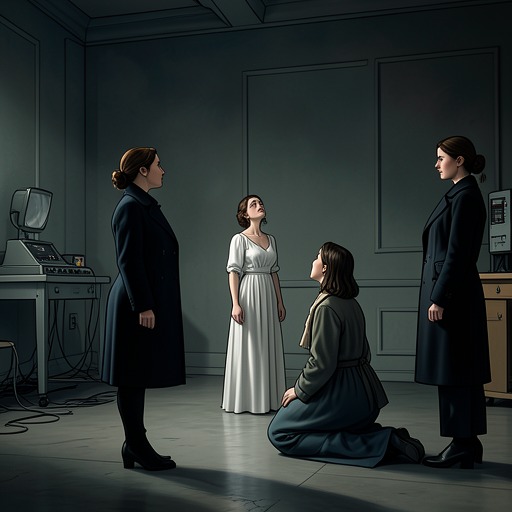
Henrietta Savernake
The HollowHenrietta Savernake is a sculptor, an emotionally controlled but deeply passionate member of the Angkatell circle, and the character who converts love into action after John Christow's death. Her attachment to John is neither a simple romantic reward nor a purely private affair: it places her between John Christow, Gerda Christow, and the wider family, and ultimately leads her to help conceal the circumstances of the murder. The same imaginative faculty that allows her to make art also enables her to recognize and construct a convincing scene. By the end, however, the ingenuity that protects Gerda has left Henrietta alone with the grief she has deliberately deferred.
Identity and Artistic Life
Henrietta is introduced at work, rolling and patting a strip of clay into place as she builds the head of a girl with swift, practised skill. The scene establishes her through making rather than explanation. Her hands are purposeful, and her artistic competence is presented as habitual, exact, and physically immediate. Sculpture is not merely her occupation or a mark of social independence; it is the discipline through which she experiences pressure, compulsion, and temporary release.
When Edward Angkatell asks whether she considers herself successful, Henrietta rejects the ordinary language of achievement. She explains that sculpture is not something one simply decides to do and then succeeds in doing. It seizes, nags, and haunts the artist until the artist must make terms with it, after which a brief peace is possible before the process begins again. Her account makes art resemble an internal demand rather than a career chosen for public recognition. It also clarifies why Edward's offer of domestic peace at Ainswick cannot simply replace her artistic life: the restlessness belongs to her identity.
Love, Refusal, and Emotional Conflict
Henrietta's thoughts turn warmly to John when she anticipates going to The Hollow. The prospect of seeing him produces a physical quickening of feeling, and her private happiness contrasts with the controlled, observant manner she presents to others. John is not an incidental attachment in her life; his presence organizes her expectation and her emotional energy.
The relationship between Henrietta and John is complicated by his marriage to Gerda. John Christow recognizes that Henrietta's feelings are powerful, yet he also resists allowing the affair to become a fully acknowledged commitment. He wanted it to remain light and easy, like other affairs, because he feared that loving Henrietta would interfere with his concentration and his chosen way of living. Henrietta understands that she affected him as a woman and that he tried to manage that effect by treating the affair as something limited. Her position is therefore both intimate and structurally subordinate: she is loved, desired, and emotionally consequential, but not given the security of a public place.
Edward's earlier hope of returning to Ainswick with her exposes another part of Henrietta's history. He suggests that she could find happiness there, even if she had to put up with him, and asks her to make the place her home. Henrietta refuses the fantasy of restoration, insisting that one cannot go back. When Edward identifies John as the reason she will not marry him, her silence confirms the force of the attachment. Her refusal is not simply a rejection of Edward; it is a declaration that the past, John, and her own emotional commitments cannot be rearranged at will.
Conduct After John Christow's Death
Immediately after John Christow dies, Henrietta cannot surrender to mourning. When Edward offers to accompany her to the swimming pool, she sharply refuses and says that she wants to be alone with her dead. The phrase expresses both intimacy and separation: she seeks a private encounter with the fact of death, but she is not yet able to receive it passively. Her response to Edward's sympathy is equally revealing, since she questions whether he is sorry that John is dead rather than merely sorry for her suffering.
At supper, the household eats cold ducks followed by caramel custard. Lady Angkatell treats the dessert as a matter of delicate social proportion, because a favourite pudding would seem too gross immediately after a friend's death. Henrietta experiences the same meal as an intolerable collision between ordinary life and catastrophe. She repeats the word dead until it loses meaning, becoming a rhythm like a tom-tom rather than a stable description. John, who seemed more alive than any of them, has become an absence while the survivors continue eating and calling themselves alive. Her language shows grief breaking through the social performance that the household uses to contain it.
Henrietta's concern is not confined to her own loss. She asks Hercule Poirot whether the police need to know that she was John Christow's mistress because she does not want matters made worse for Gerda. Gerda adored John and has already lost him; Henrietta believes that exposing the affair would impose an additional burden on a woman who is grieving. She also rejects the implication that her concern is hypocritical. In her account, she did not destroy John's married life and was only one in a procession of women who had passed through his emotional world. That explanation does not erase her responsibility, but it shows that her immediate moral priority is Gerda's protection rather than her own reputation.
The Staged Scene and the Protection of Gerda
Henrietta becomes the principal strategist in the collective effort to protect Gerda. Poirot eventually tells her that he sensed from the beginning that the scene had been set, but only later understood that Gerda's apparent attitude was itself a performance. He recognized that Henrietta's ingenuity was the chief obstacle to his investigation and that her relatives assisted once they understood what she wanted done. The revelation defines Henrietta as neither a passive mourner nor a frightened accomplice, but as the person who gives the cover-up its intelligence and direction.
Her motive is rooted in John's final appeal. Henrietta understands that when John said her name, he was asking her to protect Gerda. She believes that John loved Gerda more deeply than he understood, more than he loved Veronica Cray or Henrietta herself. Gerda belonged to him in the possessive sense that mattered to John, and he knew that Henrietta would do whatever he asked because she loved him. The concealment therefore combines devotion, obedience, rivalry, and ethical contradiction. Henrietta protects the wife of the man she loved, not because the affair was unimportant to her, but because John's last implied wish redirects her love toward Gerda's survival.
The staged murder scene also reveals the practical form of Henrietta's art. On the night of John's death, she goes to the pool and into the pavilion and deliberately draws the Ygdrasil tree mark on the iron table by the light of a match. The act is purposeful and planned. It supplies the scene with an image capable of directing interpretation, just as a sculptor controls the forms through which an observer reads an object. Yet the artistic act has a cost: Henrietta must remain purposeful when she wants to mourn, and must construct an intelligible appearance before she can confront the unbearable reality beneath it.
Change, Grief, and Narrative Significance
Henrietta's character arc moves from mastery to exhaustion. She can control clay, conversation, evidence, and the appearance of a room, but she cannot permanently control death or the return of feeling. Her relatives' assistance makes the protective scheme possible, while Poirot's investigation gradually identifies the difference between a simple scene and a scene whose simplicity has been engineered. When he finally confronts her, he calls attention to her tiredness, and the exhaustion marks the limit of her strategic self-command.
Once Poirot understands what Henrietta has done, she can at last grieve. She recalls telling Edward that she wanted to grieve for John, recognizing that she had not dared to relax or allow sorrow to take command while the protective plan remained unfinished. Now she has all the time there is. The permission is not a recovery or a happy resolution; it is the bleak consequence of having completed her duty. Her repeated invocation of John's name gives way to bitterness and rebellion, suggesting that grief has become possible only after love, guilt, secrecy, and responsibility have exhausted their immediate claims.
Henrietta's return to the studio intensifies this ending. Mrs. Crabtree and Hercule Poirot express the same idea in different language: what is gone cannot be recovered. Henrietta drives back to Chelsea, puts the car away, and walks slowly to the studio, where she faces the moment she has dreaded, being alone. The artist who began by shaping a girl's head from clay ends with no object capable of containing the loss. Her narrative significance lies in that unresolved contrast. She is the novel's most effective maker of forms, yet her deepest experience is the discovery that no arrangement, performance, or work of imagination can restore the dead or prevent grief from arriving.