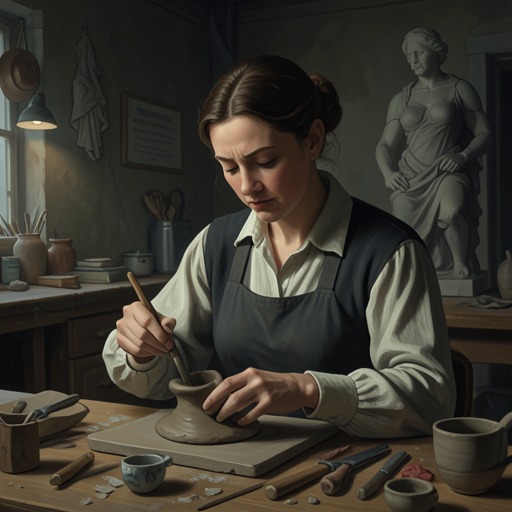
Henrietta's studio
The HollowHenrietta Savernake's studio is more than an artist's workplace. It is a private, materially exacting space where clay, wood, bronze, aluminum, and granite preserve the evidence of her imagination; later, it becomes a temporary refuge for Midge Hardcastle and a hiding place for the real weapon in John Christow's murder. The studio therefore joins artistic creation to concealment: it produces objects that can be admired, but also shelters an object whose discovery would expose Henrietta's intervention in the case.
An Artist's Working Space
Henrietta is introduced there while rolling up a small strip of clay and patting it into place, building the clay head of a girl with swift, practised skill. The gesture establishes the studio as a place of disciplined making rather than idle decoration. Her hands work quickly and confidently, and the unfinished head records the intermediate state between raw material and finished form.
The room also contains a work Henrietta regards with particular seriousness: her figure of The Worshipper. She inspects it critically and finds no fault in the pearwood or its grain, noting that she saved the wood for a long time and hoarded it before using it. She considers the piece the best thing she has done for a long period and identifies it as a worthy exhibit for the International Group. The studio consequently holds both the labor of manufacture and the standards by which Henrietta judges herself.
The Studio's Interior and Objects
The contents of the studio give Midge Hardcastle an eerie impression when she is left alone there. She moves among creations made of wood and bronze, encountering a bronze head with high cheekbones and a tin hat, possibly representing a Red Army soldier; an airy structure of twisted, ribbon-like aluminum; a vast static frog in pinkish granite; and an almost life-sized wooden figure. These works make the room feel populated even in the artist's absence. Their different materials and scales turn the studio into a dense field of bodies, faces, and suggestive forms rather than a neutral interior.
That atmosphere also complicates the distinction between a finished object and a concealed action. The works are visible because they are meant to be seen, yet their arrangement supplies cover for something that must remain unseen. The studio's artistic openness thus coexists with practical secrecy.
A London Refuge for Midge
Later, after the events at The Hollow, Henrietta brings Midge to the studio in London. The short afternoon light is already fading when they draw up at the studio door; Henrietta unlocks it, enters, and switches on the light. She notices the chill and proposes lighting the gas fire, but realizes that she has forgotten to buy matches. Her ordinary concern with warmth and hospitality gives the room a domestic function as well as an artistic one.
Henrietta leaves briefly to obtain matches from the old blind man who usually stands on the corner, telling Midge to make herself at home. Alone, Midge wanders through the studio and studies the works. The space offers her temporary shelter, but it does not feel wholly comforting: the empty room and its nearly human creations produce an eerie sensation. The studio is therefore both a place of welcome and a place charged with uncanny presence.
Concealment and the Murder Investigation
The studio's most consequential role emerges when Henrietta explains how she protected Gerda Christow after John Christow was shot. She first took the revolver from Gerda and dropped it into the pool, intending to obscure the fingerprint evidence. After discovering that John had been shot with a different gun, Henrietta searched for that weapon and found it quickly because she understood the kind of place Gerda would have chosen for concealment.
Henrietta kept the gun in her satchel until she could take it to London. She then hid it in the studio before eventually returning it to The Hollow, placing it where the police would find it. The studio thus becomes a hidden interval in the chain of evidence: neither the original crime scene nor the final recovery site, but a private holding place created by Henrietta's attempt to manage the consequences of Gerda's act.
Her method depends on the authority attached to artistic work. She concealed the gun inside a sponge bag, wired the armature around it, and built a clay model over it, reasoning that the police could hardly destroy an artist's masterpiece. The clay object is consequently both sculpture and container, an artwork functioning as a false surface over forensic evidence. When Hercule Poirot identifies the clay horse as the hiding place, the studio's protective power collapses: the room that seemed to preserve Henrietta's creative identity also preserves the material truth she tried to control.
Narrative Significance
The studio gathers together the novel's contrast between appearance and reality. At the swimming pool, the staged murder scene looks artificial, with a body arranged beside the water and several people positioned along separate paths; in the studio, an apparently innocent artistic object conceals the genuine weapon. Both spaces make interpretation depend on placement, visibility, and the difference between what is displayed and what is withheld.
Its paths and boundaries also stand against the openness of the pool. The police reconstruct how Edward Angkatell and Henrietta arrived from different routes through the woods, while Hercule Poirot later crosses the lane and passes through the chestnuts to find the pool deserted and peaceful. The studio belongs to another stage of the investigation, one in which movement has been converted into storage: the gun travels from Gerda's hand, to the pool, to Henrietta's satchel, to London, and finally into the clay horse. Henrietta's studio is therefore the physical embodiment of her effort to transform a dangerous fact into an object that can pass as art.