Hercule Poirot
The HollowHercule Poirot is the principal investigative intelligence in The Hollow, and his decisive significance lies in the way he reads appearances without accepting them. He arrives at the Angkatell estate expecting an artificial joke, but recognizes that the theatrical arrangement around the swimming pool conceals a real shooting. From that moment, his pursuit of truth exposes the difference between what the police can prove, what the household chooses to say, and what moral responsibility may require.
Identity and Introduction
Hercule Poirot enters the narrative as a self-conscious outsider to English country life. Preparing for luncheon at Resthaven, he dresses according to his own urban standards rather than imitating an English country gentleman. He dislikes the untidy asymmetry of the surrounding trees and prefers the square, orderly shape of his cottage, a preference that establishes his characteristic attachment to proportion, control, and intelligible design. His irritation at the countryside is comic, but it also prepares the reader for the method by which he will approach the crime: disorder is not accepted as natural merely because other people find it picturesque.
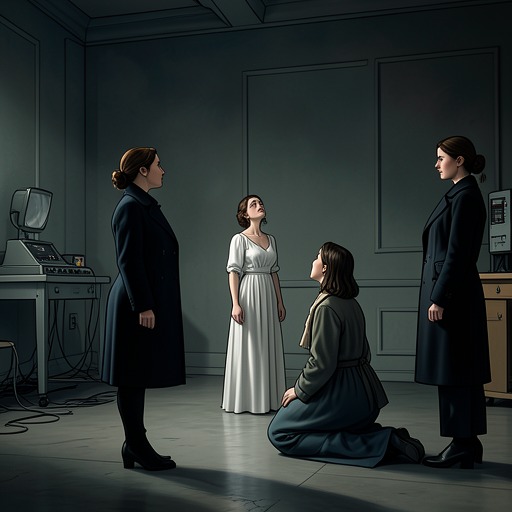
His first encounter with the crime is therefore filtered through mistaken aesthetic judgment. As he steps into the open space around the pool, he stiffens with annoyance at what he believes to be an elaborate practical joke arranged by the Angkatells. The body has been posed with an outflung arm, red liquid drips into the blue water, Gerda Christow stands over it with a revolver, and three other figures occupy separate positions around the pool: Henrietta Savernake with a basket of dahlia heads, Edward Angkatell carrying a gun, and Lady Angkatell holding a basket of eggs. Poirot immediately sees the composition as artificial and mathematical, with several paths converging on the same point. His error is not a failure of observation but a failure of interpretation: he sees the scene accurately before he understands its reality.
The Investigator at the Crime Scene
The decisive change comes when Poirot realizes that the artificial scene has a point of reality. The apparent red paint is blood, and the handsome fair-haired man is not merely performing death but has been shot very shortly before Poirot’s arrival. The scene’s theatricality becomes its central clue. Gerda Christow’s blank stance, the revolver in her hand, the arranged body, and the distribution of witnesses do not simply report an event; they direct the eye toward a prepared explanation.
Poirot’s attention remains sensitive to the physical space in which the explanation has been staged. Inspector Grange reconstructs the routes by which the participants reached the pool: Lady Angkatell came from the farm, Edward Angkatell from the left-hand path through the woods, and Henrietta Savernake from the right-hand path leading from the flower walk. Poirot understands that separate paths create separate opportunities for arrival, observation, and concealment. Later, when the police have finished their work, he returns through the chestnuts and inspects the pavilion. The platinum fox cape has been removed, but six boxes of matches remain on the table, an excessive and inexplicable quantity in a damp place. The apparently minor object becomes part of his growing suspicion that the scene has been manipulated.
His investigation also depends on distinguishing objects that seem to belong to the crime from those that merely support its appearance. Inspector Grange initially expects the revolver to be identifiable as the weapon taken from Sir Henry Angkatell’s study, but later reveals that John Christow was not shot with that revolver. The apparent weapon is thus a decoy, and the staged scene has been designed to make the first interpretation of the evidence seem conclusive. Poirot’s method is grounded in the refusal to let an apparently complete arrangement terminate inquiry.
Truth, Performance, and Conflict
Poirot defines his work against the idea that crime-solving is an artistic performance. When Henrietta asks whether he is an artist, he distinguishes artistic crime from its solution: crimes may be supreme exercises of imagination, but solving them requires a passion for truth rather than creative power. This distinction describes his conflict with the household. Gerda Christow performs the role of the guilty, overwhelmed wife; the Angkatells cooperate in maintaining the appearance that protects her; Henrietta Savernake uses ingenuity to organize the concealment; and Poirot gradually recognizes that he is fighting not only a murderer but an entire social production of innocence.
The case is also mediated by formal procedures. Inspector Grange records statements, photographs and measures the body, consults the police surgeon, and investigates the revolver. He questions Beryl Collier in the consulting room, tests the clarity of her answers, and probes the relationship between John Christow and his wife. He later reads Veronica Cray’s note inviting John to see her, transforming a private message into evidence of a concealed relationship. Poirot’s work intersects with this official investigation but is not identical to it. Police procedure seeks admissible facts and identifiable objects; Poirot interprets the relations among those facts, the gaps in the household’s story, and the motives that make an artificial scene necessary.
His confrontation with Lady Angkatell makes the ethical stakes explicit. She understands that the police may search for the owner of fingerprints they cannot identify and may eventually have to let the matter drop. She also understands that Poirot will not do so. Poirot answers that he will not let the case drop, affirming that truth is not merely an institutional outcome but a personal obligation. His resolve makes him dangerous to the household precisely because he can see through its polished hospitality and collective performance.
Relationship with Henrietta Savernake
Henrietta becomes Poirot’s most formidable intellectual opponent and, ultimately, the person whose ingenuity he must interpret rather than simply defeat. During their walk above the chestnut groves, they sit on a bench overlooking a path descending toward a glimpse of blue water. The setting gives their exchange a temporary stillness: Henrietta’s face relaxes, its tension disappears, and Poirot sees the younger woman she must once have been. Yet the apparent intimacy of the moment is inseparable from their adversarial positions. Poirot recognizes that the crime scene was arranged by someone, and later tells Henrietta that he understood fairly soon that he was fighting her ingenuity.
He also identifies the collective nature of her strategy. Henrietta is aided and abetted by her relations once they understand what she wants done. The household’s cooperation turns concealment into a social act rather than an individual trick. Poirot’s insight therefore moves beyond the question of who fired the shot: he reconstructs why the family accepted a false version and how their loyalty altered the meaning of the physical evidence.
At the end, Henrietta asks what they will do about Gerda. Poirot draws her raffia workbag toward him, empties out scraps of brown suede and other colored leathers, and fits together three fragments of thick, shiny brown leather. They form a holster. The reconstruction supplies the material explanation for the missing or concealed weapon and confirms the extent of the staging. Yet Poirot does not simply deliver Gerda to punishment. He proposes that her husband’s death be accompanied by the finding that she took her own life while of unsound mind, treating her as a woman overwhelmed by the death rather than publicly exposing the full machinery of the cover-up.
Change and Narrative Role
Poirot’s trajectory runs from amused irritation to grave moral discernment. At first he is bored by what he thinks is a cheap theatrical joke; then the blood makes the scene real; afterward every route, firearm, letter, fingerprint, and object becomes part of a design whose apparent simplicity conceals considerable complexity. His initial confidence in reading the scene is corrected by the discovery that the scene itself is an argument intended to mislead him.
The revelation at the conclusion clarifies the structure of his achievement. Poirot tells Henrietta that he felt from the first that the scene was set, but did not for a long time realize that Gerda Christow had set it because her attitude was itself an acted part. He had been puzzled by the scene’s simultaneous simplicity and complexity: Gerda’s visible role was simple, while Henrietta’s intervention and the family’s cooperation made the underlying arrangement complex. Poirot’s detection reaches the truth by separating these layers of performance.
Yet his final decision complicates the conventional detective’s triumph. He retains a passion for truth, but chooses not to convert every truth into a public prosecution. His reconstruction of the holster allows him to understand the crime materially, while his proposed account of Gerda’s suicide protects her from the consequences of a full public revelation. Poirot thus embodies both forensic exactness and ethical restraint. He insists that concealment cannot defeat his understanding, but he accepts that understanding need not culminate in the harshest available judgment.