John Christ murder investigation
The HollowThe investigation into John Christow's murder transforms an apparently simple shooting at The Hollow into a conflict between forensic fact, visual impression, private loyalty, and the ethics of protecting the guilty. The dead doctor's body, the revolver held by Gerda Christow, and the witnesses converging on the swimming pool seem to offer a complete explanation; the discovery that Gerda's weapon was not the murder weapon breaks that explanation open. What follows is not merely a search for a gunman but an inquiry into how a household can manufacture a misleading truth and how Hercule Poirot must distinguish what the eyes were shown from what actually happened.
Initial Scene and First Assumptions
The investigation is shaped from its first examination by the contrast between the pool's innocent appearance and the violence attached to it. Hercule Poirot sees the place where John Christow's body had lain, where his blood had flowed across the concrete into the artificially blue water, and where the living setting has been permanently redefined by the death. The scene appears objective because it has been photographed, measured, recorded, and examined by the police surgeon; yet its very neatness becomes suspicious. Poirot senses that everything around the pool has been strangely fluid except John Christow, whose dead body retains the purposeful, objective quality associated with him in life.
Inspector Grange initially approaches the case through practical experience of domestic violence disguised by respectable appearances. He recalls a previous case in which a quiet, elderly wife took her husband's service revolver into the garden and shot him, while the household and the police had to look beyond a convenient story about a tramp. His example places Gerda Christow's apparent guilt within a recognizable pattern: an apparently harmless spouse may conceal a motive and an act that outsiders have failed to see. Grange's method is cautious rather than theatrical; he expects the visible account to conceal something, but he does not yet possess the evidence needed to specify what.
The household's response also complicates the investigation. After John Christow's death, Lady Angkatell treats the choice of food as a matter of emotional propriety, judging caramel custard suitable because the family is only moderately fond of it and because eating a favorite pudding immediately after a friend's death would seem gross. This small social ritual shows death being absorbed into manners and domestic routine. Henrietta Savernake rejects that normalization. She tells Edward Angkatell that she wants to be alone with her dead, then confronts the speed with which a living person becomes an absence while everyone else continues eating and calling themselves alive. Her repeated meditation on the word dead makes the murder not only a police problem but a crisis in the meaning of ordinary social behavior.
The Firearm Discrepancy
The investigation changes direction when Inspector Grange asks Sir Henry Angkatell to review his collection of firearms. Sir Henry has already identified the revolver found in the pool as one of his own, but Grange reveals the crucial distinction: John Christow was not shot with the revolver Sir Henry identified. The statement separates ownership from use. The weapon belongs to the apparent story of the crime, yet it did not cause the fatal injury, so the most immediate piece of evidence against Gerda Christow cannot bear the weight placed upon it.
Hercule Poirot reacts with disbelief when Inspector Grange explains that the revolver Gerda Christow was holding, and which was later dropped into the pool, was not the firearm that fired the fatal shot. Grange admits that the fact does not make sense and that the police cannot proceed much further until they find the missing gun. The weapon came from Sir Henry's collection, and one firearm is missing; consequently, the case remains tied to The Hollow rather than being resolved by the gun displayed at the pool. The investigation therefore moves from identifying the person visibly holding a weapon to reconstructing the movement of two separate firearms and the deliberate substitution that concealed the real shot.
This discrepancy also exposes the weakness of purely visual proof. Gerda's possession of a revolver establishes that she held a gun, but not that she fired the bullet that killed John Christow. The distinction is central to the investigation's logic: a visible object can be authentic as an object and false as an explanation. The apparent evidence is not fabricated in every detail; it is arranged so that true details point toward a false conclusion.
Reconstructing the Staged Tableau
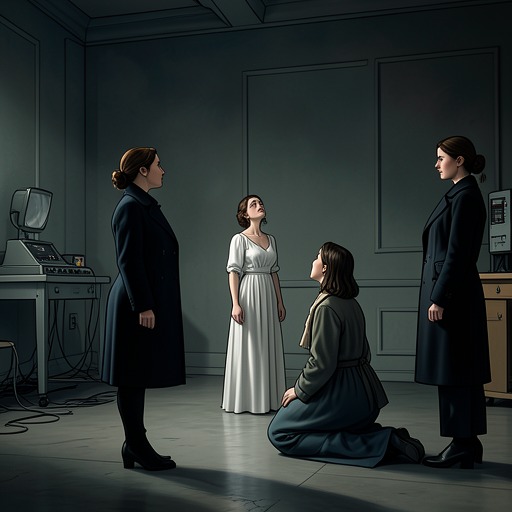
Poirot concludes that the scene resembles a stage scene. What he saw was a man who had just been shot and a woman who had apparently shot him holding the weapon she had just used, but the firearm has already proved that this picture is wrong. Once one element of the tableau is false, the remaining particulars can no longer be accepted automatically. The three people who seemed to have just arrived—Edward Angkatell, Lady Angkatell, and Henrietta Savernake—must also be reconsidered as participants in a spatial arrangement rather than merely as witnesses.
The geography of the swimming pool makes that reconsideration possible. A thick grove of young chestnuts surrounds the pool, and five paths lead away: one to the house, one to the woods, one to the flower walk, one down toward the farm, and one to the lane. Edward Angkatell approaches from the woods, Lady Angkatell from the farm, and Henrietta Savernake from the flower border above the house. Their separate entrances create the appearance of simultaneous discovery, a pattern that seems to place all three beyond suspicion. Poirot recognizes, however, that one of them could have been at the pool before Gerda Christow, shot John Christow, withdrawn along one of the paths, and then returned so as to arrive with the others. The paths therefore function as both physical routes and instruments of misdirection.
The later explanation confirms that the scene was not simply misread by accident. Hercule Poirot tells Henrietta Savernake that he felt from the beginning that the scene had been set, though he did not initially understand that Gerda Christow had arranged the performance by adopting a staged attitude. He recognizes that Henrietta's ingenuity was the force he had been opposing and that the Angkatell family helped her once its members understood what she wanted accomplished. The investigation thus identifies two layers of performance: Gerda Christow acted a part at the pool, while Henrietta Savernake and the household shaped the surrounding evidence so that suspicion would disperse.
John Christow, Gerda, and the Motive for Concealment
Henrietta's account of John Christow supplies the emotional motive behind the concealment. She fears that the newspapers will reduce him to a sensational story about a doctor's love life involving Gerda Christow, herself, and Veronica Cray. Her concern is not simply to protect her own reputation or prevent Gerda from suffering legal consequences. She wants the investigation to understand that John Christow's deepest interest and excitement lay in his work, not in women, and that his medical vocation gave him a sense of adventure.
The figure who best represents this dimension of John Christow's life is Mrs. Crabtree, a difficult, impoverished patient at St. Christopher's Hospital. John is exhausted by routine consultations and by the palliation of patients whose ailments offer him no demanding problem, but his memory of the long ward at the hospital and Mrs. Crabtree's indomitable resistance restores his energy. He sees her as a fighter who wants to live and shares his zest for existence. Their relationship is medically unequal and includes an experimental treatment whose risks John watches closely, yet he also treats her as a collaborator in a struggle against disease. For Henrietta, Mrs. Crabtree proves that John's work, rather than his romantic history, was the center of his identity.
John's attitude toward Gerda is more complicated than the public story of a neglected wife would suggest. At the end of the investigation, Henrietta explains that his final word, Henrietta, was an appeal to protect Gerda. She believes that John loved Gerda more deeply than he understood and that, because Gerda belonged to him in his possessive conception of attachment, he knew Henrietta would do anything to shield her. Henrietta's concealment therefore becomes an act of obedience to a dying request as well as an expression of her love for John. It preserves Gerda from the consequences of the murder, but it also preserves a version of John's feeling that Henrietta herself finds painful to accept.
Collective Misdirection and Aftermath
The conspiracy is designed not to establish one alternative culprit but to implicate everyone except Gerda Christow. Henrietta deliberately plants the Ygdrasil mark to attract Hercule Poirot's attention and to bring suspicion upon herself. Lady Angkatell, who understands what Henrietta is doing, leads Inspector Grange through successive possibilities, while David Angkatell and Edward Angkatell also become part of the expanding field of implication. The method is systematic: if a person who is actually guilty must be cleared, guilt should be suggested elsewhere without being fixed on any one substitute. Each clue can therefore appear promising while finally dissolving into nothing.
This strategy places the official investigation against a household form of justice. Inspector Grange follows weapons, paths, statements, and material discrepancies; Poirot tests the coherence of the entire pattern. The family, meanwhile, seeks to protect Gerda Christow from an added burden after she has lost John, and Henrietta explicitly rejects the idea that such protection is mere hypocrisy. The investigation becomes a contest between judicial truth and an improvised moral arrangement in which the living decide that the consequences of full disclosure would be worse than the preservation of a false public account.
The inquiry also changes how John Christow's death is remembered. Henrietta initially cannot mourn because she is still planning, watching, and maintaining the deception. Once the investigation has reached its decisive understanding, she can finally grieve and admits that she now has all the time there is. Her return to the memory of the pool, where she had drawn Ygdrasil by matchlight on the iron table, joins deliberate design to delayed mourning. The investigative pattern has been completed, but completion does not restore John; it releases the grief that concealment had postponed.
Mrs. Crabtree's later recollection gives the investigation its final human counterpoint. She remembers John as a joking, encouraging doctor who insisted that she could endure more treatment and told her that together they might make medical history. She felt that he expected much of her and that she could not let him down. Her acceptance that what is gone cannot be recovered expresses, in plain language, the same conclusion that Hercule Poirot and Henrietta reach through more elaborate reasoning. The murder investigation reveals how a staged scene can manipulate the living, but its aftermath leaves the irreducible fact of loss: John Christow is dead, and neither evidence nor concealment can bring him back.