John Christow
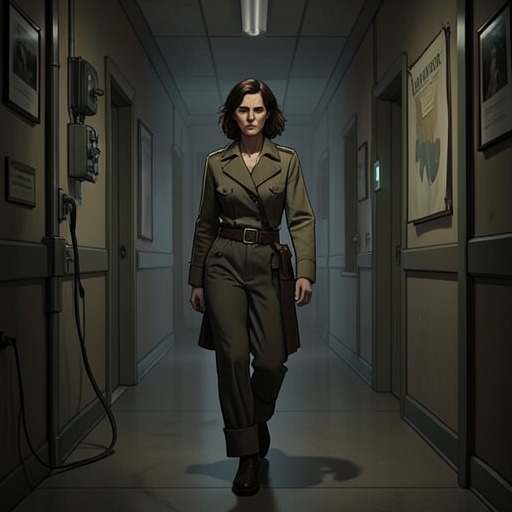
The HollowJohn Christow is a physician whose decisive importance lies in the contrast between the healer admired by his patients and the impatient, divided man exposed in his private life. At the hospital, he can transmit confidence and strength almost automatically; at home and among those closest to him, the same force becomes irritability, entitlement, and emotional carelessness. His murder at The Hollow ends the life of the person who seems to command every surrounding relationship, but his aftermath reveals that his deepest attachment was not to any of the women associated with him. It was to the difficult work of saving Mrs. Crabtree from Ridgeway's Disease.
Identity and Professional Vocation
John Christow is introduced in his consulting room, seeing the last patient but one of a tiring morning. His manner is sympathetic, encouraging, and apparently sincere: he listens to a patient's explanations, asks questions, gives directions, and sends her away revived by the sense that Dr. Christow has taken a personal interest in her. Yet once the door closes, he almost entirely forgets her. His response has become the automatic work of a healer, and the energy he has given out leaves him depleted.
That split between performance and inner attention defines his professional existence. The private patients who make his morning financially profitable offer him little intellectual satisfaction; their ailments seem to require only palliation and alleviation. He is tired of sickly women and of cases that give him nothing substantial to solve. His imagination returns instead to St. Christopher's Hospital, the long row of beds in the Margaret Russell Ward, and Mrs. Crabtree, whose illness provides the difficult, living problem that makes medicine meaningful to him.
John's ideal patient is not passive. Mrs. Crabtree has Ridgeway's Disease, a rare condition described as inevitably fatal because it has no cure, but she also possesses what John recognizes as a fierce desire to live. He sees her as a fighter and imagines the two of them on the same side, opposed to disease by a shared zest for existence. Her poverty, exhausting labor, drinking husband, and unruly children do not cancel her appetite for life; they make that appetite more striking. John identifies it with his own enjoyment of life, not as comfort or favorable circumstance but as vitality itself.
The Experimental Cure and Its Risks
John's relationship with Mrs. Crabtree is both humane and scientifically ambitious. He treats her as a collaborator in a medical struggle, encouraging her with jokes and urging her to endure the painful uncertainty of treatment. She accepts being used as a kind of experimental subject because she wants to recover and because she trusts his determination. When he tells her that she and he may make medical history, the phrase gives their treatment a shared purpose: her body becomes the site of an experiment, but her will to survive remains central to the partnership as he understands it.
The treatment also exposes the danger within John's confidence. He has been pleased by Mrs. Crabtree's reactions and believes that she can tolerate a small measured quantity, but an alarming rise in toxicity and a negative D.L. reaction overturn that assurance. He remembers her lying blue and gasping, still watching him with malicious, indomitable eyes. Instead of confirming his mastery, the setback leaves him miserable and uncertain. He asks himself where he went wrong and confronts the possibility that he had been too confident, assuming that he had already circumvented every difficulty.
His thinking remains intensely technical even in defeat. He works through how to reduce toxicity, preserve the hormone content, and neutralize the pantratin. Later, in conversation with Henrietta Savernake, he reviews setbacks, analyzes possibilities, and outlines competing theories for two and a half hours. Henrietta's quick intelligence helps him advance thoughts at the points where he hesitates, and his belief in the main theory returns. He decides to ask Neill to combine the two solutions and try the revised method. His exhaustion is extreme, but so is his refusal to accept defeat: the scene ends with him determined to continue and collapsing into sleep.
Intimacy, Irritability, and Divided Loyalties
The fatigue produced by John's work has been increasing and has become the root of an irritability he recognizes but cannot control. His marriage to Gerda Christow is especially burdened by this condition. He knows that Gerda has much to endure, yet her patience, selflessness, submission, and readiness to concede that she is wrong irritate him more than her faults would have done. She does not resent his bursts of temper, insist on her own opinions, or establish an independent line of action, and his resentment toward these virtues reveals how deeply he expects her life to accommodate his own.
John understands, at least briefly, that he chose Gerda partly for the very qualities he now condemns. The contradiction becomes sharper beside his relationship with Henrietta Savernake. In Gerda he wants independence and resistance, while in Henrietta he values an unswerving rectitude toward him; what he experiences with Henrietta is not mere irritation but anger, because her moral firmness refuses to follow the permissive pattern he applies to the rest of the world. His attachments therefore expose a recurring demand: he wants other people to possess qualities that serve him, but resists the limits those qualities place upon his authority.
At the same time, John is capable of genuine warmth and delight. He looks forward to the weekend at The Hollow, admires Lucy Angkatell as a uniquely elusive and delightful person, and enjoys the house as a place of ease. He imagines walking through the autumn woods with Henrietta Savernake, away from the existence of sick people, and values the health and vitality he associates with her. When he arrives at The Hollow, he says that it is good to be there, to breathe the air, and to see everyone, adding that the visit will benefit Gerda. These moments of pleasure do not resolve his divided loyalties; they make his later collapse more ironic, since the house promising rest becomes the setting of his death.
Murder and Posthumous Reinterpretation
John becomes conscious of danger while sitting near the swimming pool at The Hollow. Someone has been watching him, and he recognizes the click of the weapon only at the last instant. He turns sharply, quick in his reactions, but not quickly enough. His eyes widen in surprise before he can make a sound; the shot is fired, and he falls awkwardly beside the pool. Blood spreads from his left side across the concrete and drips into the blue water, making his death both a physical fact and a staged visual image.
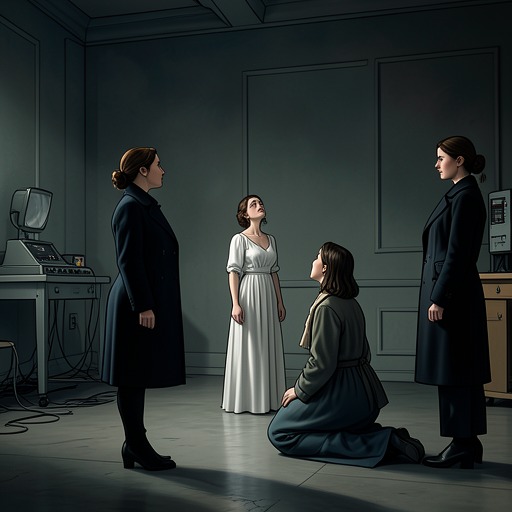
The initial appearance of the crime scene points toward Gerda Christow. Inspector Grange notes that her account could have been true but calls it thin, observing that everyone believes she killed John and that the household knows something the police do not. Hercule Poirot, recalling the scene, remembers Gudgeon stepping aside and Gerda standing over her husband with the revolver in her hand and a blank expression. Even Poirot initially believes that she has done it, or at least that the scene has been arranged to make him believe it. John's death thus immediately becomes entangled with mistaken appearances, concealed knowledge, and the difference between what a victim's relationships suggest and what his life actually meant.
Henrietta later resists the public story that would reduce John to a doctor's love life involving Gerda, herself, and Veronica Cray. She insists that women were not what mattered most to him. His real excitement, interest, and sense of adventure lay in his work, especially in the attempt to cure Ridgeway's Disease. The claim does not absolve him of his conduct toward the women around him, but it reorders the emotional hierarchy of his character. The romantic entanglements are visible and socially sensational; the obscure medical struggle with an old, poor, indomitable patient is the vocation that occupies his mind night and day.
Legacy and Narrative Significance
Mrs. Crabtree's recollection confirms Henrietta's interpretation. She remembers John as a joking, encouraging doctor who told her that she could endure more whenever she thought she could endure no more. His treatment was frightening and painful, but his confidence made her unwilling to let him down. She expects to be attending her own funeral next, yet Henrietta tells her not to surrender: the treatment remains the same, and Mrs. Crabtree must now have enough courage for two and make medical history by herself, for John.
John's legacy therefore survives not in the romantic image attached to his murder but in a patient who continues the struggle he began. His scientific ambition is ethically unstable: he risks his patient's health, places great faith in his own theories, and treats endurance as part of the work. Nevertheless, Mrs. Crabtree's testimony gives that ambition a reciprocal human dimension. She is not merely a case through which he seeks achievement; she is the person whose will to live restores his own when clinical routine has emptied him.
The character's final significance lies in this unresolved contrast. John is a gifted healer whose professional instinct can give strength even when his personal attention is absent, a researcher whose confidence is both the engine of discovery and the source of dangerous overreach, and a man who seeks vitality while exhausting those nearest to him. His murder interrupts his attempt to master disease, but it does not erase the force of that attempt. In the memories of Henrietta Savernake and Mrs. Crabtree, the dead physician remains most fully himself not as a lover surrounded by scandal, but as a fighter standing beside a dying patient against the certainty of death.