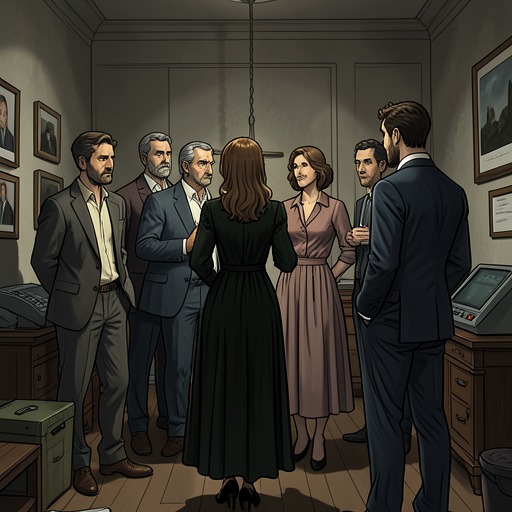
John Christow–Henrietta Savernake affair
The HollowThe John Christow–Henrietta Savernake affair is the central emotional contradiction in John Christow's private life: a relationship that gives him exhilaration and escape while also exposing the limits of his control over other people. John is married to Gerda Christow, yet Henrietta occupies the imaginative space in which he can forget illness, duty, and fatigue. Henrietta, however, understands that the affair has become more consequential than John wishes to admit. After his death, its meaning is transformed again when she recognizes his dying appeal as a request to protect Gerda Christow.
Identity and Emotional Structure
The affair exists alongside John Christow's marriage rather than replacing it. In his thoughts, John distinguishes sharply between the qualities he resents in Gerda and those he seeks in Henrietta. Gerda's patience, selflessness, submission, and readiness to yield irritate him, even though he acknowledges that he is often at fault. Henrietta, by contrast, angers him through her unswerving rectitude where he is concerned, a moral steadiness that contrasts with her less scrupulous attitude toward the wider world. Their relationship therefore joins attraction to ethical friction: John wants Henrietta's independence and moral clarity, but those same qualities prevent him from making the affair wholly convenient.
John's imagined time at The Hollow reveals the affair's positive emotional function. He looks forward to walking through the woods with Henrietta, climbing to the crest of the hill and along the ridge, because being with her allows him to forget that sick people exist. This relief is set against the exhaustion of his medical work. In his consulting room he can produce sympathy and strength almost automatically, yet afterward feels depleted; thoughts of Henrietta offer a different kind of vitality, associated not with healing another person but with escaping the demands of healing.
Boundaries, Marriage, and Rivalry
John's relationship with Henrietta is also defined by his attempt to control its meaning. He wants it to be light and easy, like other affairs he has had, because he fears that loving Henrietta will interfere with his concentration and professional purpose. Henrietta later explains that she became an obstacle between John and what he was thinking about: he could not concentrate as he wished because of her, and he made love to her partly to avoid thinking about her too much. The affair is thus not presented as a simple romantic alternative to marriage. It is John's strategy for containing an attachment that has already exceeded his preferred boundaries.
The relationship is entangled with John's earlier connection to Veronica Cray. When Veronica confronts him about another woman, John tries to identify the person she means as Midge Hardcastle, but Veronica makes clear that she is referring to the insolent woman by the mantelpiece. John immediately thinks of Henrietta, showing how rapidly the affair becomes the concealed center of Veronica's suspicion. Veronica interprets John's refusal of her through the presence of another woman, while John experiences the confrontation as a threat to the carefully separated compartments of his life.
Henrietta refuses to treat the affair as a claim on John's future. When Edward Angkatell suggests that she could find peace and happiness at Ainswick, even by making a home there with him, she answers that one cannot go back. Edward then identifies John as the decisive obstacle, saying that she will not marry him because of John. Henrietta does not answer, and her silence confirms that the affair has continuing authority over her choices even though John has not offered her an equivalent public commitment.
The Affair and John’s Professional Identity
The affair is best understood alongside John's absorption in medicine. He is tired of routine patients and of treatment that offers only palliation or alleviation, but he remains energized by difficult cases and by the combative will to live he recognizes in Mrs. Crabtree. He sees in her a zest for existence that he shares and considers discussing with Henrietta. This detail matters because Henrietta later insists to Hercule Poirot that women did not matter most to John: his work did. His excitement, interest, and sense of adventure were concentrated in medicine, especially in the struggle to bring patients through illness.
Henrietta's defense of John before Hercule Poirot is not a denial of the affair. She openly asks whether the police need to know that she was John Christow's mistress and states that the relationship lasted about six months. What she opposes is the false public story that would reduce John to a doctor's sensational love life involving Gerda Christow, Henrietta, and Veronica Cray. She argues that John was not primarily a man preoccupied with women and identifies Mrs. Crabtree as the person who would have occupied his thoughts if he had been asked to name the woman most important to him. The affair is therefore placed within a larger portrait of John as a doctor whose deepest passion is professional combat and medical discovery.
Henrietta also minimizes the affair's importance in order to preserve the truth as she sees it. She says that after a while she stood between John and his thinking, that he feared beginning to love her, and that he wanted the relationship to remain easy. Her account makes the affair a form of emotional displacement: John uses intimacy to master an unwanted attachment, while Henrietta accepts a reduced form of closeness because she loves him. The imbalance is not merely social or sexual; it lies in the different meanings each assigns to the same arrangement.
After John’s Death
The affair acquires its most consequential meaning after John Christow's murder. Hercule Poirot eventually recognizes that the scene has been set and that Henrietta's ingenuity is the force he has been opposing. He also realizes that the Angkatell relations assist her once they understand what she wants done. Henrietta explains that she acted because John asked her to. His final use of her name, “Henrietta,” was, in her interpretation, a request to protect Gerda Christow.
Henrietta's explanation revises the apparent hierarchy of John's attachments. She believes that John loved Gerda more than he knew, more than Veronica Cray, and more than Henrietta herself. Gerda belonged to him, and John liked things that belonged to him; he also knew that Henrietta would do whatever he wanted because she loved him. The affair therefore becomes the motive for an act of self-denial. Henrietta does not use her privileged emotional position to claim John or expose Gerda. Instead, she uses it to carry out what she understands as his final wish, even when that wish confirms that Gerda mattered to him more deeply than he had admitted.
This protection turns the affair into part of the collective concealment surrounding John Christow's murder. Hercule Poirot sees that Henrietta's intelligence is operating within a family effort to shape the meaning of the crime, while Henrietta's motive is neither simple loyalty to Gerda nor a desire to erase her rival. She protects Gerda because John asked her to and because love has made obedience, rather than possession, the final expression of her relationship with him.
Narrative Significance and Ending
The affair's narrative significance lies in its refusal of a conventional romantic resolution. Henrietta and John share exhilaration, secrecy, and physical intimacy, but the relationship does not lead to marriage, domestic security, or a public choice. It instead illuminates the emotional economy of The Hollow: marriage, family loyalty, class privilege, professional vocation, and concealed desire continually intersect, so that a private attachment produces consequences far beyond the two people involved.
The relationship also explains why Henrietta can understand John and yet fail to possess him. She sees his contradictions—the doctor who is exhausted by patients but animated by a difficult case, the husband irritated by Gerda's virtues, and the lover who fears that Henrietta will become too important. Mrs. Crabtree's later recollection of John reinforces this portrait. She remembers his jokes, his insistence that she was tough enough to continue, and the sense that she could not let him down. Henrietta recognizes the same commanding, life-affirming force in John that she has loved, but after his death she can express that love only through the dangerous work of protecting the woman he left behind.
The affair consequently ends not with reunion but with disclosure and exhaustion. Henrietta tells Hercule Poirot the truth about its duration, its emotional imbalance, and its place in John's life; she then reveals why she entered the staged protection of Gerda Christow. Her love survives as responsibility, while John's last appeal turns their private relationship into an instrument of mercy, concealment, and moral conflict.