Mrs. Crabtree
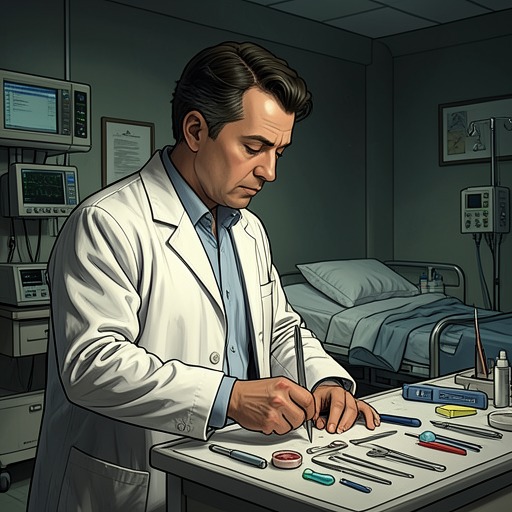
The HollowMrs. Crabtree is an old patient at St. Christopher’s Hospital whose struggle with incurable Ridgeway’s Disease becomes the most important medical and emotional project in John Christow’s life. Described as ugly, dirty, wrinkled, and indomitable, she refuses to surrender to a fatal illness. Her determination to live makes her John’s “prize patient,” but it also makes her much more than a clinical case: she is the person through whom the novel shows his scientific curiosity, his capacity to give courage, and the life-force he recognizes in himself.
Identity and Circumstances
Mrs. Crabtree lives under severe material hardship. She has a husband who drinks, unruly children, and exhausting work scrubbing the floors of offices, yet she remains eager for life rather than defeated by her circumstances. John distinguishes her from patients whose suffering leaves them passive: she is a fighter, and he feels that she and he are on the same side because both possess what he calls the zest of existence. Her desire to live is not presented as dependent on comfort or social privilege; it persists amid poverty, labor, and a disease for which there is supposedly no cure.
Her physical condition is grave. Ridgeway’s Disease is rare and inevitably fatal, and John’s treatment requires experimental work involving hormone secretion, toxicity, and pantratin. The treatment is not a simple remedy but an uncertain attempt to solve a difficult medical problem. John worries about how to diminish the toxicity while maintaining the hormone content and neutralizing the pantratin, and he recognizes that he may have been too confident in believing that he had overcome every obstacle.
Relationship with John Christow
John’s professional manner is divided between automatic clinical service and genuine engagement. With routine patients he can appear sympathetic, encouraging, and deeply attentive, yet he forgets them almost as soon as they leave and feels drained by the effort. Mrs. Crabtree is different. She gives him something to confront: a disease that resists easy palliation and a patient who actively participates in the fight for her own survival. When he remembers her, his tiredness and irritability are interrupted by a sense of purpose.
Their relationship is unusually reciprocal for a doctor and patient. John does not merely administer treatment; he draws strength from her, while she accepts the risks and discomforts of the experiment because she wants to get well. During one alarming stage of the treatment, her toxicity rises and the expected reaction fails to appear. She lies blue and gasping, but her eyes remain malicious and indomitable. When she accuses him of making a guinea pig of her, she does so with humor and consent to the shared danger, insisting that someone has to be first. John’s hand on her pulse is described as passing vitality from him to the panting old woman, an image that reverses the ordinary direction of medical care: the healer sustains the patient, but the patient also renews the healer.
Mrs. Crabtree’s courage is practical rather than sentimental. She tells John that she wants to recover because long life runs in her family, and she refuses to let a failed stage of treatment become a reason to abandon the attempt. John is moved when she tells him not to lose heart and insists that she can stand a great deal. Her willingness to endure makes her a collaborator in his investigation, although the language of experimentation also exposes the ethical tension in their bond: John’s ambition places real burdens on her, while her trust and determination make the risks meaningful to him.
Place in John Christow’s Inner Life
John’s attachment to Mrs. Crabtree contrasts sharply with his complicated relations with Gerda Christow, Henrietta Savernake, and Veronica Cray. He is irritated by Gerda’s submissiveness and angered by Henrietta’s moral rectitude, but Mrs. Crabtree seems to him worth all of them because she shares his appetite for life and his willingness to struggle against defeat. His admiration is not founded on beauty, refinement, or romantic attraction. It rests on vitality, endurance, and the possibility of discovery.
This distinction becomes central after John’s death. Henrietta Savernake tells Hercule Poirot that the public may reduce John to the sensational story of a doctor surrounded by women, but that such a picture would be false. In her account, women were not what mattered most to him; his work was. If he had been asked which woman occupied his mind, she believes he would have named Mrs. Crabtree. The statement transforms Mrs. Crabtree from a secondary patient into the decisive measure of John’s identity. She represents the part of him that is absorbed in scientific curiosity and achievement rather than in the emotional entanglements that dominate the murder investigation.
John’s work with Mrs. Crabtree also restores his confidence when exhaustion and failure threaten to overwhelm him. After a dispiriting encounter with the disease, he thinks of Henrietta’s beauty and vitality, but his medical reasoning returns to Mrs. Crabtree. When Henrietta helps him review his setbacks and theories for two and a half hours, his belief in the central theory begins to return. He concludes that he will not be beaten and falls asleep from exhaustion. Mrs. Crabtree therefore belongs not only to his hospital life but to the rhythm of his thought: she is bound to the problem that tests his intellect and to the determination that keeps him working.
After John’s Death
Henrietta eventually visits Mrs. Crabtree at St. Christopher’s Hospital because she needs contact with something that belonged to the real John rather than the distorted versions created by scandal and suspicion. In the narrow hospital bed, Mrs. Crabtree appears exactly as John had described her, with rheumy, twinkling eyes. The recognition gives Henrietta warmth and briefly lifts the darkness in her mind: through this patient, she finds John again in a form that will last.
Mrs. Crabtree remembers him through his manner as much as through his treatment. She contrasts him with the young, bespectacled doctor who has taken over her care, complaining that the successor never laughs. John had joked with her during the treatment, encouraged her when she claimed she could endure no more, and told her that the two of them were going to make medical history. She remembers that he expected a great deal from her, and that she could not bear to let him down. Her memory confirms Henrietta’s understanding of John as a doctor who converted medical difficulty into a shared undertaking without allowing the patient’s fear to have the final word.
When Mrs. Crabtree suggests that she may soon be attending her own funeral, Henrietta refuses to let her surrender. She tells her that the treatment remains the same and that she must now have the courage of two people: she must make medical history by herself, for John. Mrs. Crabtree answers cautiously that the idea sounds grand but promises to do her best. The exchange transfers John’s unfinished purpose from the dead doctor to the living patient. It does not guarantee recovery, but it changes the meaning of her continued treatment: survival becomes an act of loyalty as well as a medical possibility.
Narrative and Ethical Significance
Mrs. Crabtree gives the novel a medical counterpoint to its social drama. Around John, romantic histories and class privilege generate concealment, jealousy, and competing interpretations; in the hospital, the conflict is more elemental, between a fatal disease and a patient who refuses to stop wanting life. Yet the hospital scenes are not merely an idealized refuge. John’s treatment involves experimentation, toxic reactions, uncertainty, and the possibility that professional confidence has exceeded knowledge. Mrs. Crabtree’s humor and consent make the work humanly compelling without erasing its danger.
She also anchors the novel’s idea of John as a divided man. The doctor who can mechanically perform sympathy for wealthy or uninteresting patients is not the whole of him, nor is the man implicated in romantic complications. With Mrs. Crabtree, his intelligence, impatience, tenderness, competitiveness, and faith in life converge. Her role after his death is consequently larger than that of a surviving patient: she is the living witness who preserves the version of John that his tangled private relationships might otherwise obscure. By urging her to continue without him, Henrietta turns their shared medical struggle into a final bond among the patient, the doctor’s memory, and the future John had hoped to create.