Nausicaa
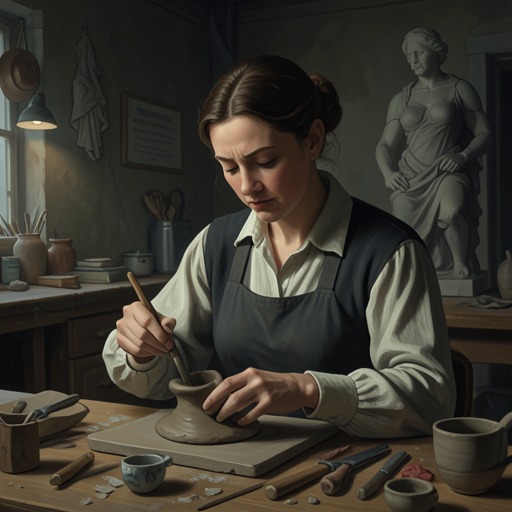
The HollowNausicaa is the clay sculpture created by Henrietta Savernake after an intense search for the face of an imagined blind girl. It becomes the material form of a vision that Henrietta has carried for ten days, but also the object through which she confronts the limits of representation: the sculpture is not a portrait of its model, Doris Sanders, and is finally dismantled when Henrietta decides that it has failed to remain Nausicaa.
Conception and the Search for a Face
Henrietta is haunted by Nausicaa before the sculpture exists in finished form. She rises with the image, breakfasts with it, and moves through the streets unable to attend to anything else. The face remains beautiful but indistinct, a “blind face” just beyond clear apprehension. She interviews models, considers Greek types, and finds each possibility profoundly unsatisfactory because none supplies the precise beginning her partially formed vision requires.
Her search is physical as well as imaginative. She walks long distances until she is exhausted, welcoming bodily fatigue because it gives shape to an otherwise unbearable restlessness. Her attention is so completely fixed on the unseen face that she scarcely registers the world around her. The process is presented as an ordeal of perception: Henrietta is not simply choosing a subject but trying to bring an image nearer, from a blind inward pressure into a form that ordinary sight can finally grasp.
The Discovery of Doris Sanders
The breakthrough comes unexpectedly on a bus Henrietta boards without interest in its destination. There, opposite her, she suddenly sees the face she has been pursuing: Doris Sanders, with a foreshortened childish face, half-parted lips, and lovely vacant eyes. The encounter converts an inward torment into a practical artistic opportunity. When Doris leaves the bus, Henrietta follows her, treating the chance sighting as the decisive evidence that the elusive Nausicaa has appeared in the world.
Doris can provide the visual stimulus Henrietta needs, but she is not identical with the sculpture’s subject. Once the model has put on her spectacles, the blind innocence and vague, confiding charm that Henrietta saw in her disappear, leaving only an ordinary prettiness. This change exposes the distance between the girl as encountered in a particular moment and the artistic conception Henrietta has extracted from that moment. Nausicaa depends on a fleeting arrangement of perception rather than on Doris Sanders as a complete person.
Form, Model, and Artistic Distance
Henrietta tells Doris that the work is finished as far as the model is concerned, although she still has considerable work to do. What she has obtained is the essential construction of the sculpture: she has “built up the planes.” The phrase identifies Nausicaa as an arrangement of masses and relations rather than a faithful likeness. Doris has served her purpose once the formal structure of the imagined face has been recovered.
The finished clay is explicitly not a portrait. There is hardly any likeness to Doris Sanders. Henrietta has retained the setting of the eyes and the line of the cheekbone as the essential keynote of Nausicaa, while refusing to preserve Doris’s individual features as such. The lips are parted as Doris’s were, but they are not Doris’s lips; in Henrietta’s conception, they belong to a blind girl who would speak another language and express thoughts unlike those of the model.
The sculpture therefore exists through transformation and subtraction. Its features are not clearly defined, because it represents Nausicaa remembered rather than Nausicaa directly seen. The work does not reproduce a body so much as preserve the afterimage of an encounter. Its apparent incompleteness is part of its identity: the indistinct features keep the sculpture attached to Henrietta’s inward vision, while the borrowed eyes and cheekbone anchor that vision in the concrete world.
Destruction and Release
After the sculpture has served as the focus of her artistic agony, Henrietta later wakes with a sharp discomfort and a haunting sense of guilt. She feels that there is something she ought to have done and has avoided. At first the obligation appears in the form of the name Nausicaa, but she corrects herself: the object before her is not Nausicaa. It is Doris Sanders.
Henrietta understands that postponement will make the act impossible. Destroying the sculpture feels like destroying something bodily and alive, and she compares the pain to the imagined necessity of a cat killing a damaged kitten. The comparison makes the sculpture more than a neutral work in her experience: it has become bound to her flesh, her labor, and her moral unease. Its defect is not merely technical; it threatens the integrity of the vision that gave it life.
She takes a quick breath, seizes the clay, twists it from the armature, and carries the heavy lump to the clay bin. The destruction is forceful but deliberate. Afterwards she looks at her clay-smeared hands, still feeling the wrench to both her physical and mental self, and cleans them slowly. Returning to bed, she feels a curious emptiness alongside a sense of peace. Removing Nausicaa ends the immediate agony that had been growing for ten days, replacing obsessive possession with painful release.
Narrative and Material Significance
Nausicaa makes artistic creation appear as a struggle between vision and matter. Henrietta’s imagined blind girl is initially more powerful than the surrounding world, directing her movements, exhausting her body, and narrowing her attention. Yet the sculpture can never simply contain that vision. The encounter with Doris Sanders supplies the face, while the finished work must reject Doris’s identity in order to remain faithful to Nausicaa. The object is thus created through a contradiction: it depends on a real model while insisting that it is not a portrait of her.
The sculpture’s destruction completes that contradiction. Henrietta does not preserve the clay as evidence of successful making; she removes it when its material presence has become an obstacle to the conception it was meant to embody. Nausicaa’s disappearance reveals the work’s deepest function in the narrative. It records the intensity of Henrietta’s perception, but it also shows that memory and artistic imagination may require the rejection of the visible object. The clay becomes most revealing at the moment it is torn from the armature, when its weight, damage, and physical resistance expose the cost of turning an inward image into form.