St. Christopher's Hospital
The HollowSt. Christopher's Hospital is the medical institution that embodies John Christow's serious professional life. It is where he confronts incurable illness, tests a difficult treatment, and forms his most authentic relationship with a patient, Mrs. Crabtree. In contrast with the profitable but emotionally empty Harley Street practice, the hospital gives his scientific ambition a human stake: the attempt to keep one indomitable woman alive. After John's death, it also becomes the place where Henrietta Savernake can encounter the part of him that was not reducible to his marriages, affairs, or public reputation.
Definition and Setting
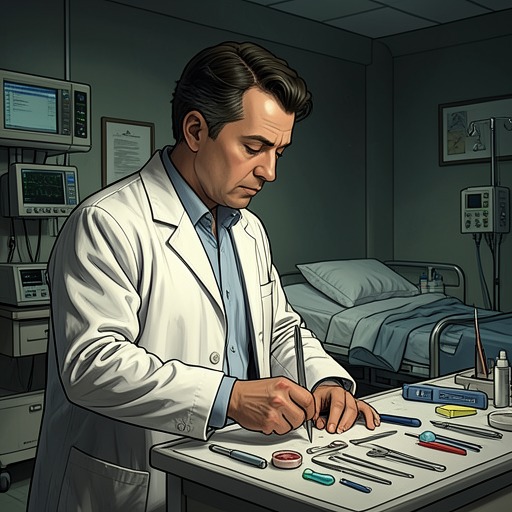
St. Christopher's Hospital is presented through its wards, patients, and clinical work rather than through an institutional history or administrative structure. John remembers the long row of beds in the Margaret Russell Ward when the routine of private consulting has left him depleted. The hospital therefore stands behind his professional identity as a place of sustained contact with serious illness, where medical work is slower, riskier, and more consequential than the routine palliation available to wealthy private patients.
John's ordinary consulting room reveals the contrast. He can listen sympathetically, ask the right questions, offer directions, and send a patient away almost happy, yet once she leaves he forgets her existence and recognizes that the performance of healing has become automatic. The work is financially profitable but, in his private judgment, boring. At St. Christopher's, by contrast, a patient's condition gives him something to investigate and a life that he is unwilling to surrender to a diagnosis.
John Christow's Clinical Work
The hospital is the setting for John's treatment of Mrs. Crabtree, a patient suffering from Ridgeway's Disease, a rare illness described as inevitably fatal because there is no established cure. John has been conducting experiments involving hormone secretion and is trying to devise a treatment that can preserve the hormone content while reducing toxicity and neutralizing pantratin. The treatment is not a simple success: Mrs. Crabtree has reached a point at which she can stand for only .005, and an alarming rise in toxicity has produced a negative D.L. reaction where he expected a positive one.
The experimental uncertainty exposes both John's scientific ambition and the patient's physical danger. He had been confident that he had circumvented the difficulties, but the setback leaves him miserable, doubtful, and unsure where his reasoning went wrong. He must reconsider how to diminish the toxicity while maintaining the treatment's desired effects. The hospital thus represents medicine as unfinished labor rather than settled authority: a place where expertise produces hypotheses, trials, reversals, and the possibility of failure.
John's manner with Mrs. Crabtree is nevertheless charged with mutual recognition. He treats her as a fighter who wants to live, not as a passive body awaiting professional management. When he places a hand on her pulse, the narrative describes vitality passing from him to the panting old woman, making their encounter reciprocal even though the medical power remains his. Mrs. Crabtree jokes that he is making a guinea pig of her, but accepts the risk because she wants to get well and believes that someone has to be first. Her consent is expressed in the rough language of endurance and shared adventure, while John's response turns the dangerous treatment into a joint undertaking.
The relationship also reveals a tension in clinical power. John is exhilarated by the possibility of discovery and by a patient willing to bear the burden of experimentation, but he is not protected from the ethical and emotional consequences when the treatment behaves unpredictably. Mrs. Crabtree's courage helps him continue, yet her courage also makes her vulnerable to becoming the vehicle for his medical achievement. The hospital holds both sides of that bond at once: care as solidarity and treatment as an experiment imposed upon a body that may pay the price.
The Hospital and John's Identity
John's memories of St. Christopher's restore proportion to a life otherwise crowded by difficult personal relations. He is increasingly tired and irritable at home, and Gerda Christow's patience, selflessness, and willingness to subordinate her wishes often anger him precisely because they expose his own selfishness. His thoughts move instead toward the hospital and Mrs. Crabtree, whose desire to live seems to match his own zest for existence. What they share is not comfort or social compatibility but an appetite for life itself.
After the setback in Mrs. Crabtree's treatment, John leaves St. Christopher's overwhelmed by hatred of long, slow clinical work. On the hospital steps, however, his weariness turns toward Henrietta Savernake, remembered through beauty, freshness, health, and vitality. The transition shows how closely the hospital is tied to both sides of his character: it is the source of his noblest concentration and the pressure from which he seeks escape. His attraction to Henrietta does not replace his scientific work; it appears at the moment when that work has become almost unbearable.
Henrietta later insists to Hercule Poirot that John's real excitement lay in his work, not in women. She identifies Ridgeway's Disease and Mrs. Crabtree as what had occupied his mind for months, day and night. Harley Street and its wealthy patients were, in her account, only a sideline beside the intense scientific curiosity and achievement represented by St. Christopher's. Her defense of John depends on the hospital because it supplies concrete evidence for a version of him that the scandal surrounding his death would otherwise obscure.
After John's Death
St. Christopher's Hospital becomes a destination of mourning and investigation for Henrietta. Driving toward London, she imagines the empty studio where John will never again bully her, be angry with her, love her, or speak eagerly about Ridgeway's Disease, his triumphs and despairs, Mrs. Crabtree, and the hospital. The institution survives in this recollection as part of the repeated vocabulary of their intimacy: John's medical discoveries and failures were among the subjects through which he most fully revealed himself to her.
Henrietta decides to go to St. Christopher's rather than remain with grief in abstraction. In the hospital she finds Mrs. Crabtree lying in a narrow bed, peering up with rheumy, twinkling eyes. The patient is exactly as John had described her, and the recognition gives Henrietta warmth and a lifting of the spirit. The visit turns the hospital into a site of material continuity. John is absent, but the patient he cared for remains, and through her Henrietta encounters a living fragment of the man she has lost.
Mrs. Crabtree remembers John's treatment as a mixture of ordeal, humor, and encouragement. A different doctor now attends her, a young man with spectacles whom she considers unlike John because he never laughs. She recalls John's insistence that she could bear more, his promise that she and he were going to make medical history, and the expectation he placed upon her not to let him down. Her testimony confirms that the hospital relationship was not merely Henrietta's idealized interpretation: Mrs. Crabtree also experienced John as a demanding, lively partner in the struggle against disease.
Continuing the Work
When Mrs. Crabtree suggests that she may soon be attending her own funeral, Henrietta refuses to let the patient's will collapse. She tells her that the treatment remains the same and that she must have the courage for both of them, making medical history by herself for John. Mrs. Crabtree answers that the idea sounds grand but agrees to do her best.
This exchange gives St. Christopher's its final significance. The hospital is not a monument that preserves John unchanged; it is a working place in which his absence alters the burden of care. His treatment, his language of toughness, and his faith in Mrs. Crabtree must now be carried forward without him. Through Henrietta's intervention, the bond between doctor and patient becomes an obligation rather than a completed triumph. St. Christopher's therefore closes the story not with a cure or a definitive scientific victory, but with an imperfect continuation of effort, in which the patient's survival and John's memory are joined through the work he began.