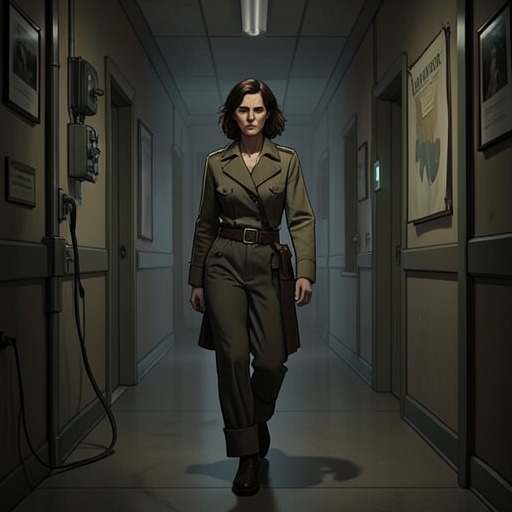
The Clue of the Dripping Fountain
The HollowThe Clue of the Dripping Fountain is a detective novel within the narrative of The Hollow, but its importance exceeds that of a casual reading reference. It becomes a transferable set of instructions: the knowledge that a bullet can be identified by the marks left by a particular gun allows Gerda Christow to construct a false appearance around John Christow’s death. The novel therefore links reading, imitation, and violence, showing how an apparently inert object can move from the private world of leisure into the material mechanism of a murder investigation.
Appearance in the Story
The novel first appears indirectly through John Christow’s reading. Sir Henry Angkatell later identifies it as the book John had been reading on Saturday, the day of his death. Its presence places detective fiction inside the weekend at The Hollow as an ordinary domestic object, associated with John’s habits rather than initially marked as evidence. Yet the book’s remembered lesson will eventually give the murder its most revealing technical clue.
The novel also enters the story through recollection and interpretation. When John thinks about Veronica Cray, the immediate subject is not the book but the persistence of his past: after fifteen years of separation, the Mediterranean, mimosa, and hot dust still signify Veronica to him. The juxtaposition establishes a contrast between memory as emotional recurrence and the detective novel as mediated, usable knowledge. One carries the past involuntarily; the other can be deliberately applied.
The Technical Clue
During the investigation, Inspector Grange considers whether Veronica Cray might have shot John with her own revolver and then planted another weapon taken from Sir Henry Angkatell’s study. That possibility depends on the principle that the police can identify the gun used to fire a bullet from the marks on the rifling. Sir Henry says that many people might know this because detective stories commonly feature the idea, and he specifically cites The Clue of the Dripping Fountain, which John himself had been reading.
The reference changes the novel from background detail into a clue about available knowledge. The investigators are not asking merely who possessed a gun; they are asking who understood that two revolvers could be used to manipulate the apparent evidence. The book supplies a plausible source for that knowledge, while John’s reading of it makes the information especially relevant to the household at The Hollow.
Gerda Christow’s Use of the Book
Gerda eventually confirms that she learned the method from The Clue of the Dripping Fountain. She had arranged to use two revolvers: one to shoot John and another to leave in her own hand. Her expectation was that the police would first assume the weapon she held had fired the fatal shot, then discover from the bullet marks that it could not have done so, and conclude that she was innocent. The book thus becomes the conceptual blueprint for a staged murder scene.
Her plan also depends on practical preparation. Sir Henry had shown her how to load and fire a revolver that afternoon, and she intended to hide the weapon actually used while allowing the substitute to be discovered. The novel provides the investigative idea, but the household’s firearms and Gerda’s access to them turn that idea into an executable scheme. The distinction between knowledge and action is crucial: reading alone does not cause the murder, but the book gives Gerda the form in which she can imagine impunity.
The plan is not wholly successful. Gerda forgets the leather holster in the drawer of her bedroom, and the overlooked object threatens to expose the connection between her preparation and the shooting. The failure is materially specific: the detective novel teaches her to think about rifling marks, but it cannot make her perfectly attentive to every physical trace. The object that seemed to promise control over evidence is answered by another object left behind.
Memory, Materiality, and Consequence
The novel’s influence illustrates how objects in The Hollow preserve and transmit knowledge. It is first a private possession, then a remembered title in conversation, and finally an instrument in the reconstruction of the crime. Its agency is not supernatural; it operates through the minds and hands of the people who read, recall, and misuse it. The book changes the field of possibility by making a particular deception imaginable.
Its effect also deepens the novel’s treatment of recurrence. The residents of The Hollow repeatedly experience the past as something that remains active after the event that supposedly ended it. John is dead, yet Henrietta Savernake feels that he is still present at The Hollow; the past relationship and the murder continue to govern the living. The Clue of the Dripping Fountain belongs to the same structure of return: words encountered earlier reappear later as a method, and a harmless reading experience is retrospectively transformed into part of the murder’s history.
The title therefore carries an ironic weight. Detective fiction traditionally promises that clues will lead from concealed crime to intelligible solution. Here, the genre itself becomes a source of concealment, since Gerda borrows its logic to manufacture misleading evidence. Nevertheless, the physical world resists the neatness of her literary design. The rifling marks and the forgotten holster expose the gap between a printed solution and an actual crime, between an imagined perfect trick and the stubborn material remainder that survives it.